Counter Attacking and the Death of Tiki-Taka Football

For a while, tiki taka, highlighted by the intricate triangles created in Spain's Xavi-Iniesta years, prevailed as the dominating tactic of the beautiful game. However, with Spain's struggles in recent tournaments and the much talked about "possession without purpose" that has haunted many teams in recent modern day matches, I pronounce the death of tiki taka.

All Roles in Football Explained

Why Understanding Football Roles Changes the Way You Watch the Game Football Is More Than Just Attack and Defense Many casual fans think football has only two simple tasks: stop goals and score goals. That idea misses how the modern game actually works. Today, teams rely on specialist roles across the pitch. Some players progress … Continue reading All Roles in Football Explained

Formations in football and when to use them

Why Football Formations Shape the Entire Game A Formation Is More Than Just Numbers on a Tactics Board Many casual fans see formations as simple numbers: 4-4-2, 4-3-3, or 3-5-2. In reality, formations in football define how a team attacks, defends, presses, and controls space. They shape defensive transitions, attacking width, midfield balance, pressing triggers, … Continue reading Formations in football and when to use them

How the Best Managers in the World Used Formations to Gain an Advantage

At the end of the day, a team can win playing any formation and there isn't necessarily any formation that is superior to another. However, some of the best teams in the modern era have perfected certain systems and styles of play, guided by the formation they use. Here is an examination of some of the best teams in the world and how their formation has led to their success.

4-3-3 vs. 4-1-4-1: Tactical Flexibility

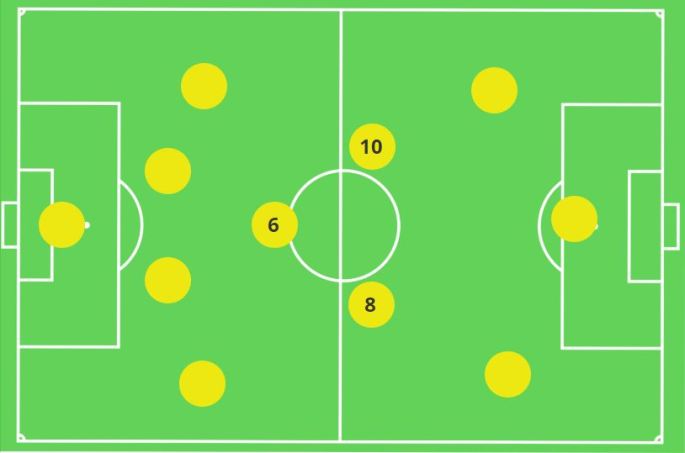
In the post 4-4-2 era, teams all over the world play a variety of different formations. These formations change game by game or even within games, so it is becomingly increasingly difficult to nail professional teams down to just one single formation. That being said, two of the most popular formations in the world right now are the tactically flexible 4-3-3 and 4-1-4-1, both of which have been used heavily by Pep Guardiola throughout his career. Ultimately the formation has to suit the players that you have and their developmental, psychological and physiological characteristics. But the 4-3-3 and 4-1-4-1 are two very similar formations. The 4-1-4-1 is perhaps a little more physically demanding and tactically complex, while the 4-3-3 is perhaps more rooted in wing-play and the collaboration of the midfield triangle. Although these formations are very similar, they can offer a team a completely different dynamic, depending on how a manger or coach wants to implement them. 

5 Ways To Modify Small-Sided Games

Over the past decade, small sided games have become the preferred method of teaching game mechanics in football. Whether for young players or pros, small sided games have been proven to have benefits in allowing players more touches on the ball, more decisions to make but less time to make them, more 1v1 situations, more … Continue reading 5 Ways To Modify Small-Sided Games

Playing in a Midfield Three

In the post 4-4-2 era, the 4-3-3 is one of the world's most popular formations. Not only is it attack-minded but it is inherently possession-based by providing an extra man in central midfield. That is one of the prime reasons why a midfield three has become the first choice of many managers around the world. … Continue reading Playing in a Midfield Three

Moulding Players into Specific Positions: A Case for Developing Confidence

At any level, there can sometimes be a mismatch that occurs between a player's preference for a position and their playing style. Don't get me wrong, as a youth coach, you should always play your players in the positions they want to play. Rotation is an equally important consideration. But sometimes there's a mismatch that … Continue reading Moulding Players into Specific Positions: A Case for Developing Confidence