

If you’ve been been listening to football discussions in the media over the past few years, you may have heard the term “rest-defense” popping up more often.
It’s not a term that really existed in coaching or analysis circles before 2019, although the notion of “when we attack, you stay back” has existed in football since its inception.
Likely taken from German coaching and analysis origins, rest-defense is essentially the players that are “resting” when the attack takes place. They are not “resting” in the sense that they are doing nothing. But they are “resting” in the sense that they are thinking more about where they should be if the ball changes hands, rather than contributing to the attack.
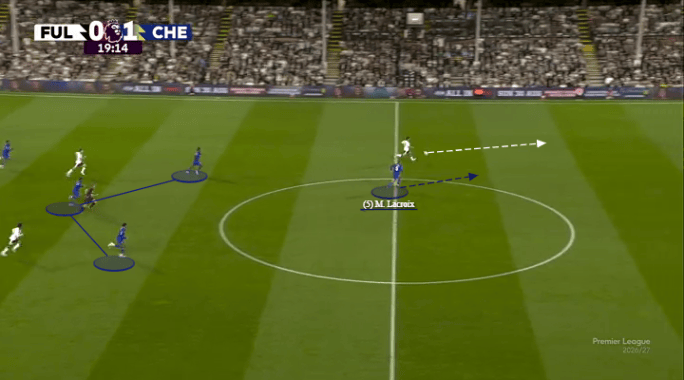
Instead, their role is to remain behind the ball, and focus on their positioning to handle any change of possession (a defensive transition) that might occur.
Again, if you’ve heard the term before, you likely know all of this.
But what I’m going to discuss today is how “rest-defense” continues to evolve with the best teams in the modern game, and why it’s so much more than just what happens behind the ball. It’s also much to do with the structures and shapes teams use at the very back-end of their possession in the attacking half. As you will see, “resting” players aren’t really resting at all.
To explain these evolving theories, I’ve watched hundreds of clips from the Premier League’s current top three clubs: Arsenal, Brighton, and everyone’s favourite team right now: Manchester City. Let’s start with last season’s league leaders.
ARSENAL
Embed from Getty ImagesWhen people discuss rest-defense they are often most obsessed with the shapes and structures. For example, a 3+1 that forms a nice diamond. In this article, I’m going to break that notion, exploring how a lot of the top teams are much more concerned about how they’re setting up their structures to attack, with little concern over the exact formulas.
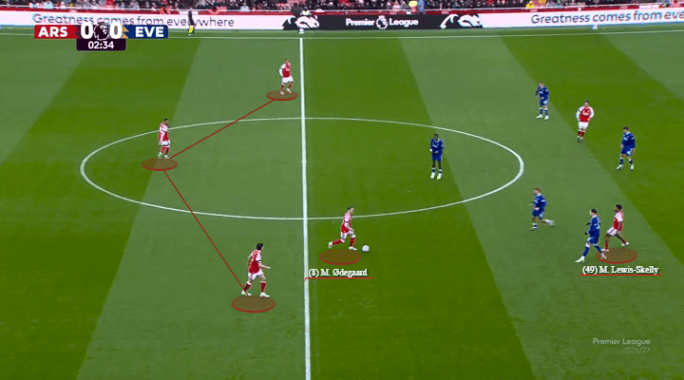
Arsenal are one of these teams. They build attacks from inside the opposition’s half using this 3+1 shape. It will typically involve one midfielder (usually Rice or Lewis-Skelly) dropping toward the back-line, as the other floats above them. The full-backs spread high up the pitch (Calafiori more inside left, and White or Timber more wide right).
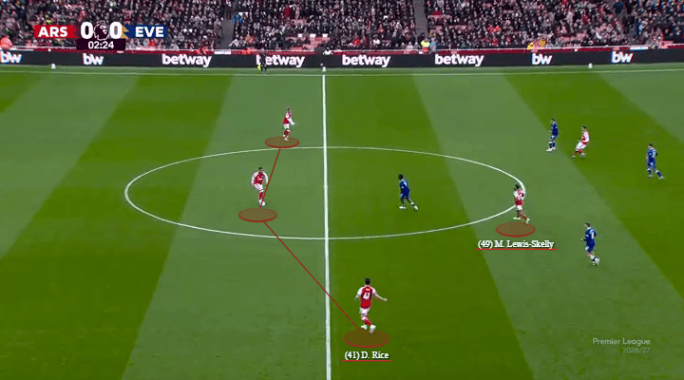
But so much rotation goes on in these early stages of attacking moves. And by the way, this is all important to their rest-defense. It’s not just about what’s behind the ball. It’s about what they currently have in front of them to defend a transition. They have a back three + one midfielder.
And they maintain that throughout their rotations to ensure enough coverage remains in-tact.
So as Ødegaard drops toward the ball, Lewis-Skelly floats up.
Now as Rice looks to drive forward into space, Ødegaard stays all the way back as part of that back-three. This ensures that if Rice loses the ball, Arsenal still have the numbers advantage over the two Everton attackers.
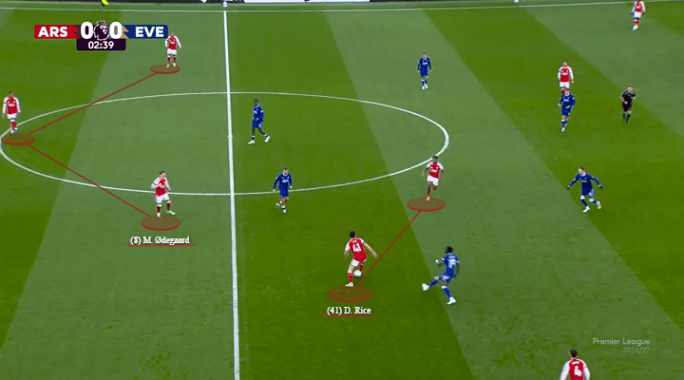
But what about as the ball continues to progress closer to goal?
Well, you see, Arsenal (and clubs at their level) aren’t all that concerned about advancing as many players forward as necessary. They’ve recruited the best in the world at defending in transition – fast, physical, solid 1v1 duellers. Not only that, but it’s highly relational to the opposition’s set-up.
To say that Arsenal defend in a 3+1 or 2+2 rest-defense simply wouldn’t be true. “Behind the ball” in the below image is only Rice and Konsa, with Gabriel thinking much more about receiving a pass and spreading width than remaining central and ready to help with a defensive transition.
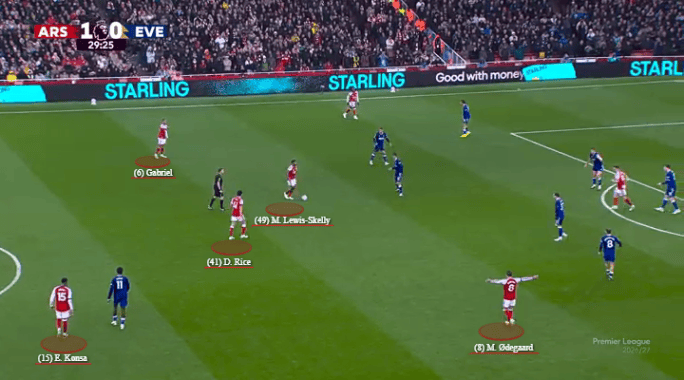
When your centre-backs are Gabriel, Konsa or Saliba, you can afford to leave even just one of them in plenty of 1v1 situations like this. They will win them most of the time, and if the opposition does extremely well to breakaway, that 1v1 will quickly become a 2v1 as David Raya can spring forward as others fall back.
Embed from Getty ImagesIf a team like Everton wanted to play with a second striker against them, Gabriel would likely hold his position in this attacking move. But with no one to watch out for, he’s free to advance.
In fact, the Brazilian loves to venture forward when the time is right. It needs to be backed up by Riccardo Calafiori down his side (they can’t both go up at the same time), and it needs to be backed by Ezri Konsa holding his position too. But it’s not like it’s his sole responsibility to “rest” when Arsenal attack. He still remains highly influential to the way Arsenal shift the ball in the opposition’s half, just like Declan Rice and Myles Lewis-Skelly.
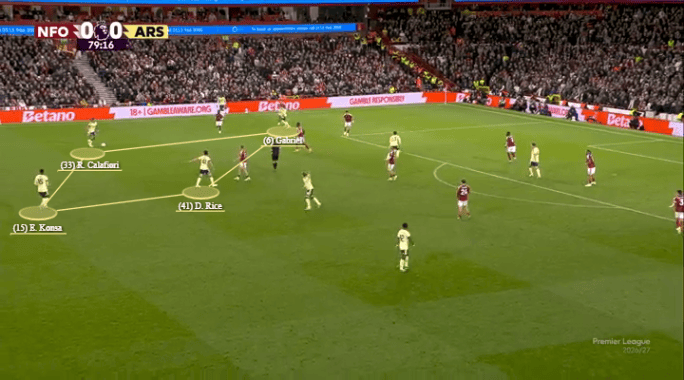
If you really look for it, you could call Arsenal’s rest-defense a 3+0 or 2+1 some of the time. One midfielder will stay back with the two centre-backs.
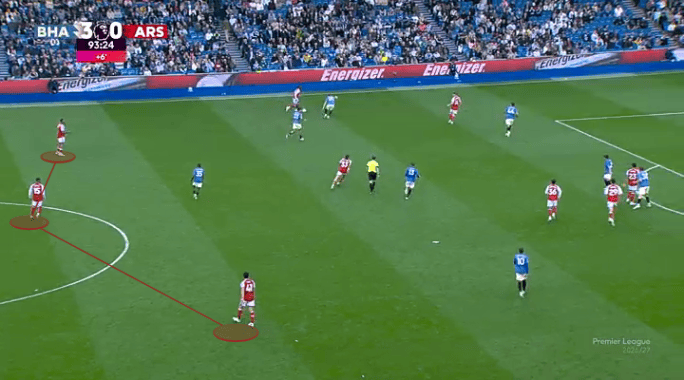
But in longer spells of possession where they’ve advanced closer to goal, I’m not convinced there’s any set structure beyond the broad principle that one centre-back and one midfielder should remain close enough to the immediate outlets.
Again, when you have the likes of Gabriel and Rice in your team, it’s incredibly difficult to hit them on the counter attack.
Embed from Getty ImagesNormally, you would say to position a player high and wide, where you can pull the centre-back out of position. But on those occasions, Gabriel and Konsa are always quick to win the 1v1 duel and restart the attack.
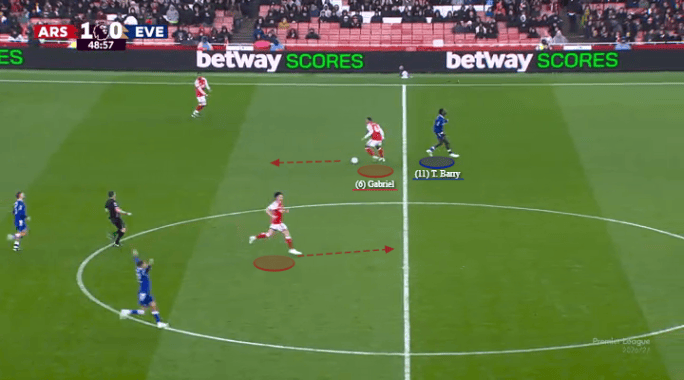
Here’s a great image of Gabriel easily winning his 1v1 battle against Thierno Barry. Declan Rice is still back-tracking by the time Gabriel’s able to get his head up and restart Arsenal’s attack.
Here’s another example where Declan Rice quickly closes down the wide area by using his strength and physicality.
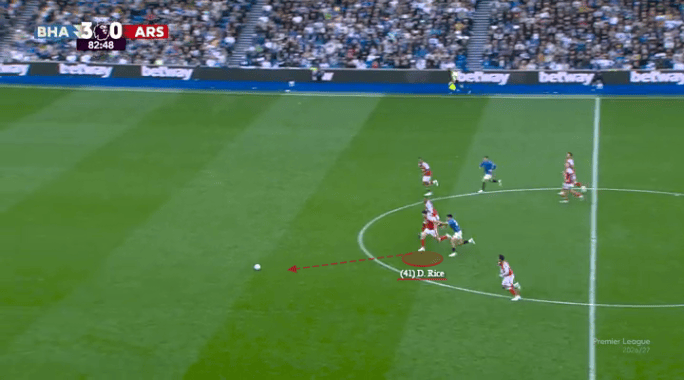
You can’t really position too many players high and wide, because Arsenal attack with so many numbers going forward.
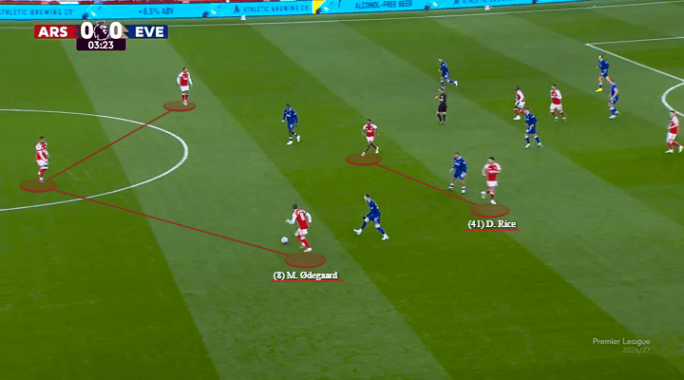
When we look back on those examples of their recent performance against Everton, you can’t even see Everton’s wide men in most of the images. They’re having to come all the way back to mark Ben White and Riccardo Calafiori. They’re not able to position themselves high and wide for a counter attack.
The only outlet is Barry, and he’ll lose most of those battles against Konsa, Rice or Gabriel. It doesn’t matter who he’s up against.
Embed from Getty ImagesSo in their best moments, Arsenal don’t have to concern themselves with “rest-defense” much at all. They can continue to push as many numbers forward as they like, with the few necessary figureheads “behind the ball” to handle the one or two immediate outlets in transition.
BRIGHTON
Embed from Getty ImagesBrighton don’t necessarily have that same luxury. Luka Vušković already looks amazing at 19 years old, and Chema Andrés is fantastic too. But relying on the likes of Lewis Dunk and Pascal Groß to fall back into position isn’t exactly the same thing as Rice and Gabriel (as fantastic as the two Brighton men have been throughout their careers).
To combat that and provide more stability (in theory), Brighton only attack with one full-back at a time. Usually as the Seagulls work the ball down the wide left, the right full-back will hang low.
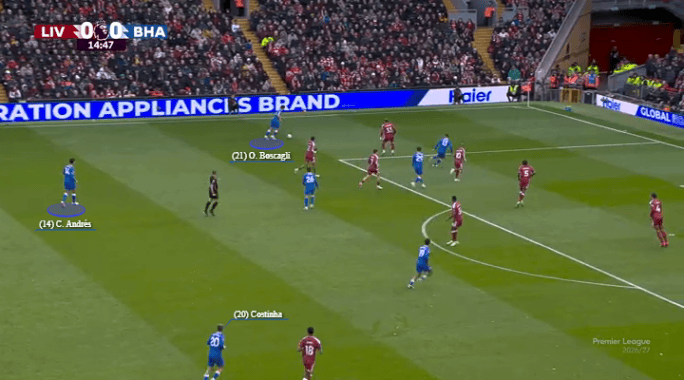
Beyond that, similar ideas apply. Chema Andrés will generally stay as the deepest midfielder to allow Pascal Gross and Yasin Ayari to create more numbers in the attack.
Meanwhile, Luka Vušković must track the opposition’s first outlet in transition, and ensure he cuts the attack out before it even begins.
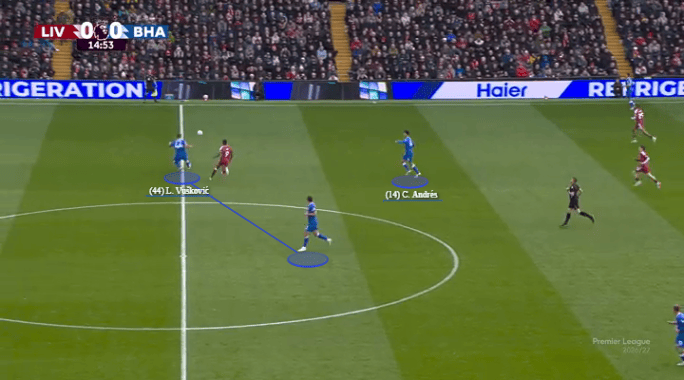
But Brighton can be susceptible to being hit on the break more than Arsenal.
Since they position one full-back higher and even a centre-back at times to create more numbers in the attack, opposition teams usually know they can position a player high up the pitch down that full-back’s side.
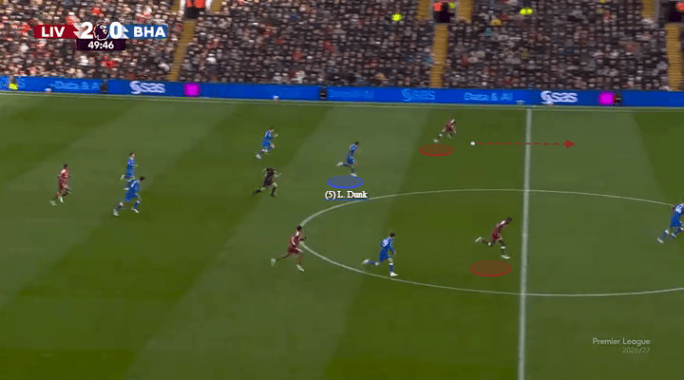
If you can then find that player in the immediacy of the transition, you can kickstart a counter-attack against very few players that had been set-up (“resting”) to defend.
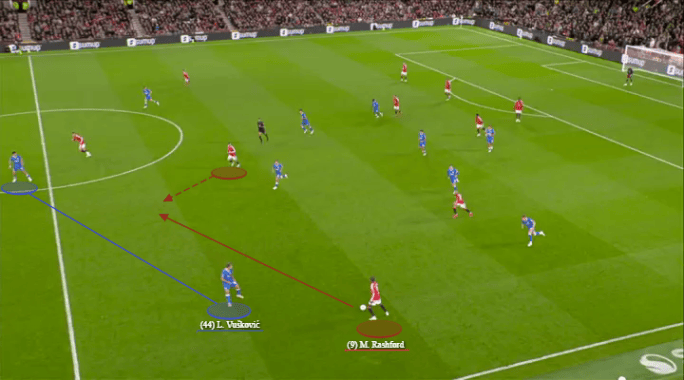
You can then pull that centre-back out of position, widening the gap between the pair of defenders, and exploiting space in between the gap.
Brighton’s current set of players are all relentless in their running, and they fall back into position extraordinarily quickly.
But when they’re up against some of the better players in the world, they can still find themselves undone.
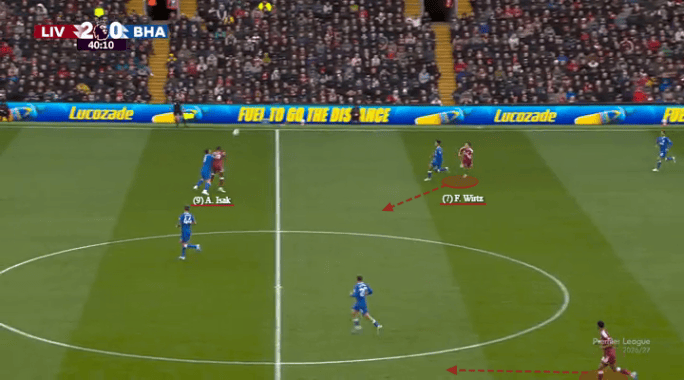
Embed from Getty ImagesHere’s an example where Lewis Dunk doesn’t win his 1v1 battle against Alexander Isak, and Florian Wirtz capitalizes on the open space in the centre to receive the knock-down. With the advancing player on the far-side, Liverpool are now away.
A similar example can be found here, where the full-back meant to hang low misplays his pass. Instead of putting this back in play to one of his Brighton teammates, he plays it right to a Liverpool shirt.
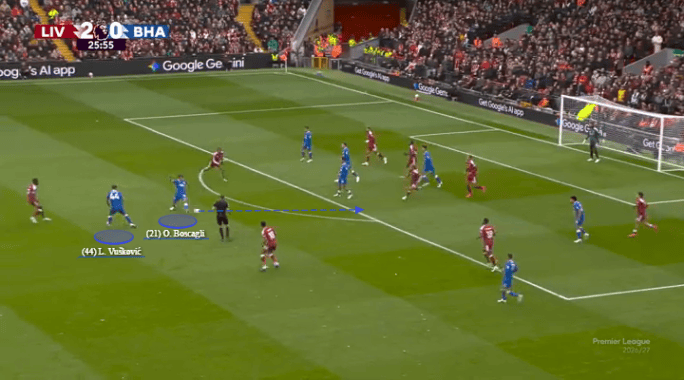
Vušković is already out of position (because one centre-back is almost always stepping), and suddenly, Liverpool are away in a 2v2 with both centre-backs turned away from the ball.
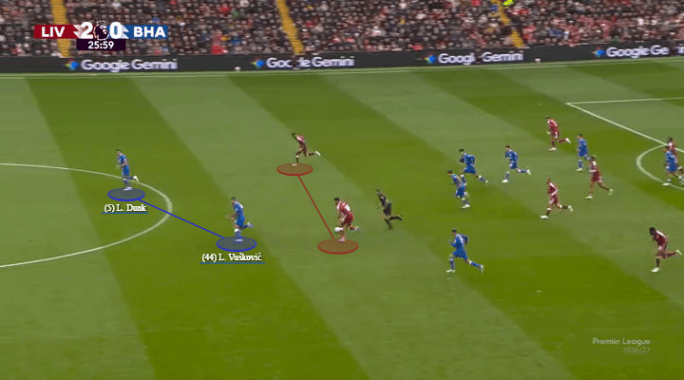
Thankfully for Fabian Hurzeler‘s hair and sanity, Brighton have still been comfortable handling these types of situations.
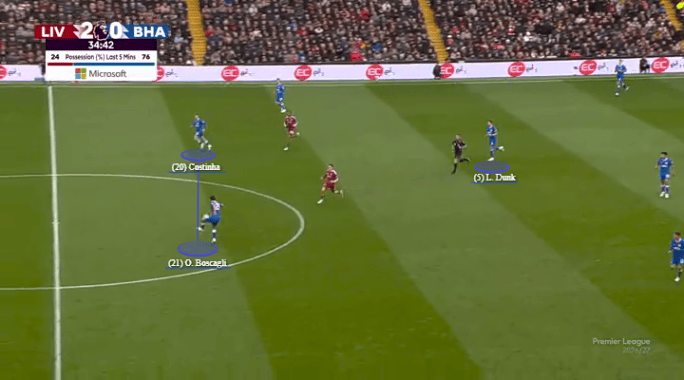
Here’s an example where Boscagli quickly recovers his position on the loose ball.
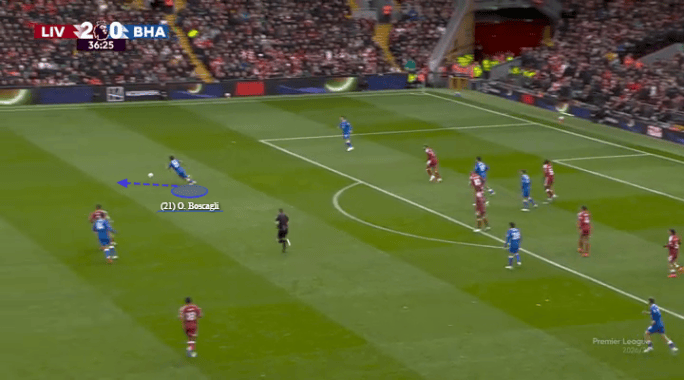
He wins it before the counter-attack can even commence, and is able to restart play for his team.
So again, you can talk shapes and structures all you want, but it’s much more about their build-up into how they create chances that matters. These “rest-defense” shapes are much more about what they want to do with the ball, then what they plan to do without it.
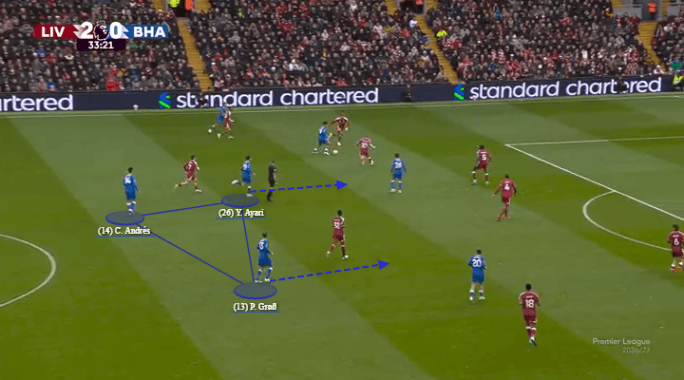
Here’s an example. Pascal Gross drops in between the centre-backs, with the other midfielders remaining firmly in front of them. A common 3+2 build-up structure.
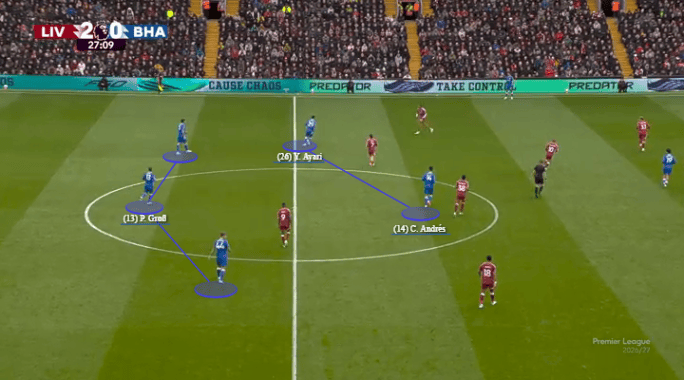
Once they’ve broken free of Liverpool’s defensive set-up by finding the free player out wide, immediately Pascal Groß and Luka Vušković begin to talk.
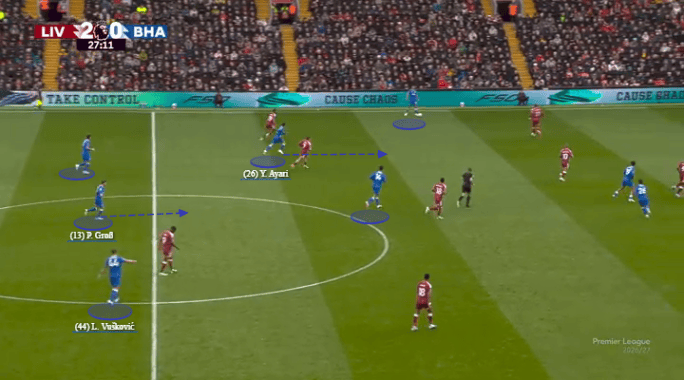
You can see the Croatian gesturing for Groß to go forward, with the German giving him a thumbs up in response. Ayari’s going to continue his run too, so that now leaves just Chema Andres with the two centre-backs.
But because all of these players exist in close proximity, even Andres remains active toward the attack. He’s not just “resting” and waiting around for the transition to occur, he’s constantly thinking about his own positioning so that he can be an option to receive.
As a quick aside, rest-defense is perhaps most important in the modern game when it comes to set-pieces. These teams will usually leave their smaller players back (full-backs and central midfielders), particularly ones that know how to defend 1v1.
In the image below, you can see the two full-backs recovering the ball, as Lewis Dunk falls back into the position that you’d expect him to be. His centre-back partner in Vušković is nowhere to be seen, having gone up for the corner kick.
MANCHESTER CITY
Embed from Getty ImagesFinally, we come to Manchester City. Obviously they’re under the microscope for many reasons right now, but they remain a tactically complex outfit under Enzo Maresca.
Their rest-defense principles are also highly impacted by their build-up structures. They use Elliot Anderson in a 3+1 in the initial stages when building the ball out from the back, and so he’ll naturally be the one required to press first if possession changes hands.
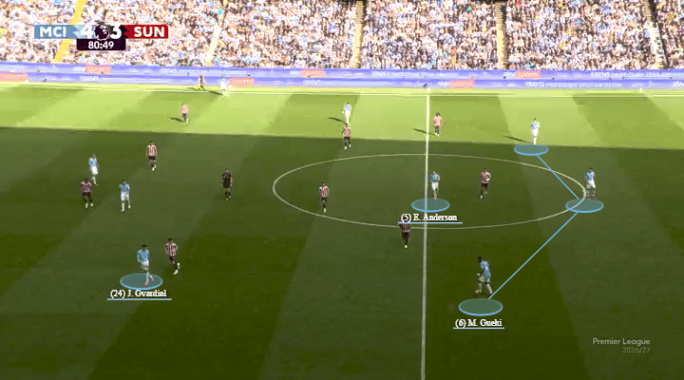
But if you’ve watched City this season, you’ll know that Anderson is involved in the attack as much as anyone. And it’s not like his partner is sitting, covering for him. It’s literally just Ruben Dias sitting alone.
When coaching, I would always tell my defensive midfielders to remain back if a full-back or centre-back ventured forward. That became a key part of their job description.
The best teams in the world don’t really play this way right now. Their defensive midfielders keep going, and keep going and keep going. Because the opposition also have to respond in the same way. They have to defend, rather than placing someone high up to be an outlet in transition.
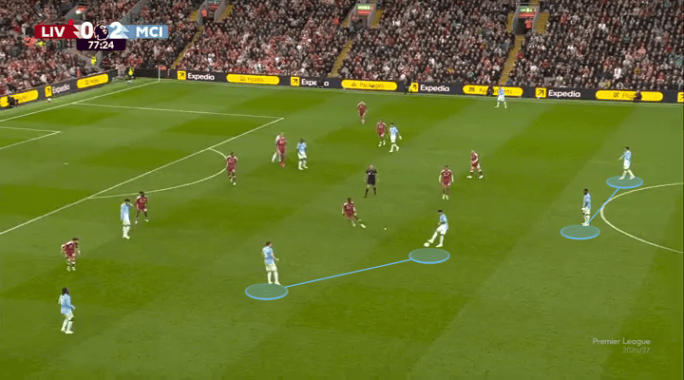
Here’s a great example of that for Rayan Cherki’s goal against Liverpool in their 3-0 win. Jeremy Doku attracts the 2v1, so Elliot Anderson floats into the space and goes “hey, pass me the ball, please!”
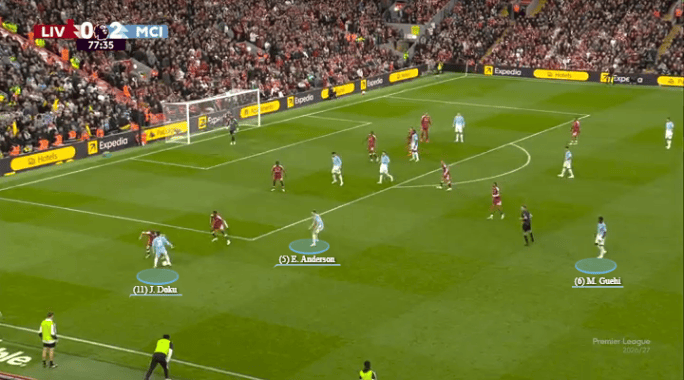
Marc Guehi meanwhile remains in behind, but he’s trying to be an option for a pass too. He’s coming wide, further and further away from his centre-back partner. In a transition, he’d be left for dead.
From this position, you might know the rest. Elliot Anderson picks up the ball, Cherki dummies it, and then scores moments later. But do you notice who else is in the box here? Josko Gvardiol – the team’s left-back.
It’s not Anderson’s job to cover that space. Doku’s brilliance has already attracted Liverpool’s right winger to the ball. So he can take advantage of the fact that there’s no Liverpool outlet to cover in transition. He doesn’t have to sit back in some 3+1. He can go all the way forward.
And as this goal shows, this is how these teams are scoring a lot of goals from open play right now. They’re throwing everybody forward in places you don’t expect them to be, and it just becomes too much to track.
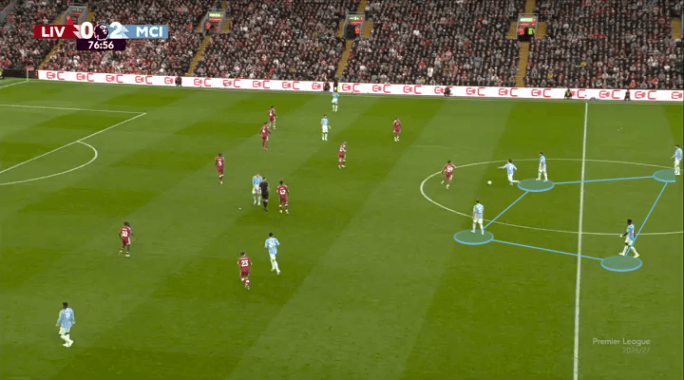
Another interesting facet of City’s play that aids their rest-defense is how they’re often looking to play in close proximity. This image is actually taken in the lead-up to Cherki’s goal. Cherki himself is on the ball, with four City players forming a diamond protective shield around him, where they can play nice short passes between them all.
Here’s another one where Elliot Anderson has the ball, surrounded by his teammates in close quarters.
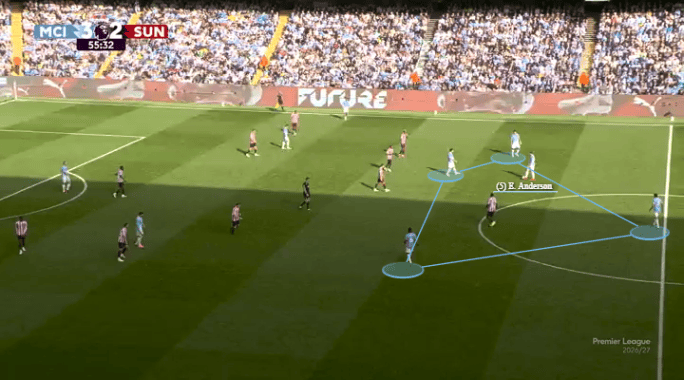
The purpose of structures like this is to attract pressure toward them, and unravel the defense by attracting pressure to one side of the pitch. They can then work the ball to the other side, shifting the defense across, before working the ball back again, where the opposition will be caught off-guard.
But again, this is also for rest-defense. Should Anderson lose possession here, Manchester City will easily swarm in numbers, and win it right back. That’s key to how Maresca wants to play.
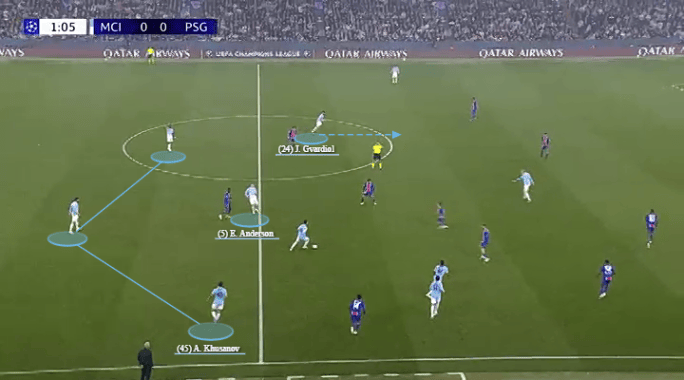
Like Arsenal, Manchester City haven’t conceded much in transition so far this season. The act of pushing so many numbers forward into attack means that the opposition must match that stride for stride, or risk conceding. They can then control games from start to finish, without having to worry about always having a perfect 3+2 or 3+1 at the back.
SUMMARY
- The best clubs in the world right now, with Arsenal, Brighton and City as examples, have a general concept of who and how many players must stay back when the team attack. But this is far more dependent on the opposition than just a generic number.
- The who and the how many is also becoming far fewer in number, as they look to push every player forward into the attack. Sometimes only one centre-back will stay, and sometimes they are only joined by a single defensive midfielder.
- What goes on “behind the ball” is impacted greatly by the structures teams use to build their attacks in the opposition’s attack. The “rest-defense” players are actually the ones constructing attacks most of the time. They’ll attract pressure toward them, thus freeing those further ahead to work their magic with more time and space.
- This approach works because opposition teams are more likely to match them stride for stride than position an extra player high up the pitch. With most teams playing with a single striker (3-4-2-1 or 4-2-3-1), that means only the opposition’s striker will be behind the ball. The players that clubs like Arsenal, City and Brighton recruit at the back are all excellent 1v1 battlers, with their ability in transition a massive part of their role at the club.
- Rest-defense is not just about what happens “behind the ball”. Most players that might typically exist “behind the ball” in attacking phases are still active attackers and thinking far more about how they can contribute to the attack than to the defense. They are never actually “resting”.
Thanks for reading and see you soon!
You might also enjoy…
How to coach pressing & the five most common pressing triggers
Pressing was all the rage from the late 2010’s to the early 2020’s. Some of the most successful teams across that period played a “high-pressing” game, including Liverpool, Borussia Dortmund and Bayern Munich. But today, press and possess styles of play have started to die out. Brighton have been the best example of a team…


Bruno Fernandes isn’t helping
This season, the Portuguese playmaker has been underwhelming to say the least. On paper, Bruno’s start to the season looks okay. He’s scored 3 goals with 1 assist inside those 7 matches, and he’s still producing a high output when it comes to things like line-breaking passes, accurate long passes, and shots. Unfortunately, stats like…

Matheus Cunha is crazy, but that’s part of his charm
Always playing on the edge, getting in the face of the opponents, and dancing his way through celebrations, Cunha is the fighting spirit that can bring United out of a slump.
Discover more from TheMastermindSite
Subscribe to get the latest posts sent to your email.

