Attacking Transitions – The Basics

Transitional moments are an understated, underrated and under-coached part of the modern game. How a team sets up after winning or losing the ball can make or break a team. As a result, today we dissect the basics of attacking transitions. Attacking transitions can be defined as the moment of time between gaining possession and going on the attack right away. In more complex terms, it is the reshaping and restructuring of the team to set up for the attack after winning the ball. Attacking transitions are also closely connected to the concept of counter attacking. Integral elements to attacking transitions include the decision of when to dribble vs. when to pass, width, verticality and speed. In this article, we will touch on all of these aspects, with example diagrams to a team's first introduction to transitions at the 7v7 stage, playing 2-3-1.

Pressing From The Front – The Basics

Pressing from the front is one of the most important elements of the modern game. As opposed to a low-block and allowing the opposition time and space to play out from the back, almost every professional team in existence presses high up the pitch, vigorously and rigorously in an attempt to win the ball back and go on the attack right away, closer to the opposition's goal. As a result, coaches of any age group should be looking to teach players young and old the necessary steps of pressing from the front. In order to help guide these coaches, we examine some of the most basic elements of pressing from the front, with example diagrams for a 7v7 team playing 2-3-1.

Playing Out From The Back – The Basics

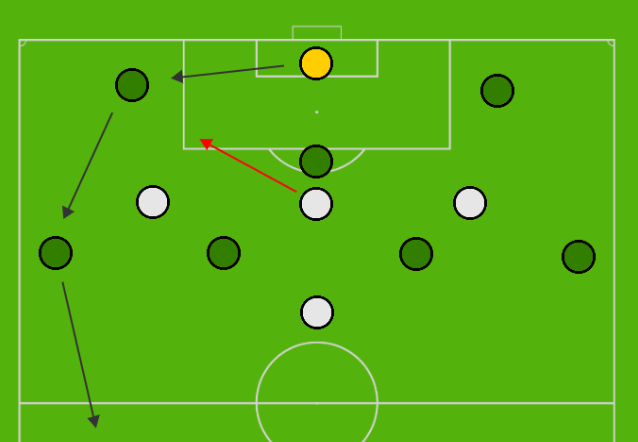
Playing out from the back is one of the most important elements of the modern game. Not only is it better for development than kicking it long, it is also easier and allows a team fewer risks at losing the ball. As a result, coaches of any age group should be looking to teach players young and old the necessary steps of playing out from the back. In order to help guide these coaches, we take a look at some of the most basic elements of playing out from the back, with example diagrams from a 7v7 team playing 2-3-1.

Overlapping Centre-Backs – Tactical Analysis

Any team's style of play needs to fit the personnel and formation. But a relatively new, unexplored tactical innovation arising out of the re-emerging rise of back-three formations is the concept of overlapping centre-backs. Teams like Sheffield United and Atalanta have achieved widescale success utilizing attack-minded centre-backs, who frequently find themselves in advantageous positions, attempting to join the attack and create chances for their teammates. By adopting this style of play, these teams create overloads in wide and/or central areas, and push more numbers into the box, where the delivery of crosses can be a great asset. On the surface, this may seem like a very simple approach. But the concept of overlapping centre-backs is far more complex than just the simple nature of a centre-back running around a wing-back. So let's get right into this Tactical Analysis all about Overlapping Centre-Backs.

Tottenham Hotspur – Premier League 2020-21 – Transfer Market Analysis

After a disappointing start to the 2019-20 campaign, long-time managerial legend Jose Mourinho came into Tottenham Hotspur to solve all the problems they had under Mauricio Pochettino (which were actually few and far between before 2019-20). Now after half a season in charge, Mourinho will be hoping to instill his philosophies on the team to … Continue reading Tottenham Hotspur – Premier League 2020-21 – Transfer Market Analysis

Hansi Flick – Bayern Munich – Tactical Analysis

In his first season at the club, Hans-Dieter Flick has seamlessly achieved success with Bayern Munich in stunning fashion, reaching the Champions League final for the club's first time since Jupp Heynckes was at the helm in 2012-13. The former Bayern player achieved widescale success as Germany's assistant coach, even winning the World Cup as Joachim Low's assistant in 2014. With all his experience at international management, Flick has now taken his former side to new heights, creating the most exciting Bayern Munich team since the days of Ribery and Robben. In the 2019-20 Bundesliga season, Bayern won 26 of their 34 games, scored 100 goals in the process and won the league by 13 points over arch-rivals Borussia Dortmund. In the Champions League, they've fared arguably even better, winning all 10 of their games and scoring 42 goals in the process. That's right, they've averaged over 4 goals per game in the toughest competition in club football this season. So, as we prepare for Sunday's 2019-20 UEFA Champions League Final, here is a Tactical Analysis of Hans-Dieter 'Hansi' Flick's Bayern Munich.

Thomas Tuchel – Paris Saint Germain – Tactical Analysis

For the first time ever, Paris-Saint-Germain have reached the final of the UEFA Champions League. Beating out Borussia Dortmund in the Round of 16 paved the way for PSG to play Atalanta and surprise semi-finalists RB Leipzig upon a return to the competition in August, where they now await German giants Bayern Munich in the final on Sunday. Under the fantastic management of Thomas Tuchel, PSG have been extraordinarily good. Some might argue that their path to the final was a tad easier than previous finalists of the competition, but it would be hard to argue PSG to be undeserving of their place in the final with such a star-studded lineup. The Ligue 1 champions have scored 25 goals in Champions League play thus far, conceding just 5 in the process. Here is a Tactical Analysis of Thomas Tuchel's PSG as we head toward the 2019-20 UEFA Champions League Final.

The Steps to a Perfect Demonstration for Any Activity

The art of carrying out the perfect demonstration is an underrated skill, often neglected by coaches in the quest to get the activity going as quickly as possible. What coaches often don't realize is that by not demonstrating, and by not demonstrating properly, they are wasting time as players are thrust into an activity without having a clue as to what they are supposed to do. The demonstration is probably the most critical component to any activity or game in a practice session, yet many forget about the necessity of the demonstration or neglect to realize a) how important it is to raising understanding and painting the picture for the players and b) how many crucial steps there are to an effective demonstration. As a result, in this article, I will break down every element to a perfect demonstration in helping coaches better paint pictures for their players.