

The role of the goalkeeper continues to evolve in the modern game, with keepers becoming better with their feet by the year. Not only are goalkeepers now a crucial part of their team’s build-up structures, but they’re coming higher and higher out of their penalty areas to contribute. We recently discussed how Robert Sanchez often joins the Brighton defense as an auxiliary centre-back when the Seagulls play out from the back. But Sanchez is not alone in the art. The likes of Alisson, Ederson and Manuel Neuer all perform a similar function for their teams, adding another number by which their team can shift the ball around and make the opposition sweat. But why exactly is this happening and what are the advantages? Let’s explore.
A NEW MEANING TO THE ‘SWEEPER KEEPER’
Embed from Getty ImagesAt the 2014 World Cup, Manuel Neuer attracted much in the way of attention for his ability to sweep in behind Germany’s high line and clean up messes in behind. He was quickly dubbed a “sweeper keeper” for his role, highlighting his transcendence from the average keeper tasked with making saves, to one who does so much more. But in the past few seasons, we’ve seen a whole new meaning to the term “sweeper keeper”, as goalkeepers are starting to become libero’s, tasked with helping their team create swift attacks from the build-up. There is no player better at the art than Ederson Moraes, who has the vision, accuracy and range of a midfielder (which makes sense given that he played as a midfielder in his youth). In Manchester City’s recent 2-1 victory over Arsenal, Ederson stepped far outside of his penalty area to play alongside Aymeric Laporte, as Nathan Ake and Ruben Dias stretched the field wide. This gave City another number to play out from the back, which would have been even more imperative had Arsenal suddenly ramped up their press.

In addition to just being another number, it offered City the advantage of having one of their best distributors in a better position to distribute. This seems like logical sense, but given that Ederson is a goalkeeper, it’s incredibly radical thinking. The result? The tactic worked like a charm. Ederson was intelligent with his long passes forward, adeptly spraying fast balls into half spaces for players to chest down. This allowed City to quickly advance up the field, breaking Arsenal’s high-block in the blink of an eye. He could do the exact same thing on goal kicks as Arsenal set up to press high, and in fact, it was he who made the picture-perfect pass into Gabriel Jesus’ chest seconds before Arsenal’s Gabriel barged into the Brazilian and got himself sent off.
Embed from Getty ImagesBy the same token, Brighton use Robert Sanchez to achieve positive results in their build-up. As Adam Lallana receives with his back to pressure in the image below, he still has many options. He could go into the middle centre-back, but that area of the field is slightly congested. Instead, the best option is to play in his goalkeeper, who has acres of space ahead of him.
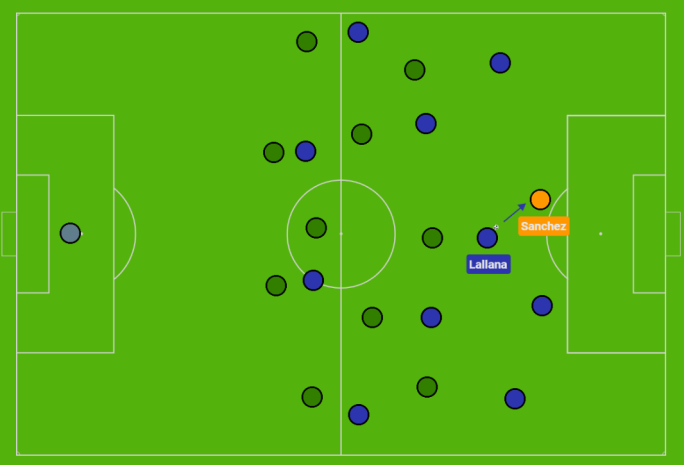
By doing this and creating an extra number, Brighton pose a problem that becomes very difficult to solve. Each team has 10 outfield players, who if they want, can go man-for-man on their opposition. But in the examples we present of Manchester City and Brighton, suddenly there’s an extra player who simply cannot be marked without leaving another player unmarked. Simultaneously, the goalkeeper’s teammates can stretch the field and the opposition all the more, knowing that there’s now an additional body to spray passes around and switch play from a central position. This makes for a more efficient build-up process, allowing a team greater advantages in both wide and central areas as they pass the ball around. As goalkeepers become better with the ball year after year, this tactic may begin to take off in the years to come.
BUT WHAT IF THEY LOSE THE BALL?
Now that we’ve dissected the advantages to this approach, we’d be remised to not mention that there could be some pitfalls if things were to go horribly awry. If say the goalkeeper in the image above accidentally played his next pass into the closest red attacker, he’d be out of position and done like dinner. Taking a goalkeeper away from the goal is a dangerous approach, and means they have to back-peddle a great distance if their team lose the ball in a disadvantageous area of the field. This is the one major downside to an otherwise foolproof tactical plan. So what does this mean? Well, only teams who are exceptional at playing out from the back (e.g. Liverpool, Manchester City, Brighton and Bayern), can successfully adopt this approach and get away with it. Without the right players, beyond just the goalkeeper, this could go horribly wrong. Luckily, we haven’t seen that happen yet, and clubs like City and Brighton are only reaping the rewards of this approach.
CONCLUSION
Embed from Getty ImagesThe role of the goalkeeper continues to evolve with each and every passing year, with the modern keeper becoming more involved in a team’s build-up structures than ever before. This past year, we’ve seen a change in how goalkeepers help in that process, as the likes of Ederson and Sanchez join their defensive line as another number to facilitate build-up. A brilliant tactic that puts a stellar distributor in a stellar position to distribute, things could go horribly wrong if this is done incorrectly. For now, we have to praise the likes of Ederson and Sanchez for their unique role, all part of the evolution of the modern day goalkeeper.
So there it is! A discussion about how adding goalkeepers to the build-up has given a whole new meaning to the term ‘sweeper keeper’. Be sure to check out more of our tactical analyses, and follow on social media @mastermindsite using the links below. Thanks for reading and see you soon!

Elliot Anderson’s start to life at Manchester City, and what happens next?
If you’ve been living under a rock during this international break from club football, you may have missed that Manchester City have been charged with 114 Premier League financial rule breaches. If the punishment fits the crime, Manchester City will almost certainly be relegated from the league, meaning they will lose all of their strongest…


Total Football Analysis stole 5 of my articles
I’ve been writing about football for over 10 years on this website. In that time, I’ve had the odd instance of stolen words and zapped insights.
Normally it comes from small, lazy creators trying to start a YouTube channel or their own site. Other times it comes from websites that don’t seem to have…

What we learned from Canada’s friendly wins over Chile and Peru
Canada’s first matches since the World Cup revealed a team with more quality, competition and depth than ever before. Luc De Fougerolles and Nathan Saliba strengthened their claims for automatic starting roles, while Liam Millar and Jacob Shaffelburg continued to impress. The next generation have shown that they’re not waiting around for their opportunity. They’re…

3 Canadian stars making their mark at new clubs
The 2026 summer transfer window was a busy one for Canadians. Just about every one of our national team stars changed clubs – many earning exciting moves to take their careers in new directions.
It’s only September, but it’s gone better than expected for most. Here is how our biggest stars have fared since…

Pascal Groß: Brighton’s £1.7 million masterstroke
In the month of September, Pascal Groß has arguably been the best midfielder in the division. Certainly one of the most influential, putting up 3 goals and 3 assists to start this season. Here is what makes the German midfielder so special.
Discover more from TheMastermindSite
Subscribe to get the latest posts sent to your email.


12 thoughts on “Goalkeepers in the build-up – a new meaning to the ‘Sweeper Keeper’”