

When you think of the epitome of a modern-day manager, former players often come to mind first. Xabi Alonso immediately springs to my mind, after he won the Bundesliga with Bayer Leverkusen in one of his first managerial stints. Vincent Kompany has also earned much acclaim in his early career between Burnley and Bayern, and now making their way through the ranks is another former Premier League legend – Cesc Fàbregas.
Fàbregas is one of just a few coaches in the world right now, where you feel like you’re getting a fresh take for the first time in awhile. Something new. Something different. Something exciting.
Embed from Getty ImagesHe might be playing the same 4-2-3-1 as every other team these days, but it feels different. Many of his players are up-and-coming ballers, which only adds to the flavour behind his tactics and the hype around everything he’s accomplishing at Como.
Embed from Getty ImagesWith the club reaching the Champions League for the first time in their 119-year history, and annihilating some of their competition, this is an exciting time in the life of a Como fan. Here is my analysis of Cesc’s Como so far in 2026-27, and why the Spaniard might be the next great modern manager.
SYSTEM OF PLAY: 4-2-3-1
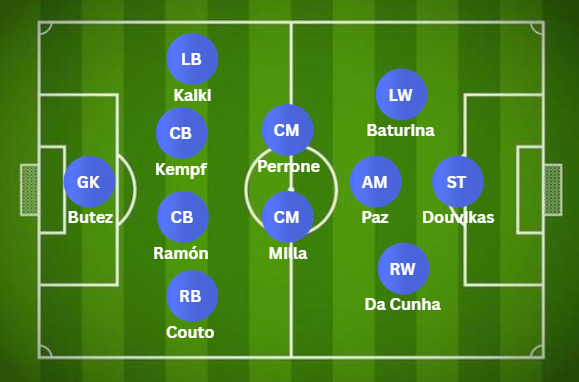
Cesc Fàbregas sets Como up in a 4-2-3-1, with consistent shape and structure shifts throughout different phases of possession.
In build-up, you might see a 2-3-4-1 or 2-4-3-1 emerge. In defense, it turns into a narrow 4-4-2.
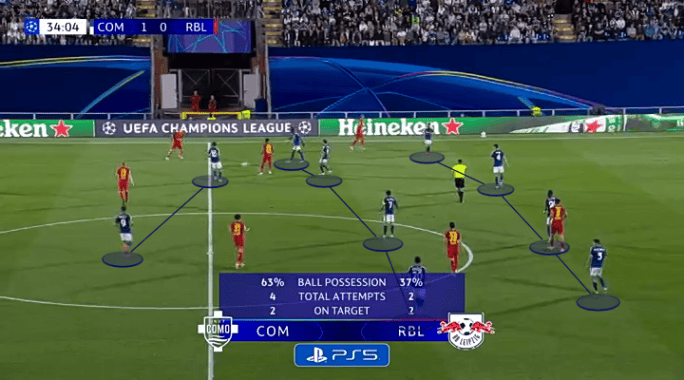
The magic in Como lies within their possession-based approach, emphasized by the technical brilliance all around the field. The Spaniard’s recruitment over the past few years has centered around players who are good with the ball at their feet, creating chances through their own trickery and brilliance.
Embed from Getty ImagesThis is in contrast to the more physical approaches we’ve seen over the past few seasons in the Premier League. But for Como, intensity, energy and that “physicality” comes in abundance through what they accomplish with the ball at their feet, and how quickly they can triangulate it around the pitch before the defense can react.
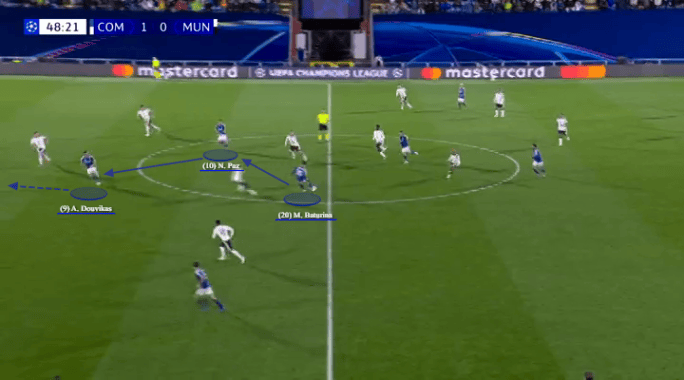
The likes of Yan Couto, Maxence Caqueret, Martin Baturina, Lucas Da Cunha and Nico Paz are all great examples of that recruitment process. They want the ball at their feet, and want to play a technical, tactical focused game.
Embed from Getty ImagesCesc Fàbregas has also skewed younger in the building of this team. One player that I’ve really enjoyed is 21-year-old Jacobo Ramón at the back, who arrived at the start of last season from Real Madrid. He’s an extremely savvy ball-player, and excellent at progressing the play up the pitch with clever passes and occasional long thrusts at the right moment.
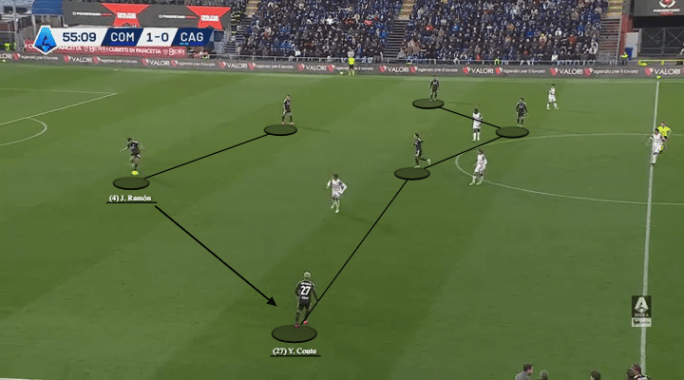
But he’s not the only one. There’s 22-year-old left-back Álex Valle, competing with the Brazilian Kaiki – who just earned his first national team call-up. There’s the lightning quick pace of 21-year-old Assane Diao. There’s the technical and tactical intelligence of Argentinean midfielder Maximo Perrone, alongside the more experienced Luis Milla too. All around the pitch, Como check the boxes of a cohesive team.
Embed from Getty ImagesAs I’ll come to illustrate in greater depth, when you then have a few superstars in Anastasios Douvikas and Nico Paz, a good supporting cast and crew is all you need to build one of the best teams in Europe. Despite not having the funds or the stardust, that’s exactly what Cesc has done since joining Como in 2023.
ATTACKING PRINCIPLES
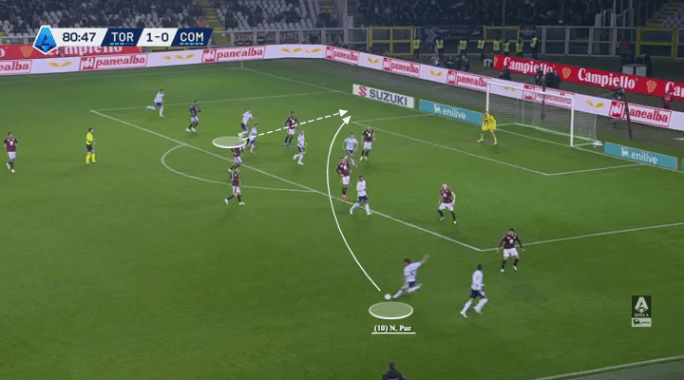
Embed from Getty ImagesBefore going on any complicated, longwinded explanation about Como’s attack, it’s important to note that absolutely everything funnels through Nico Paz.
Embed from Getty ImagesWe’ll see how things shake out on my end of year Top 100 Footballers list, but this is a player that has immediately entered the upper echelon this year. He’s so clever with the ball at his feet, so talented at striking the ball for either goals or assists, and highly aware of how to receive in space at any moment.
So first, let’s start with how Como build out from the back. Fàbregas has a great interview with the Coaches’ Voice below, which details much of his approach.
It’s typically a 2-4-3-1 shape, with both central midfielders hanging low and full-backs ready to shift between inverting more centrally or holding the width at varying heights.
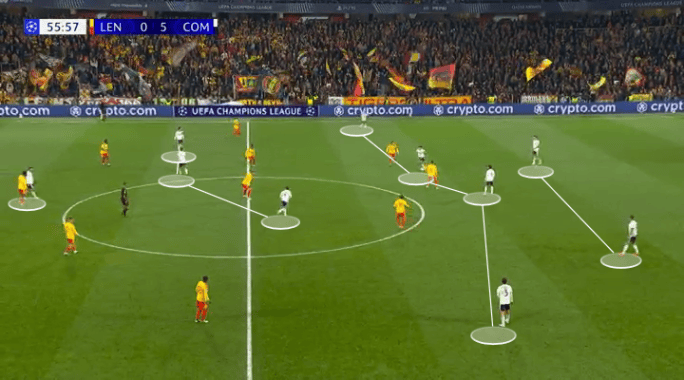
The other most important elements of his build-up play are as follows:
-> Central midfielders are never on the same line when looking to probe for space out from the back. One may drop deeper as the other floats slightly higher but still within distance for a short pass. With that one midfielder dropping deep, diamonds can then form with the goalkeeper.
As they combine with short passes in close quarters and attract pressure, they can then find avenues to play passes into space behind.
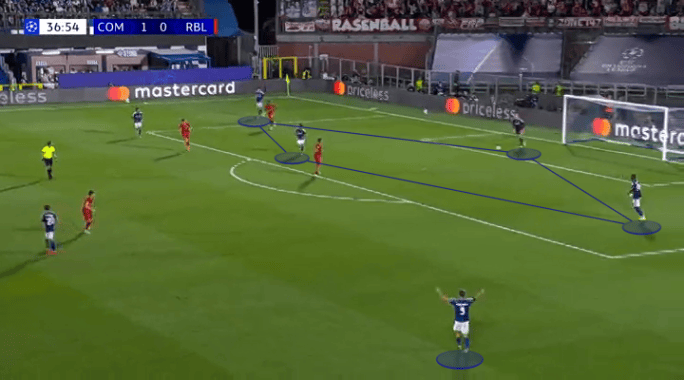
The full-backs will also exist at different heights, just like the central midfielders.
-> The entire spine of the team (central players) must recognize the moment that the centre-back is in trouble. Most often, this then involves one of the defensive midfielders moving toward the ball, to open more space for either the attacking midfielder or striker to receive in between the lines.
In the video, Cesc calls these players “10’s”. So the ‘9’ or ’10’ are essentially on the same line, acting as that outlet to receive progressive, line-breaking passes.
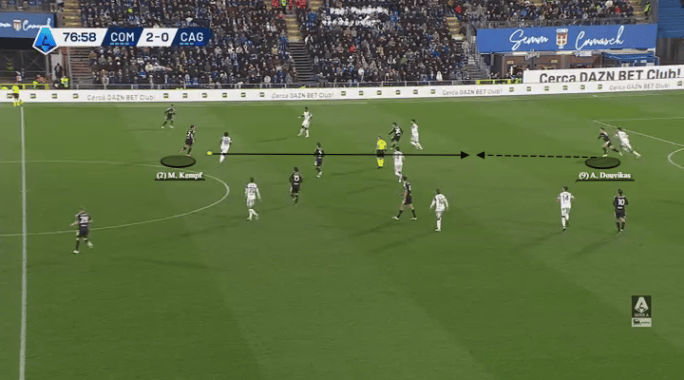
-> Imperatively, they want to use build-up as a key mechanism for forming their attacks. They want to break the opposition down through one short pass to another, before finding their key men in space to attack.
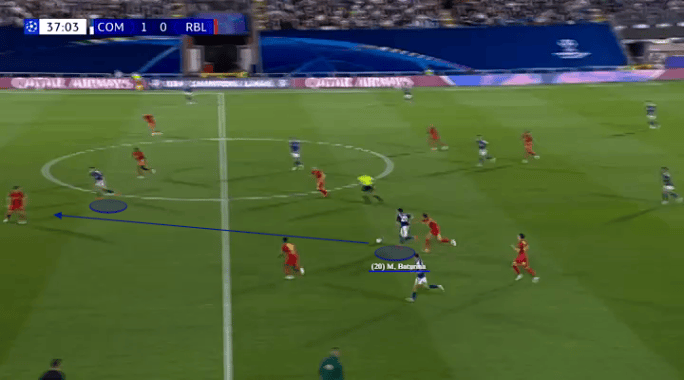
Beyond that, it’s the technical and tactical quality of the players involved, many of whom have come through Spanish youth ranks. They recognize when to play long vs. when to play short. They recognize how to balance their partner. They intuitively know when they should carry the ball forward as opposed to finding a better option for a pass. They’re also keenly aware of how to create space for those most likely to shine.
Embed from Getty ImagesAs the ball advances higher up the pitch, full-backs and wingers will often interchange in wide overloads, pulling players toward them. Nico Paz meanwhile roams around the centre into the half-spaces, looking for the space to receive untracked.
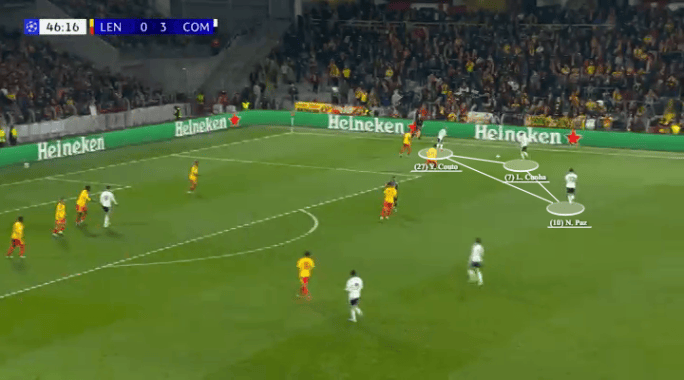
This works particularly well on the right side with Couto and Da Cunha, as Paz loves to drive from out to in on his left foot. He’s a very left-footed player, and has a really nice ability to strike a ball pure and powerfully.
Embed from Getty ImagesBut it can work from both sides, and it’s particularly notable that Cesc has preferred to use the likes of Baturina, Caqueret, and Da Cunha from the wide areas rather than natural wingers. They’re typically thought of as either central or attacking midfielders in that kind of ’10’ slot. So the width on the field is much more about creativity than it is about physicality and explosion. Of course, Assane Diao and others will challenge that notion. But for the most part, we’ll see players like Paz, Da Cunha and Baturina coming inside onto their stronger feet and inverting, rather than hugging the touch-line and taking players on 1v1.
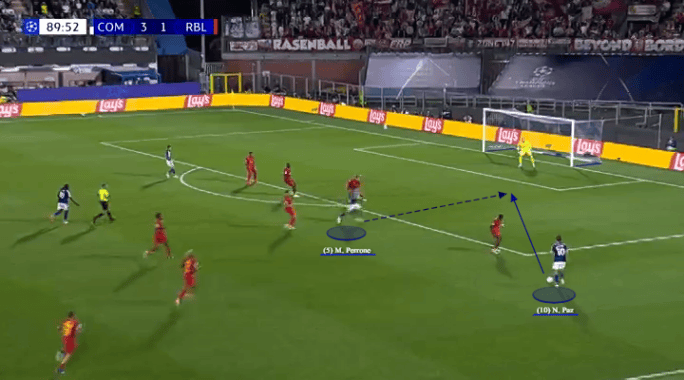
With the likes of Baturina and Da Cunha being so excellent in tight spaces, Nico Paz is often able to receive from his wide-men in free space. From there, he’ll create tons of damage, and combine nicely with Greek striker Anastios Douvikas. In just 5 Champions League matches so far, those two players have contributed to 15 goals alone. Outrageous.
Embed from Getty ImagesDouvikas has hit all the high notes this season, scoring 11 goals in his first 17 matches to start this season in all competitions. He’s a great link-up player and has a fantastic understanding with Paz. But he stands out most for how clever he is as getting his body in the way of a defender, or in front of the defender just in time to finish off a chance.
Embed from Getty ImagesWhen you have players like Paz and Couto who can conjure the crosses of dreams, a player like Douvikas can then have an easy time finishing in a variety of fashions.
DEFENSIVE PRINCIPLES
Embed from Getty ImagesFor all the flash and panache in attack, Cesc Fàbregas has kept his defensive principles simple.
It’s a 4-4-2 in really any phase of defensive play from the high press to the low-block, and a very narrow one at that, allowing for potential penetration out wide.
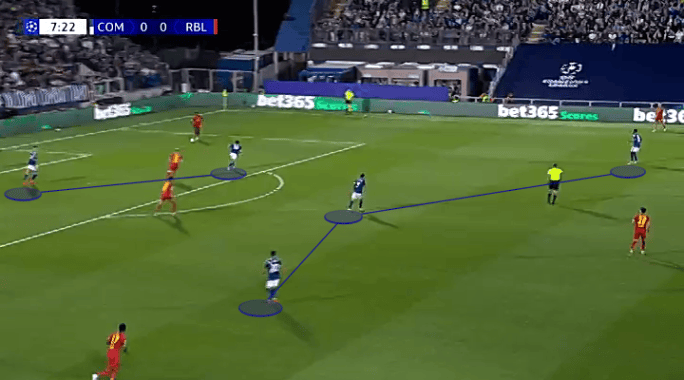
When teams attack through the centre, they’ll more intentionally shut down those central channels and force passes into the wide areas, where they’re then looking to use the touchline as that extra defender and quickly shut down the space. Sometimes, like in the image below, this can leave too much space out wide for the opposition to deliver a dangerous ball into the box.
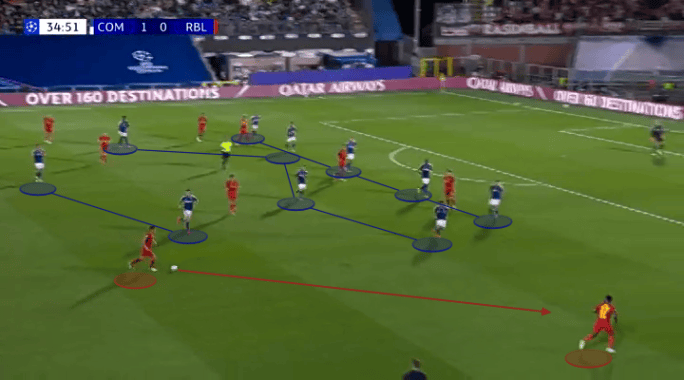
But despite that potential shortcoming, Cesc’s team are tremendously together in their approach. Paz and Douvikas will come all the way back in crowding over the midfield, so it’s not exactly like they’re positioning their two best players high up the pitch to be utilized in transition. This is probably due to the trust that Fàbregas has in his players to play their way out of pressure when they win possession, and the desire for a more methodical approach in attack.
Embed from Getty ImagesOne thing Como will need to keep in mind as they progress their philosophies under Fàbregas is how they respond to misplaced passes in the build-up. As they strive for this approach time and time again, it then means that opposition sides will inevitably pick up the ball close to Como’s goal on occasion. If the distances between centre-backs are too wide or they struggle with that transition from defense to attack, a sucker punch can hit before they even have time to react.
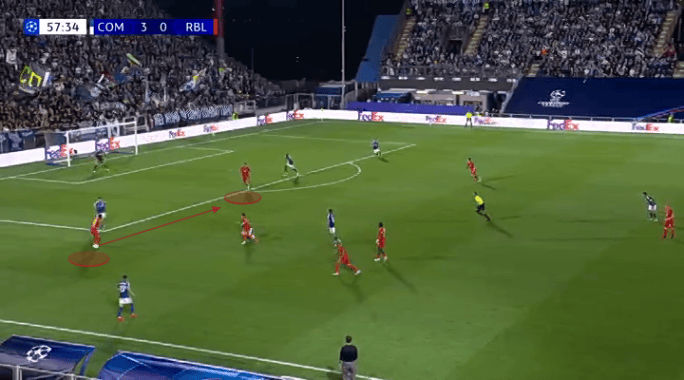
This is what happened against Leipzig, where one misplaced pass was turned into a goal for the German club within a matter of seconds.
Fortunately for I Lariani, this kind of sight is a rarity. They’re conceding just 0.8 goals per match so far in Serie A, the joint lowest in the league with Lazio.
Embed from Getty ImagesWith the club in fifth place in Serie A and tearing it up in the Champions League, it’s been another dream start to the season for Cesc’s Como. With all of their brilliance, it might prove difficult for I Biancoblù to keep hold of all of their talent, and the manager himself. But for now, Como can continue to live in the moment, feeling proud of what they’ve built under Cesc Fàbregas.
Thanks for reading and see you soon!
Discover more from TheMastermindSite
Subscribe to get the latest posts sent to your email.

