
Sarina Wiegman’s England are four games into their World Cup campaign and despite attaining four wins, there remains some skepticism around the nation surrounding how far they can go. Losing there captain Leah Williamson, and 2022 Ballon d’Or nominee Beth Mead to injury, England are having to navigate the biggest competition in world football deprived of two of their best players.
In matchdays one and two, it became clear this isn’t the same England that won the Euros last year, just scraping their way past Haiti and Denmark. But then, the 6-1 destruction of China in their final group game made them ones to watch going into the knockouts. A change of shape from their familiar 4-3-3 to a 3-4-1-2 can partially explain the sudden jump in performance. With that, we investigate the side’s tactical system and why this shape suits the players at Wiegman’s disposal.
SYSTEM of play: 4-3-3 / 3-4-1-2
Embed from Getty ImagesSarina Wiegman‘s England are now touted the ‘chameleons’ of the World Cup after their impressive adjustment to a new shape mid-tournament turned many heads. The knockout round against Nigeria couldn’t fully convince, but their final group stage match against China conjured up 6 of their 8 goals.
But even with a change in system, Sarina Wiegman has continued her consistency with her selection. Mary Earps has remained the clear choice as England’s ‘#1′. Calm in possession and a quality shot-stopper, Earps’ only goal conceded so far has been from the penalty spot.
Embed from Getty ImagesIn front of her, stand-in captain Millie Bright has played every minute. Her leadership qualities are invaluable to a side without their regular skipper. Alongside the Chelsea centre back is her club-mate Jess Carter, who has impressed with her progressive passing out from the back and tough slide tackles. The composed presence of Alex Greenwood at left-back / left-centre-back has been crucial to the patient build-up desired of all England sides. She too is yet to miss a minute for the Three Lions, and her quality out from the back compliments Lucy Bronze’s high-flying running into the final third on the opposite side.
Embed from Getty ImagesIn their new system, it made sense to adapt both players’ roles for Greenwood to become an outside-centre-back and Bronze a dynamic wing-back, suiting both of their playing styles, and giving Bronze more license to create chances for the team.
Embed from Getty ImagesThe midfield is where large changes have occurred over the course of the tournament. Wiegman began with Keira Walsh as a lone pivot, Georgia Stanway just ahead – to the right – as an all-round progressive ‘8’ and Ella Toone as the ’10’ on the left of the trio. They struggled to get Toone involved or to progress the ball through central space, and so bringing Lauren James into the mix quickly proved a blessing.
Embed from Getty ImagesWalsh has since made her return from injury, with Katie Zelem proving a capable understudy in her stead. But Lauren James might be a bigger miss as England now prepare for their next match against Colombia.
Embed from Getty ImagesJames stood out in the match against China as her technical quality came to life, putting on the best individual performance of the tournament thus far – scoring 2 and assisting 3. England struggled to then get her involved in the right ways against Nigeria, where she ultimately let her frustrations get the best of her. If Sarina Wiegman continues with the shape in the next match, Ella Toone or Chloe Kelly may earn the nod from the off again.
Embed from Getty ImagesThey also began the tournament with Rachel Daly as the ‘#9’, but due to her brilliant work ethic and tenacious nature, Wiegman has since reverted her to the left wing-back slot she fulfilled at the Euros. Alessia Russo has become the main striker instead, with Chloe Kelly or Lauren Hemp joining her up front. With so much quality, England should be ticking on all cylinders just as they did in the Euros. But it hasn’t quite panned out that way.
Attacking Principles
Embed from Getty ImagesDespite only achieving true dominance against China, England have maintained the lion’s share of the possession in each of their fixtures thus far. Within their new shape, progression out from the back from the outside centre-backs remains a key way forward. Jess Carter has proven to be a capable breaker of lines, and we already know the quality Alex Greenwood possesses from deep. Keira Walsh and Georgia Stanway sit in front of the two centre-backs as pivot players, with Lucy Bronze also typically starting in a lower position than Rachel Daly.
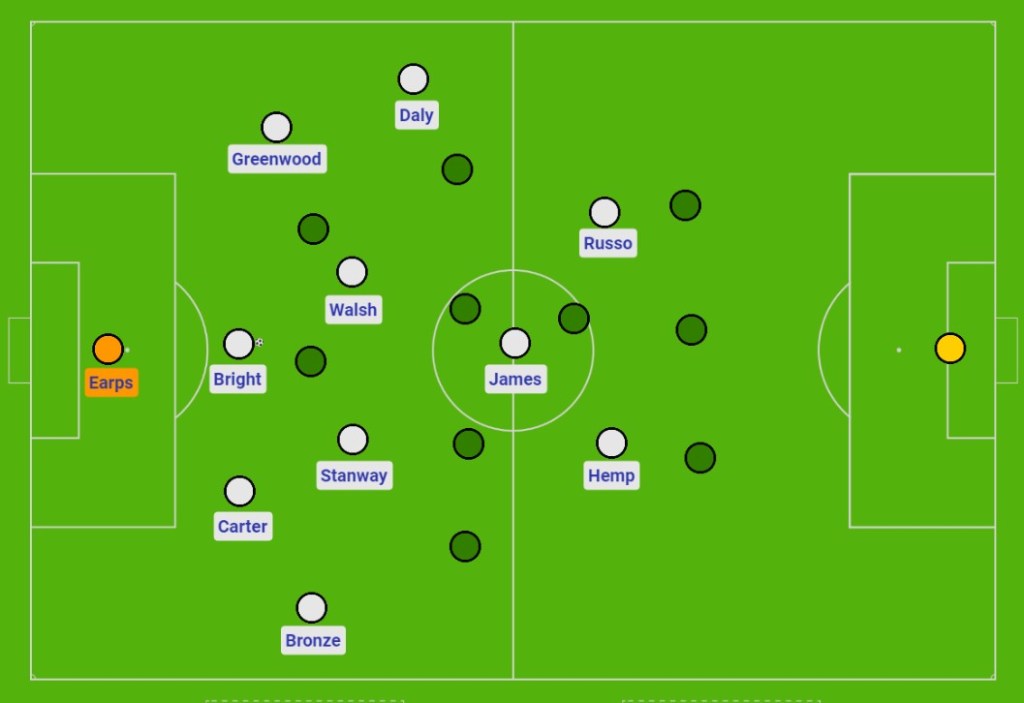
At times, this can potentially confuse onlookers about England actually building out in a back-four shape. However, it’s simply more about getting the best out of players’ strengths, as already highlighted with the quality of Bronze and Greenwood, and the more or less final third quality from Rachel Daly.
Like the men’s team, the Lionesses look to progress the play with short, sharp passes but in reality, this turns into slower, more tedious possessions as they struggle to progress the ball centrally.
There’s lots of shifting the ball wide whilst waiting for space to appear, but they lack the dynamism and incisiveness to really open teams up. It takes Wiegman’s side long periods of possession before creating a chance. This is an area that improved against China, but they struggled to get Lauren James involved to the same extent against Nigeria.
Embed from Getty ImagesHaving James as the lone ’10’ gives her a substantial amount of ground to cover. Given that Kelly, Hemp and James all excel as wide players, a 3-4-2-1 might have made more sense in allowing England greater options in progressing through the centre of the pitch, and more natural ways of bouncing the ball into Georgia Stanway.
Embed from Getty ImagesThis formation, like the 3-4-1-2, suits the positional freedom of the wing-backs as both Daly and Bronze are effective on the overlap. But it decreases the burden on them to create chances from deeper crosses, and raises the potential for natural overloads to occur in the half-spaces. Even with the room for more, England have yet to be truly hurt by their lack of attacking potency, given that they’ve been so solid at the back.
Defensive principles
Embed from Getty ImagesAveraging 68.5% possession a game, there aren’t too many defensive actions required by England. Although they have struggled defending counter-attacks, the lack of time without the ball explains why they’ve only conceded once. And even that came from the spot.
Embed from Getty ImagesHaiti and Nigeria came closest to scoring from open play with their transitions proving to cause danger for England’s lack of tremendous pace at the back. Melchie Dumornay caused England’s defence a wealth of problems through her speedy dribbling; whilst Mary Earps had to come up with the goods to keep Nigeria at bay.
Embed from Getty ImagesThey do have the energetic running of Daly and Bronze to help defend transitions, both of whom are excellent in 1v1 situations. But Greenwood and Bright can sometimes be caught too high or too over-active in stepping up, while Carter can dive in when standing up the opposition.
Embed from Getty ImagesIn the defensive phase, it would be nice to see more intensity in pressing from the front because Wiegman’s side often drop into their mid-block quite early, instead of imposing their own intensity on the game. Russo can dictate the press, picking a direction and forcing the opposition toward the sideline so that the remaining diamonds can fall into place. When moving to the 3-4-1-2, the pressing from the front has become tougher, due to the awkwardness of the 1+2 front line. Defensively, they are then quick to form into a 5-2-1-2, making their ability to counter-attack all the more difficult going the other way.
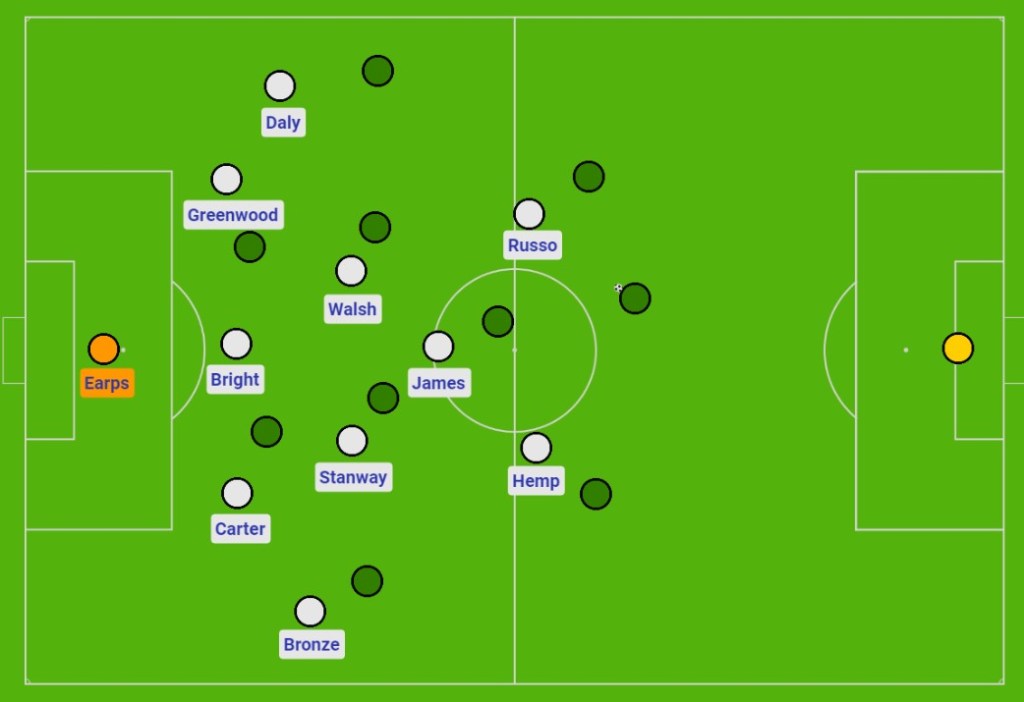
But their counter-press remains important, swarming the ball before the opponent can initiate a counter-attack. Their 3+2 rest defence is arguably the strongest five-player defensive structure available, and that’s another benefit of switching to the new system, giving them more defensive solidity that is required to win the tournament.
Embed from Getty ImagesIn spite of our critiques and the potential for further modifications to be made, England have only conceded 1 goal in 4 games, and that has to be commended.
Conclusion
Embed from Getty ImagesSarina Wiegman did a stunning job last year at the European Championships and it’s only now with the injuries of some key players, that England look as though they may falter. Regardless of how much they’ve convinced the eye, the Lionesses are unbeaten at this World Cup, scoring 8 and conceding 1. So whatever Wiegman decides, England will remain one of the favourites in the kinder half of the draw, avoiding Japan, USA, Spain and the Netherlands.
YOU MIGHT ALSO ENJOY…
Chloe Kelly has the strongest mental frame in Women’s Football
One of my biggest disappointments of not having a functioning laptop the past few weeks has been my inability to watch the Women’s Euros. But I’ve seen all the highlights, and just about every single time a highlight comes on of the Women’s Euros lately, England’s Chloe Kelly remains a prime fixture. Chloe Kelly, for…


Women’s World Cup 2023 – Team of the Tournament
This summer’s Women’s World Cup has been full of drama and entertainment, with several big hitters going out early, and under-established sides making deep runs into the competition. Tournament hosts Australia have certainly made their mark, and the competition on the other side of the bracket with the likes of Sweden, Netherlands and Spain has…
Spain – Women’s World Cup 2023 – Tactical Analysis
With the likes of Aitana Bonmatí, Mariona Caldentey, and Ona Batlle back in the fold following the dispute, Spain have been firmly on fire at the World Cup. They’ve lost just one game in their possession-heavy flamboyance, a 4-0 loss to the counter-attacking genius of Japan in the group stage. Since then, Vilda’s team have been…
Discover more from TheMastermindSite
Subscribe to get the latest posts sent to your email.

