

Written by Jeremy Barnes & Rhys Desmond
After a slow start to the season, Southampton are one of the in-form Premier League teams at the moment. Fielding a 4-2-2-2 on paper, the Saints recently picked up unexpected points against some of the league’s biggest hitters – Manchester City, Tottenham Hotspur, and Manchester United. Results in tow, Southampton’s implementation of quick and progressive attacking transitions have them climbing the league table, playing with a distinct style and groove.
HOW TO COUNTER ATTACK LIKE THE SAINTS
Embed from Getty ImagesAs mentioned, Southampton line up in a recognizable 4-2-2-2 to 4-4-2, with changing shapes and structures depending on the phase of the game. The 4-4-2 is their most common defensive shape, with strikers staying high and ready to pounce in transition. With these basic principles generally in place, it’s important to note that as a fan of automatisms and clearly defined principles of play in each phase of the game, Ralph Hasenhuttl changes his attacking transition approach based on the area of the field, his game model, and the opposition. In other words, once possession is regained, the Saints may implement noticeably different strategies based on the area of the pitch, as they look to counter and break free of their opposition.
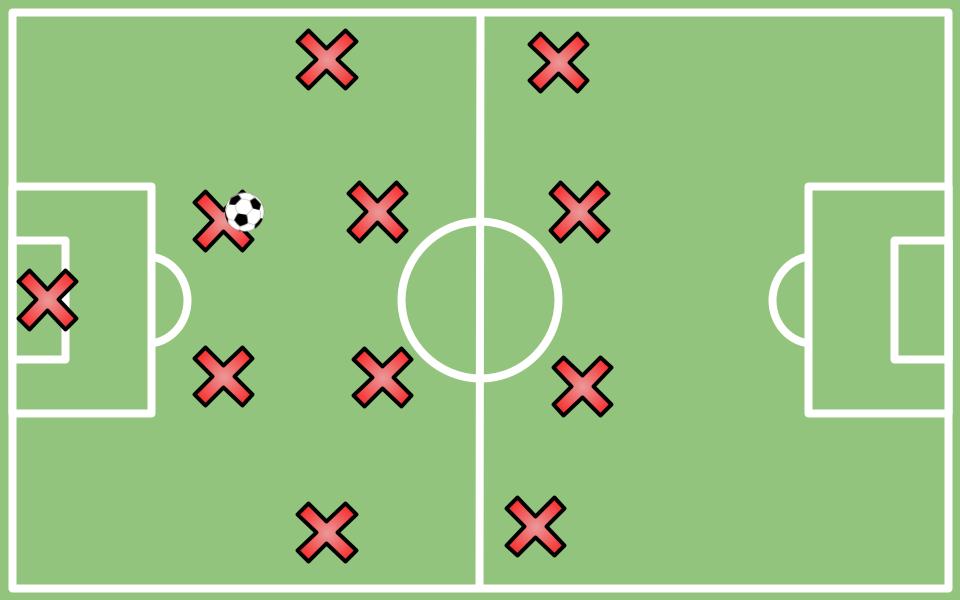
In their defensive third, Southampton expand and establish width, pushing players conservatively up and out to help move the ball forward. They may utilize longer passes, where their speedy strikers can chase down the ball in half-spaces, or utilize ball carriers like Oriol Romeu or Mohammed Elyounoussi to break lines on a dribble.
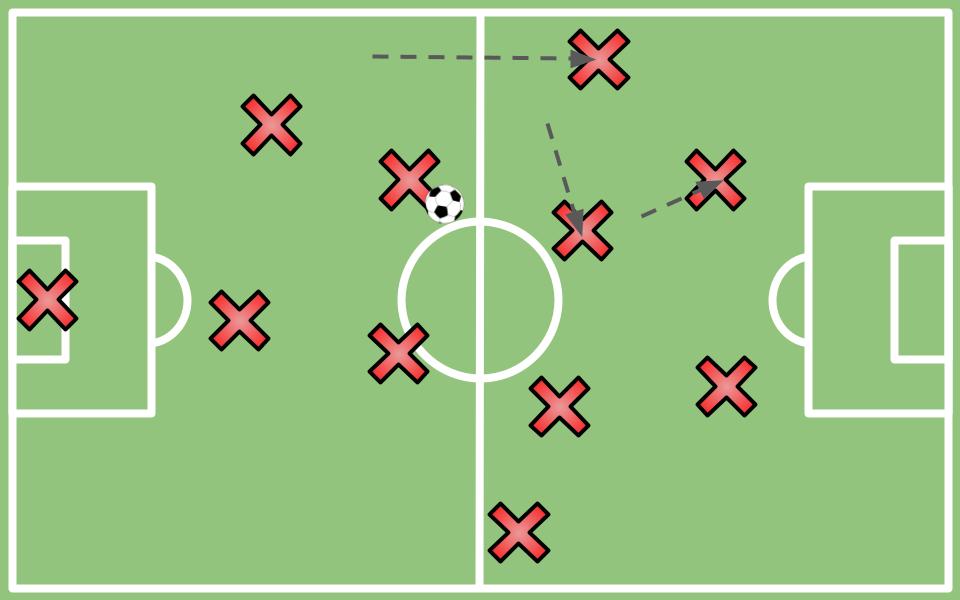
In the middle third, rotations begin to shape form, as wide midfielders tuck inside, fullbacks progress out wide, and forwards maximize depth. The central midfielders will generally position themselves with a slightly withdrawn role, understanding they still need to hold shape for potential losses of possession of their own. The Saints may be direct in utilizing looping passes over an opposition’s high-line, or play in close quarters and progress vertically up the pitch through bounce passes and positional interchanges.
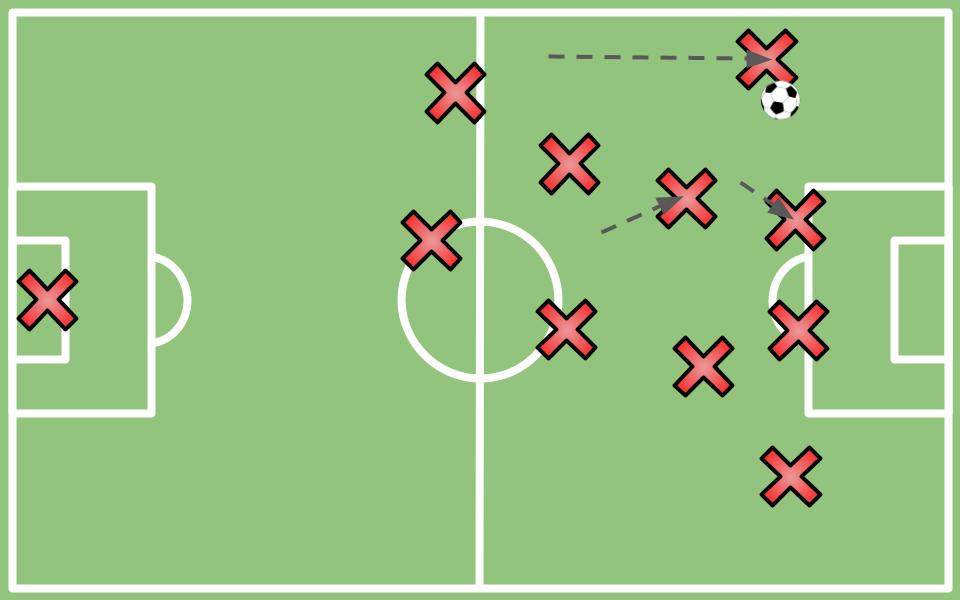
When they regain possession in the final third, long passes are no longer an option, and the team instead are looking for the quickest route to goal, with minimal passes in close combinations to work shooting angles. The entire team may shuffle across to the side where the ball has been won, with both fullbacks potentially getting up the byline into the wide areas up high. An oversimplified, numbers-only representation of this progression would be 2-4-4 to 2-2-4-2 to 2-2-2-4.
| Image 1 | Image 2 | Image 3 |
|  |  |
So, how does all this help Southampton compete? Here’s a few key outcomes of their described attacking transitions:
1. Forwards stay in dangerous areas. Whether for direct runs behind or for service in the box, Southampton’s front two are often found high and wide, within the width of the penalty area. In principle, this offers the dual benefit of occupying the opposition back-line through their constant counter-attacking threat, while simultaneously giving a focal point for crosses and final third combination play. The relatively focused roles and responsibilities assigned to Southampton’s forwards subsequently maximizes the efficiency and goal production from the likes of Broja and Adams in this crucial position.
2. Pre-planned rotations free up unexpected playmakers. Perhaps the most entertaining aspect of Southampton’s play is the repurposing of wide midfielders as dual number 10’s, particularly when the team are in possession of the ball. This ideology frees up space for full-backs to venture forward and get on the overlap, while providing a potential solution for the team’s lack of creativity. A lack of creative willpower can sometimes plague 4-4-2 systems, and Hasenhuttl has managed to mitigate that in recent weeks through his wide combinations, particularly in transitional moments.
3. Rhomboid adaptations help keep possession. Truthfully, the square shapes inferred by the team’s 4-2-2-2 set-up is misleading. Southampton simply could not be as effective with the ball without real-time flexibility, and positional play to match. And so, what is most easily represented as rhombi, provide perpetual evidence of each player’s individual technical ability and understanding as they make the relatively small adjustments needed for passing angles and goal creation. Near-side support paired with weak-side balance sets the stage for quick ball progression, sharpening the cutting edge of everything Southampton does so well.
So there it is! How the strategy behind Southampton’s attacking transitions vary between the different phases of the game. When analyzing any team, it’s important to denote these differentiations, and not jump to conclusions about a team’s over-arching ideology without first taking a look at the variations based on the third of the pitch. For coaches, it’s also important to make these differentiations when creating a game model, something Southampton boss Ralph Hasenhuttl will have undoubtedly done before he even arrived at St. Mary’s. Thanks for reading and see you soon!
You might also enjoy…
-> How Southampton used positional automatisms to gain advantages v. Manchester United
-> Ralph Hasenhuttl – Southampton – Tactical Analysis
-> How to counter attack like Jose Mourinho’s Tottenham
-> Attacking Transitions – The Basics
DON’T FORGET TO CHECK OUT…

Picking the 2025-26 Premier League Team of the Season
Every time you open social media and listen to the noise of the 2025-26 Premier League season, you will often hear cries of “worst season ever.” Even Arne Slot called the league “boring”. I beg to differ. This feels like a season that will come down to the final day, and still have plenty to…


Tottenham win the award: Most disastrous season in Premier League history
With one of the highest wage bills in the league, if Tottenham succumb to relegation, this will be one of the most disastrous seasons of any top-flight side.

Picking England’s 2026 World Cup Squad
The World Cup is just a few months away, and Thomas Tuchel already seems to have a clear idea of both his squad and how he wants England to play. His teams are built on energy, physicality, and discipline — players who stick to their roles and execute a system, rather than drift and freelance.
…

Ali Ahmed: The £1.4 million steal powering Norwich’s revival
Norwich might not be in the hunt for Premier League football next season, but they are slowly rebuilding their squad back to one that can challenge toward the top of the Championship. And in Ali Ahmed, they didn’t just sign a useful squad player. They may have found their next star.
Discover more from TheMastermindSite
Subscribe to get the latest posts sent to your email.
 TheMastermindSite