
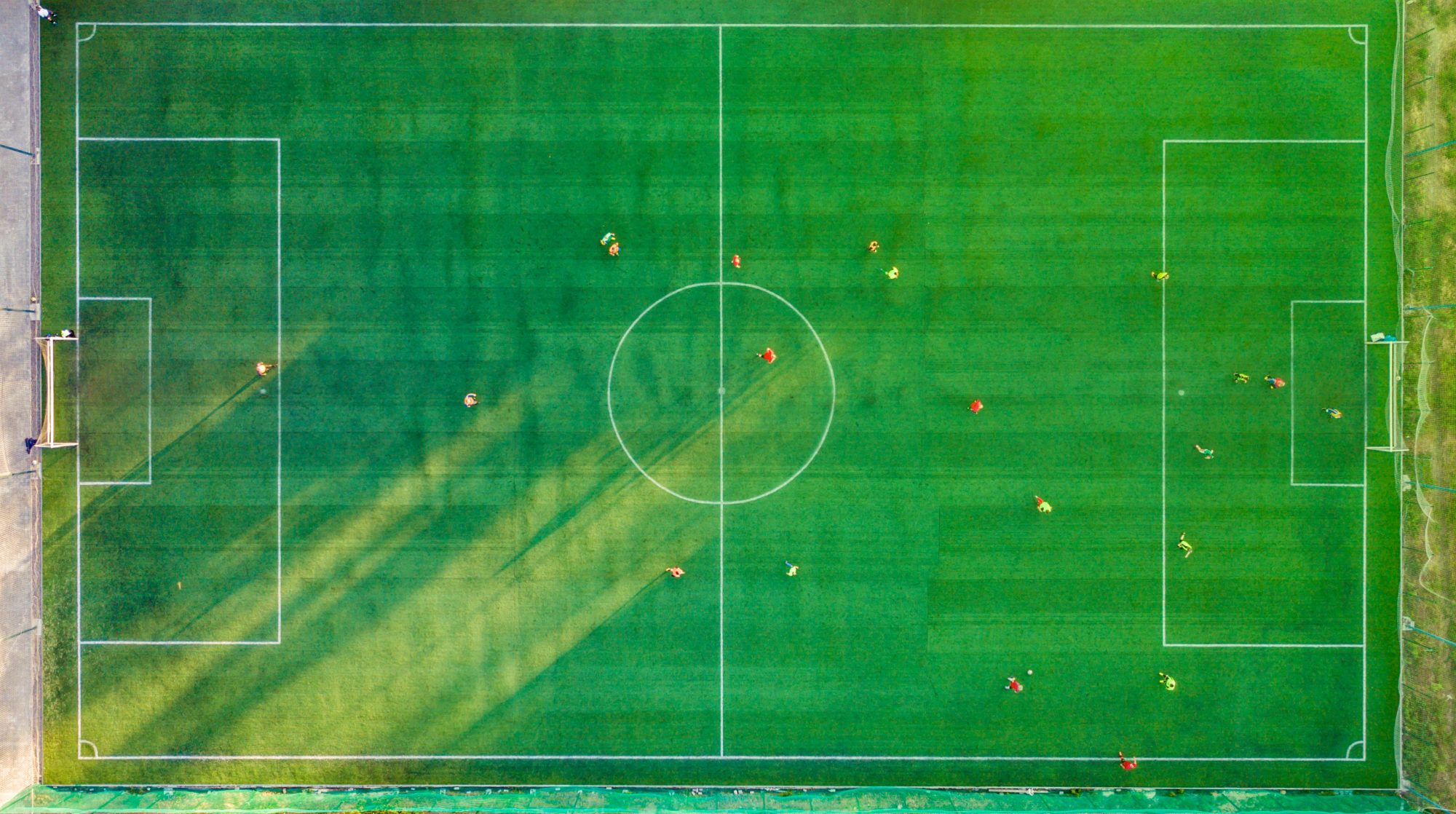
When establishing a style of play, all top-level managers face the same pragmatic questions: How will positional defenders become functional attackers (and vice versa) as changes in possession occur? Where is the balance between earnest advancement and cautious reserve? And how is that equilibrium expressed, implicitly and explicitly, on the team sheet?
On paper, solutions seem simpler; the use of wing backs or outside backs, extra center backs or designated defensive midfielders all infer something different about offensive and defensive posture. But a football formation guarantees performance about as much as a tennis star’s stance ensures a serve is aced or returned (meaning, it doesn’t… not on its own, anyways). And while the location of names on a projected pitch says one thing, mid-match, a side’s tendencies may be operationally accomplished in a less presumptive manner by expression of players’ unique strengths, planned alterations which enhance both individual contributions and tactical nuance while accessing the desirable aspects of multiple “formations” all at once.
At Euro 2020, Italy have been a strong illustration of this principle in action. While they have been relatively consistent in their approach throughout the competition, let’s look below at the structural propensities which drove Italy’s quarterfinal victory over Belgium.
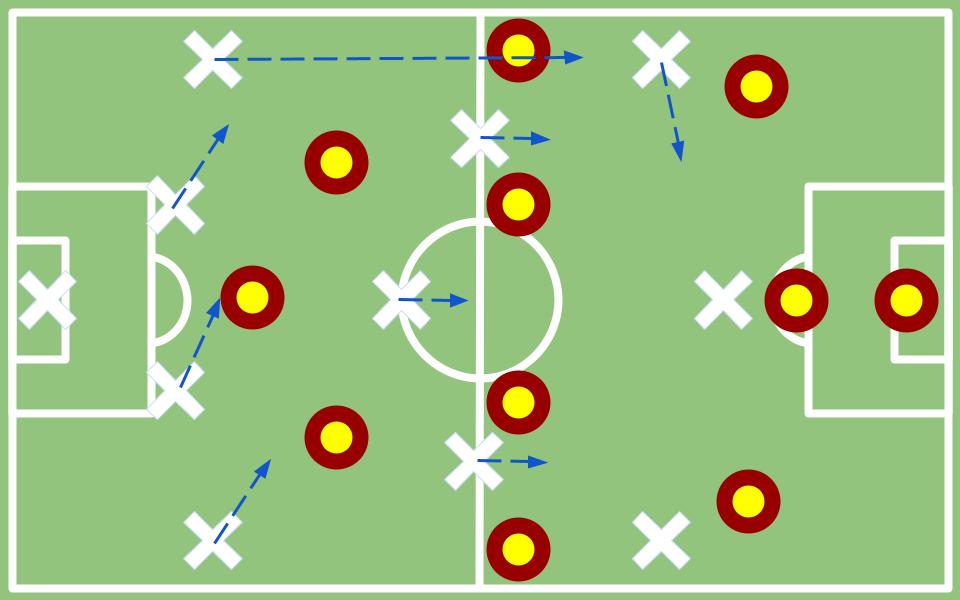
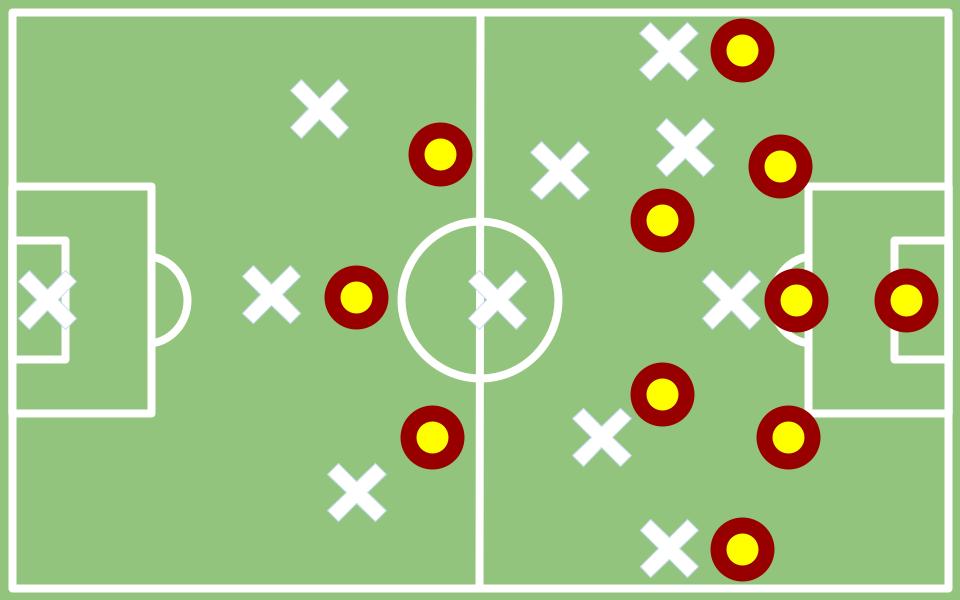
To begin, both sides maintained their usual starting formations: Italy (white X) lined up in a 4-3-3 and Belgium (red/yellow O) in a 3-4-2-1. And though each sought to occupy different spaces when in and out of possession, Italy arguably posed the greater challenge to their opponent’s defensive solidarity. One major reason for this dissimilarity was Italy’s progressive repositioning, and adjustments made possible in part by Belgium’s preference for a less energetic press. With possession secured, the Italians quickly reshaped (blue arrows): Spinazzola (left back), more often than Di Lorenzo (right back), pushed into the opponent’s half while the rest of the backline rebalanced as a triad. This opened passing lanes for drop balls, and mitigated Belgium’s threat on the counter. Insigne (left winger) drifted unpredictably, either taking up a position alongside Immobile (center forward) or picking up the ball around midfield to start the attack. Chiesa (right winger) notably stayed wide, stretching the Belgian backline, occupying the opposition left wing back, and playing to his strengths as a 1v1 dribbler with support from Barella (central midfielder). All things considered, Italy in possession could be better characterized as a 3-1-5-1 or 3-5-2 (right diagram), a remarkable conversion from 4-3-3 and impressive display of tactical fluidity.
More and more, we see world class managers disregarding precedence in favor of strategy, differentiating responsibilities of positional enantiomers or recasting talented players in uncharacteristic roles, with the ultimate reward being realized when the whole is so much greater than the sum of its parts. The implications are extensive: formations become formalities, lineups appear misleading, and humdrum team rosters eclipse all-star casts. Suddenly, the match at hand turns out to be just the visible iceberg above a submerged colossus of technical and tactical identity. And football is all the better for it.
you might also enjoy…

Picking the 2025-26 Premier League Team of the Season
Every time you open social media and listen to the noise of the 2025-26 Premier League season, you will often hear cries of “worst season ever.” Even Arne Slot called the league “boring”. I beg to differ. This feels like a season that will come down to the final day, and still have plenty to…


Tottenham win the award: Most disastrous season in Premier League history
With one of the highest wage bills in the league, if Tottenham succumb to relegation, this will be one of the most disastrous seasons of any top-flight side.

Picking England’s 2026 World Cup Squad
The World Cup is just a few months away, and Thomas Tuchel already seems to have a clear idea of both his squad and how he wants England to play. His teams are built on energy, physicality, and discipline — players who stick to their roles and execute a system, rather than drift and freelance.
…
Discover more from TheMastermindSite
Subscribe to get the latest posts sent to your email.
 TheMastermindSite
2 thoughts on “Quick Take: Italy’s Shield is the Euro’s Sharpest Sword”