Dortmund 3-0 Copenhagen – Match Analysis

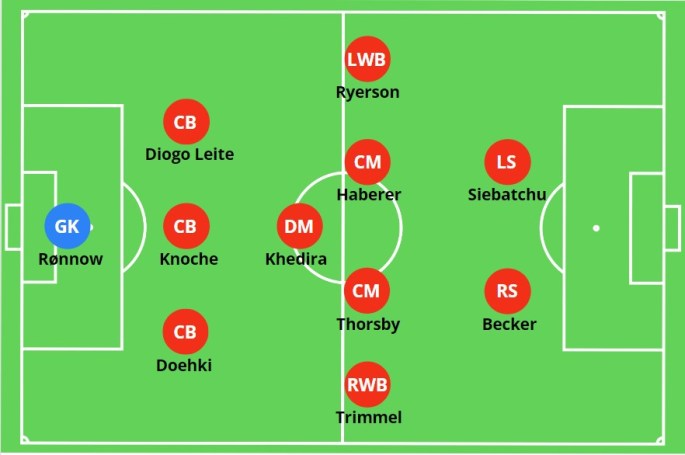
Edin Terzic has enjoyed a positive start to the season, even despite some of the kinks in the system clearly still being worked out. Dortmund have lost just one game since the start of the campaign, achieving six wins and one draw in the process. No clearer have their principles of play come to life under Terzic this season than against FC Copenhagen, where the Black & Yellows picked up three points in their first UEFA Champions League match of the season. Here is our analysis of Dortmund's big win.

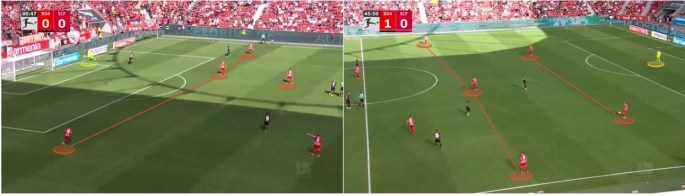
Game of Numbers #5 – Changing Shapes Mid-Game

One of the truest tests of any tactically adept coach is to identify mechanisms for changing around their team’s fortunes mid-game. This is never an easy task, but one that managers must be reflecting on not only with their substitutions, but with the potential for changing the master-plan on a grander scale, whether that be a tactical tweak in style or system. In what was one of the games of the weekend, both Freiburg and Leverkusen made pivotal formational changes as the match wore on. Crucially, both teams changed back to the shapes that they've prioritized since the start of the season, calling into question why they ever abandoned their favoured choice in the first place.

Union Berlin – Tactical Analysis – 2022-23

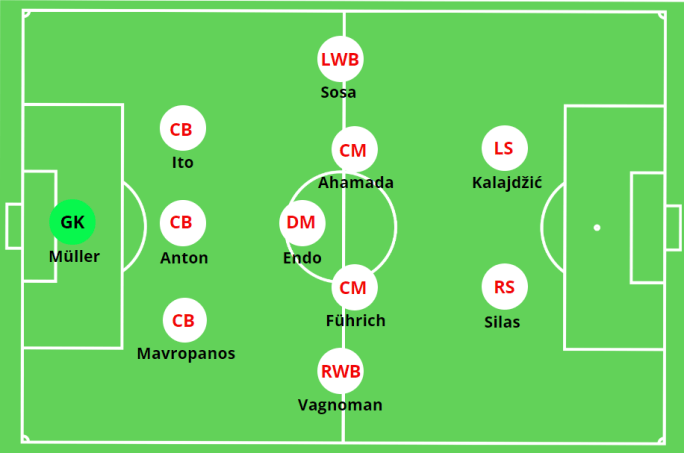
Union Berlin have only kicked on since the start of 2022-23, currently sitting fourth place in a competitive Bundesliga campaign that has seen them start with an unbeaten run of form. Along the way, Fischer has maintained a succinct style of play, that drastically differs from the other German giants around them in the table. Here is our tactical analysis of Union Berlin in 2022-23, under the influence of the extraordinary Urs Fischer.

Pellegrino Matarazzo – VfB Stuttgart – Tactical Analysis

While they've endured a difficult start to the season, they've surpassed expectations in terms of tactical nous and game IQ since the start of 2022-23. Here is an analysis of Pellegrino Matarazzo's tactically intriguing VfB Stuttgart.

Game of Numbers – #3 – The Evolution of the Target Man

Target Men are often seen as the bottom of the barrel centre-forward in terms of footballing ability. But increasingly, it's becoming more difficult to quantify 'Target Men', recognizing the vast skillsets they employ. The likes of Aleksandar Mitrović and Sasa Kalajdzic are easier to distinctly categorize as 'Target Men' for their physical, imposing frame that allows them to score headed goals for fun. But it becomes more difficult to keep the likes of Erling Haaland and Darwin Nunez in that same specification, recognizing the vast array of traits they possess, particularly speed on the break. Target Men have historically been seen as slow, technically inept individuals who use their physicality, whether that be height or strength, to get one up over the opponent. But more and more, we are seeing an evolution of the 'Target Man' in 2022, to include a vast array of traits.

Game of Numbers – #1 – Lucas Paqueta & The Bernardo Silva Role

In our latest analysis series: Game of Numbers, we break down the various tactical undertones of the modern game, most notably the roles that individual players hold on the pitch to help their teams explore avenues for greatness. Positions are often broken down into 'numbers' to describe the areas of the field that a player may operate. This series aims to illustrate the ever-changing, fluid nature of those roles, and the ways in which various footballing teams may use the same players in the same roles to completely different effect. This is Issue No. 1, featuring the following: Lucas Paquetá & The 'Bernardo Silva Role', Joachim Andersen's 'Quarterback' Role vs. Arsenal, and Musiala's Masterclass vs. Eintracht Frankfurt.

Explaining the Deep-Lying Playmaker – Player Role Analysis

The 'Deep-Lying Playmaker' is one of the already attributed player types that we have adopted within our system. Also known by its Italian name 'Regista', the 'DLP' is tasked with setting the tempo of the match from build up to progression, all the way to creation. They sit in front of the defensive line as an 'Anchor', but hold a more offensive, progressive and possession-oriented role than the other two 'number 6' types within our 'Anchor' persona. Their role is in both helping create space between the lines, and then breaking lines, recycling play, or even changing the point of attack upon receiving the ball, so that their team can advance up the pitch, beat an opposition's press and seek spaces closer to goal.

Explaining the Anchor – Player Role Analysis

Anchors tend to play at the base of a midfield three, holding the midfield together, and allowing others to work their magic up ahead. Their role is in both screening in front of the defense to disallow progressive passes forward, particularly into the opposition's striker, and to 'anchor' the midfield by holding everything together as other members step out of position or drift into the half-spaces. Unlike the 'Midfield Destroyer' they do not need to be overly active in defensive phases on sheer statistical contributions, but should be equally active on the hard work done off the ball to shift, shuffle and slide with the play.