

It feels as though it’s been a decade since Manchester United were really, really good.
Sure! They’ve won trophies here and there. But not since the days of Sir Alex Ferguson have they won a league title.
And since then, a lot has changed! Manchester United have become more of a commercial entity than ever before. And instead of winning Premier League titles, it often feels as though the commercial product of Manchester United is the greater concern.
But even despite their dwindling success, recent signings have been smarter. In Ruben Amorim, the Red Devils have a manager who has a distinct philosophy, guiding purchases around that style. And while it might not be perfect, you can clearly see what Amorim is trying to do at United, and for what feels like the first time in forever (to steal a line from Frozen), the new signings have pretty much all gelled together.
Embed from Getty ImagesWith that, this is a rather optimistic take on the state of Manchester United, amidst much in the way of common criticism and calls for Amorim’s head that will likely continue to circle the media all season long. Here is my tactical analysis of the Red Devils to start the 2025-26 season.
ADJUSTING EXPECTATIONS
Embed from Getty ImagesFirst of all, let’s readjust expectations.
Manchester United are not Arsenal.
They’re not Manchester City.
They’re not Liverpool.
They’re not Chelsea.
They’re not even Newcastle.
There are at least five teams in the league right now with better squads than Manchester United. With better structures, patterns of play, and ideologies around how to get the best out of their entire squad of personnel.
Under Sir Alex, they were better than all of those teams. But as CHRVCHES say in one of my favourite songs of all time, ‘The past is in the past. It isn’t meant to last.’
This isn’t the case anymore. So to expect them to win the title would be a misalignment of expectations.
Expecting them to finish top four, maybe? ✅
I think that’s a much more realistic expectation.
So for what it’s worth, Manchester United are making smart decisions right now, in relation to meeting the demands of a top four finish. They’re developing their future with the likes of Amad Diallo, Patrick Dorgu, Leny Yoro and Kobbie Mainoo. They’re also prioritizing their big name, big game players – Casemiro, Bruno Fernandes, Luke Shaw, Matthijs De Ligt. They’re even smartly integrating their new signings – like Benjamin Šeško, Bryan Mbeumo, and Senne Lammens.
Embed from Getty ImagesThere is every reason to believe that United can push for a place in the Champions League next year. They’ve performed really well in their matches at Old Trafford this season, and as their squad continues to gel together, they will improve their form away from home.
SYSTEM OF PLAY: 3-4-2-1
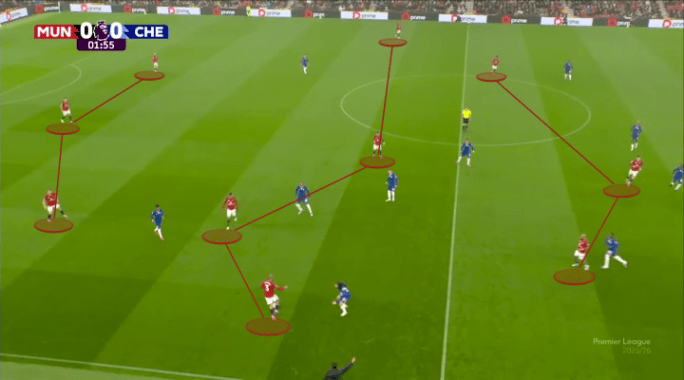
Ruben Amorim seems to love a 3-4-2-1, and has made it his mission to make the formation work for the players at his disposal.
He’s received some criticism for sticking with a system that has sometimes looked discombobulated.
But it’s evident that United’s issues go beyond just a system. They’ve got systemic issues, but not formational ones.
Embed from Getty ImagesIt’s true that a 4-2-3-1 might serve the players well at this point in time, but it’s not the system that Amorim wants to play. He loves his 3-4-2-1 and that will never be the crux or the breaking point for United’s Champions League hopes, so long as he doesn’t become inflexible in making changes on the fly when needed.
Within that current approach, Senne Lammens looks destined to become United’s first choice keeper this season.
Embed from Getty ImagesHe’s a proven shot stopper that will grow in his assuredness on the ball and sweeping in behind. In that regard, he reminds me a bit of David De Gea. David was an exceptional shot stopper, who was often overly-criticized for his on the ball skills, and probably paired with the wrong centre-backs within a high-line scheme. Lammens seems to command his box well, and certainly has those De Gea chops. And if you ask United fans if they’d rather have a good shot stopper like David De Gea or a good ball player like Andre Onana, I think they now know which option they’d choose 10/10 times.
Embed from Getty ImagesLammens is supported by the assuredness of Matthijs De Ligt, and the speed of Luke Shaw and Leny Yoro. The two outside centre-backs also make for a better balance with a player like Harry Maguire or Lisandro Martinez, who will require solid speed and sweeping in behind. While he’s still evidently growing his game, Yoro looks more assured than a 19-year-old in a Manchester United shirt ought to look. Luke Shaw meanwhile is fantastic on the ball, and versatile within multiple roles.
Embed from Getty ImagesOn the wings, you then have Diogo Dalot, Noussair Mazraoui, Patrick Dorgu and Amad Diallo as solid options.
My one looming question within this system is – what is the purpose of the wing-backs? If it’s to maintain width and stretch out the opposition defense, thus funnelling play closer to the centre, then they are doing a great job.
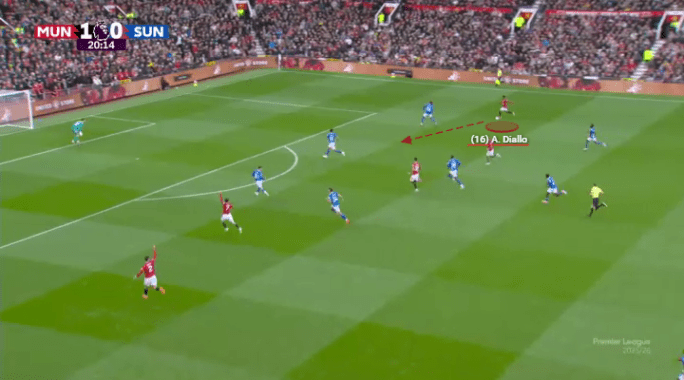
If it’s to greatly contribute to attacking play, combine in wide overloads and cause a nuisance down the wing itself, then only Amad Diallo looks the part in that regard.
Although, I do think Diogo Dalot has a lot of that in him, and so too does Luke Shaw. But we haven’t seen a lot of great, genuine attacking threat from Amorim’s presumably preferred options in Mazraoui and Dorgu.
I definitely want to be proven wrong as the season unfolds, but the best two options might be Dalot a bit awkwardly on the left, and Diallo rampaging down the right.
Embed from Getty ImagesDiallo is such a finessed dribbler and intelligent combiner in tight spaces. He’s a powerful runner, and a genuine threat to defenses. If you play him on that right touchline, I then think you have much more room for tactical nuance within that left wing slot.
This is where we saw Mason Mount have a really fine performance against Sunderland. He’s certainly more of that ‘Inverted Winger’ type, where he will want to play closer to the centre than the touchline. He’s sublime on the ball, and able to understand his defensive responsibilities.
Embed from Getty ImagesBruno could also play there if Amorim wanted to opt for a double pivot in midfield or the box to box mobility of Kobbie Mainoo.
But currently the other looming question in this equation is – why even have a left winger that’s not direct and alternatively threatening like Diallo, if the majority of play is going to be funnelled through others?
While Mount played a nice role against Sunderland, he was still relatively anonymous in the attacking half. Because this is the secret sauce of what Amorim has created this season. It’s all in the combination play between Bryan Mbeumo, Benjamin Sesko, and Bruno Fernandes.
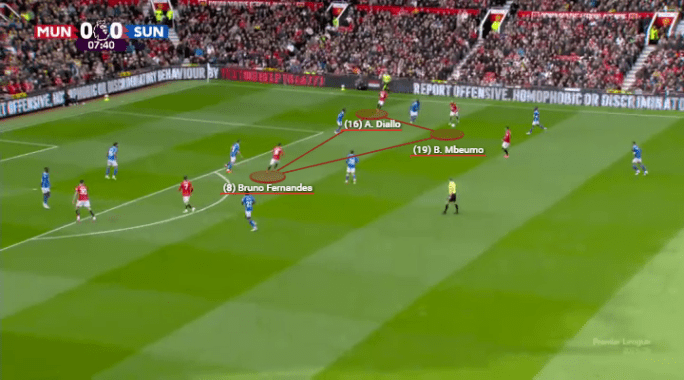
Bruno wants to be on his right foot. It’s where he feels most comfortable crossing the ball into the box and creating magic. And it’s where he naturally now has to gravitate as Mbeumo becomes the key outlet in behind.
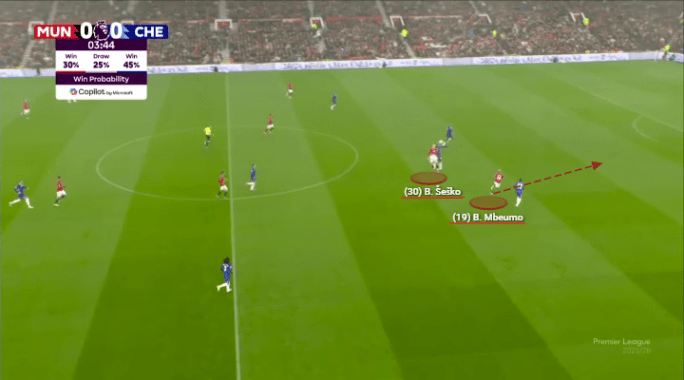
Mbeumo is such a powerful runner. Such a dynamic, direct forward. And that’s funny to an extent, because he’s a left-footer on the right side. But he’s made to bounce off a ‘Target’ like Benjamin Šeško.
The two new signings have formed a solid partnership to start this season. The Slovenian’s hold-up play is exceptional, and it really suits Mbeumo’s running style. Šeško will naturally attract attention as defenders look to get touch-tight and knock him off the ball (something that’s been hard to do this season). That leaves more space for Mbeumo to run in behind and take on chances of his own.
Embed from Getty ImagesAs he then pulls opposition players away from positions, Šeško should in turn be afforded more room to roam in the box. It’s a great combination of skillsets, and you can see why Bruno Fernandes naturally then gravitates toward that. You can also see why Amad’s further threat down that side creates havoc for defenses.
I then think – why not just play Mount as another game-controlling midfielder. I can see the balance in the side starting to form around that ideology, whether or not Mount acts like a midfielder or acts like a winger. His position is essentially the same.
Embed from Getty ImagesMbeumo and Šeško already have a good thing going. Why not play them as a front two, in more of a 3-5-2? The 3-4-2-1 can even operate as such if Mount and Fernandes occupy and overload half-spaces interchangeably. That would be fun.
There’s a lot of room to play with here, with still enough defensive solidity in behind.
For the number freaks, Casemiro will generally stay and hold, which makes for a 3+1 rest-defense. The left-sided attacker might also slot further down in defense, making for a front two combination that can almost look like a 3-5-2 in defense at times.
But the structures are less important than how they play, and how they score goals, which has been a key issue for the Red Devils this season. So that is where we will go next. Straight to the back of the net!
MOST SHOTS IN THE LEAGUE?
Embed from Getty ImagesManchester United have threatened with more shots on target than any other team this season.
And before you get on your high horse and talk about xG (expected goals), they also have the highest xG. And it’s a fairly substantial difference between them (14.1) and Arsenal (12.1) in second.
So they’re not just shooting the ball aimlessly and picking inopportune moments to score. But they are genuinely generating good quality chances. They’re just not scoring them.
As xG is meant to indicate, this will come good over time. They are still gelling together, and they will find more ways of being clinical in front of goal as the season unfolds. Šeško is a good goalscorer, and so too is Mbeumo. Bruno Fernandes is always a threat, and the likes of Amad Diallo, Matheus Cunha and Joshua Zirkzee will have their moments this season.
But again, let’s realign expectations. This is not Haaland, Mbappe, Salah.
Yes, they’d like for Šeško and Mbeumo to be on more than just 2 goals a piece. But they are outperforming expectations by the number of high volume chances they’ve created, and the high volume of good quality chances they’ve generated.
Embed from Getty ImagesFor the most part, this has come from a high energy counter-attacking style.
They break forward with a quick and direct style of play that serves the front-line really well. Fernandes has the finesse in his passing to unleash those ahead, and they are quick to create something against a poorly set-up defense.
They also have a set-piece prowess via the likes of Fernandes, Mount and Shaw to deliver; and Casemiro, Šeško and Maguire to head it home. It might not always be pretty, but United have many methods of scoring goals this season if they want.
This is one of the reasons why I think United will start to come good, and even better than good, as they continue to gel. A lot of the lack of scoring comes down to decision making in the final third. As the players grow their understanding of one another, this is bound to improve.
SURING UP THE BACK-LINE
Embed from Getty ImagesNow for all the positives I can pinpoint about United in attack, they have been underperforming at the defensive end. They top the table for xG, but they also sit on the podium for xG conceded (10.1).
As is often the case with United across recent years, rest-defense has been a primary concern.
While I think Amorim has constructed a better unit to prevent rest-defense issues than other managers in the past, this is also something that takes time to solidify – especially with several young and inexperienced players still growing into their roles.
United love a set-piece situation. But unfortunately, they often look vulnerable following the poor payoff from a set-piece. Against Sunderland, we saw a prime example of this when Bertrand Traore broke through and should have won his team a penalty.
Chasing a goal against Manchester City, they also left themselves vulnerable in a similar fashion, putting together one of the most nightmarish images you could ever imagine to see in a Premier League fixture.
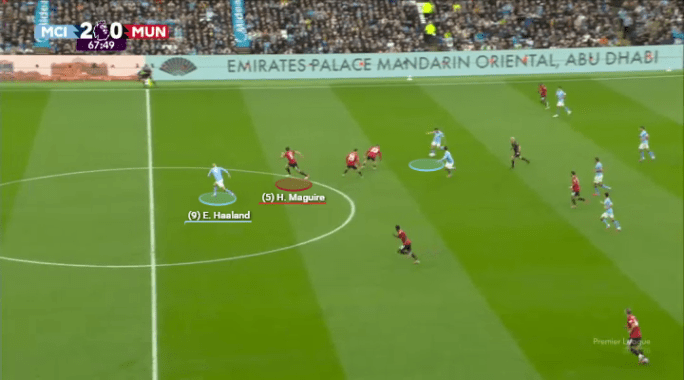
So while they’ve been great going the other way, they also need to ensure their rest-defense maintains the proper numbers and structures to defend.
Most of the goals they’ve conceded this season have either come from…
- Set-pieces
- Counter attacks
- Tiny spaces in between their defensive line
These are all fixable concerns for Amorim, especially as a better goalkeeper now enters the frame.
Embed from Getty Images
So with that, this is my optimistic take on Manchester United this season. Where do you think they will end up this time around? Be sure to share your thoughts and maybe, just maybe, look out for more Premier League content in the future! Thanks for reading and see you soon!
Discover more from TheMastermindSite
Subscribe to get the latest posts sent to your email.
 TheMastermindSite
2 thoughts on “Ruben Amorim – Manchester United – Tactical Analysis – 2025-26”