

I’ve long endeavoured to take my analysis over to the NWSL and the Women’s game in greater depth, and this season, I’ve finally managed to carve out the time to increase my NWSL coverage and league-wide game of eye-spy. Many aspects of the NWSL have struck me since increasing my bird’s eye view, but one particular peculiarity has captured my attention at this early stage of the 2022 season. In quite fantastic fashion, there is an abnormal representation of centre-halves on set-piece duties. Normally associated with banging in the goals from free kicks and corners, several NWSL teams instead have one of their centre-backs as a key taker of set-pieces. This begs the question we should always be asking in analysis – and that is…why?
Embed from Getty ImagesIn the men’s game, you rarely ever see centre-halves taking set-pieces. Sure, you get the odd frilly haired David Luiz banging one in from forty-yards, or even Eric Dier giving his best attempt at James Ward-Prowse magic (he can never quite live up to that strike in Euro 2016). But you rarely see centre-backs responsible for sending deliveries into the box from free kicks and corners. In fact, I can’t think of a single centre-back that I’ve seen repeatedly cross the ball into the box from either corner kicks or wide free kicks. While most modern day centre-backs possess some of the best long passing characteristics and accuracy in their teams, they also tend to possess dangerous strengths closer to goal that the same teams look to capitalize on from set-routines.
Embed from Getty ImagesThis may include a tremendous height, strength or physicality that can often be unrivalled elsewhere on the team. The vast majority are over 6’0, and tend to not only be capable in the air, but sound in timing their leaps to take advantage of their imposing frame. This then allows the Kevin de Bruyne‘s of the world to see out set-piece duties, rather than say Aymeric Laporte, who also happens to be an exceptional long passer of the ball.
In the women’s game, particularly in the NWSL, we are perhaps witnessing a shift away from pure defenders in the exclusively strong, physical imposing nature of the positional mold. More and more centre-back pairings include two exceptional passers of the ball, in large part due to the importance of playing out from the back and kickstarting attacks from deep. Most of the pairings in the NWSL involve two players who read the defensive side of the game exceptionally well, and still fulfill their defensive tasks to its truest form.
Embed from Getty ImagesBut unlike the men’s game, they are less likely to impose the same level of height and strength. Again, they instead tend to be sound ball-players, with the women’s game prioritizing building out from the back and the technical proficiencies of short passing. But as a result of being excellent ball-playing-defenders, they are also accustomed to hitting long passes over great distances. This is why many top-level NWSL centre-backs are also responsible for set-pieces. While they could contribute an aerial prowess and physical strength similar to an Aymeric Laporte, many of them also possess the ability to excellently deliver a pass from distance – which many set-pieces require.
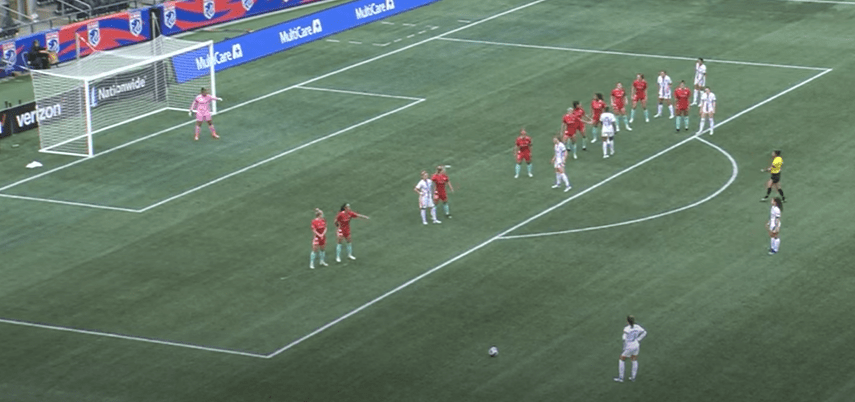
You then have players like Alex Loera (KC Current), Sam Staab (Washington Spirit), Lauren Barnes (OL Reign) and both of Orlando’s Carrie Lawrence and Toni Pressley delivering that quality, rather than positioning themselves to get on the end of moves. This is despite the fact that in each of those teams, you have a number of players who you would normally associate with providing that pizzazz and finesse from a dead-ball.
In other facets of the game, Washington embrace the creativity of Ashley Sanchez and Anna Heilferty. Reign boast Rose Lavelle, Jess Fishlock, and even Megan Rapinoe, all of whom have the stardom and ability to demand set-piece taking responsibilities. Orlando have the likes of Sydney Leroux and Jordyn Listro in their ranks, who more naturally spring to mind when thinking about assisting goals. But in all cases, those extraordinary flair players and creative passers either seek spots closer to goal and respond to the delivery, or lurk outside the edge and react to second balls.
Embed from Getty ImagesLike anything in life, there are both strengths and weaknesses to this tactical approach. The obvious danger, particularly from corner kicks, is that the centre-back in question then has a mountain to climb in racing back if the ball changes feet. When galloping up to get on the end of a set-piece, they at the very least remain within the same central channel as their orthodox positioning, and can (in theory) better respond to the verticality of an impending counter-attack. When taking corner kicks (although not necessarily wide free kicks), not only are they taken out of the equation, but they begin that process of transitioning to defense from a far less advantageous position. You can always position other players to sit deep and combat counter attacks, but defenders tend to be defenders for a reason. That is, you want those players to do the defending.
But that’s old school thinking, isn’t it? Because on the other end of the coin, if the likes of Sam Staab and Lauren Barnes clearly have the quality bursting through their boots to deliver the fashionable ball into the box – why not take advantage of their range and accuracy?
Embed from Getty ImagesIt’s an interesting premise, and one that will likely only continue to expand as the game evolves, and models of the modern day centre-back become more about keeping the game ticking and play-making from deep. None of the players mentioned above would rank among the best set-piece deliverers in the league, but they still hold an important role for their team. Nevertheless, this is a unique and noteworthy trend entering the women’s game and the NWSL, and one that we haven’t ever seen take centre-stage on the men’s side. But as positions and roles expand in the future and more ball-playing-centre-backs emerge from the shadows, we may see a similar shift in set-piece tactics on the men’s side the future.
So there it is! Why there’s an abnormal amount of centre-backs taking set-pieces in the NWSL. Be sure to check out more of our NWSL content, and follow on social media @desmondrhys and @mastermindsite to never miss an update. Thanks for reading and see you soon!
YOU MIGHT ALSO ENJOY…
Best Formations for 9v9 – Ebook
9v9 is one of the most exciting stages in the development of young players and can often be the first time they are truly able to understand positioning, formations and how to play to the strengths of their teammates. This Ebook gives coaches an opportunity to learn all the in’s and out’s of coaching 9v9,…


Pep Guardiola, Copy-Cats & Why Team Tactics Must Work for Your Players
The weirdest of the weird proclaim modern football to be boring, because every team endeavours to play the same way. High-possession, high-pressing, building out from the back, goalkeepers involved in the build-up, inverted this, inverted that, and some degree of positional rotation. The man credited for starting or popularizing many of these modernizations is Pep…

Game of Numbers #36 – Role Changes for Dejan Kulusevski & Konrad Laimer
One thing is for certain. Spurs have not been the same since injury to James Maddison. Spurs were flying high with no signs of slowing down at the start of the season. But injuries across the squad have since stunted their progress and made for a more difficult second half of the first half to…

Game of Numbers #35 – Anthony Gordon’s embodiment of the Newcastle way
Newcastle United have been defined in the Eddie Howe era by energy and intensity, including an all-out press, and fervid counter attacking immediately upon regaining possession. Anthony Gordon perfectly embodies the Newcastle way under Eddie Howe, and has been one of the surprise stars of the 2023-24 season. Many scoffed at Chelsea’s interest in the…
Discover more from TheMastermindSite
Subscribe to get the latest posts sent to your email.
 TheMastermindSite
8 thoughts on “Why there’s an abnormal amount of centre-backs taking set-pieces in the NWSL”