
Currently in the process of chasing down a fourth Premier League title under Pep Guardiola, Kevin de Bruyne has taken charge of Manchester City’s dominance in the last few months, rising above the rest as a completely untouchable figurehead in the team. Last night saw the Belgian score four goals in a single match, taking his tally up to 15 for the season – his most in a single Premier League campaign. With that, we break down the tactical elements of Kevin de Bruyne’s masterclass against a normally stern Wolves defense, and how the Belgian led his team to a smashing 5-1 victory.
IN POSSESSION
Embed from Getty ImagesIn Manchester City’s phases of possession, which lasted over 66% of the match, Kevin de Bruyne operated in and out of right-half-spaces to central corridors. He floated in between the lines of Wolves’ zonal marking system, which perfectly allowed the Belgian to receive in spaces that it made it difficult for Wolves’ midfield men to recover. As soon as he would pick up the ball in space, de Bruyne always looked to drive forward with the ball. He would then wait for the perfect moment to release a teammate in an advantageous position – with the perfect weight of pass.
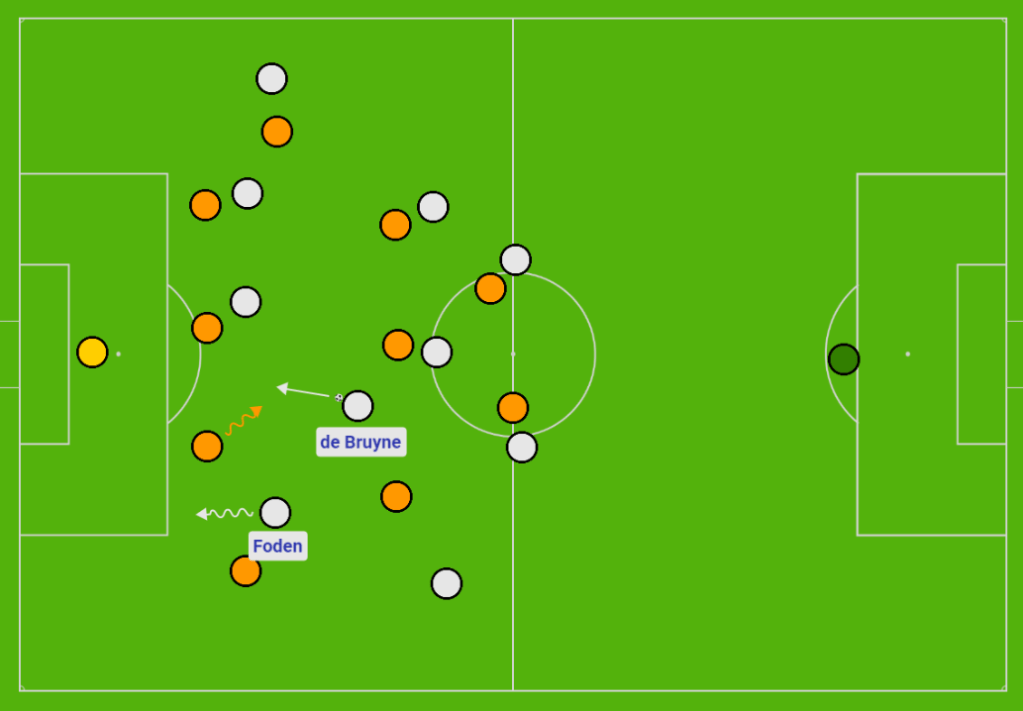
As wonderfully expected of a Manchester City player, de Bruyne also masterfully participated in City’s rotations, in their quest to unbalance Wolves’ defense. Wolves have put on a few defensive masterclasses under Bruno Lage this season, even earlier in the season in a narrow 1-0 defeat to the Citizens. But on this particular occasion, they left too much space for the likes of de Bruyne to receive in between the lines, and failed to adequately manage City’s rotations. As Foden drifted into left-half-spaces to pick up possession and take a defender with him, de Bruyne would instantly kick his sprint into high-gear to advance into the vacated central channel. Evidently a difficult dilemma for Wolves to sort out, as you never want to give Phil Foden time to turn and get his head up. But if the wing wizard doesn’t receive the ball, someone else will always be available to receive in City’s masterplan. That’s exactly what transpired for de Bruyne’s second goal of the game.
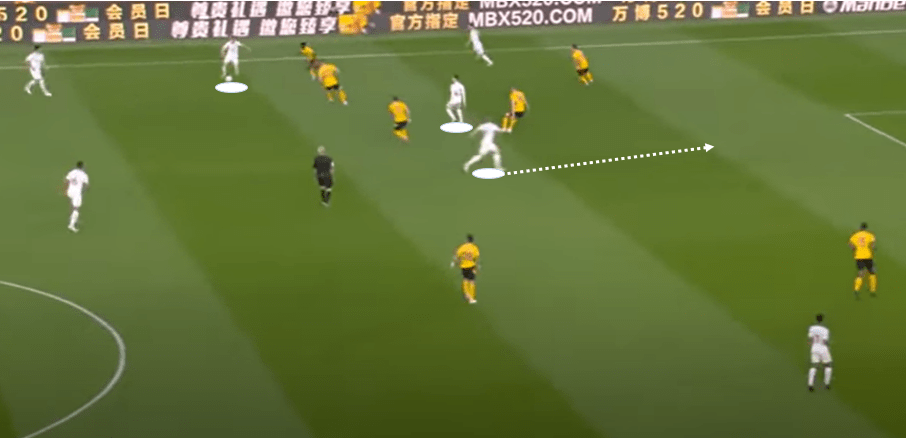
Foden shifted wide into an already congested area, attracting the attention of Conor Coady. De Bruyne could then easily sprint through the middle, and receive a pinpoint pass from Zinchenko through the centre to eventually score.
One of the Belgian’s most frequent positions on the night was actually that of the highest City player, as Foden and Bernardo drifted toward the ball and he floated up to the top of the attack. As City then progressed into the final third, de Bruyne would then move in front of Wolves’ low-block, receiving in space away from their midfield line. He could then pick the ball up in dangerous areas to thread the needle through the gaps, or switch play over to the right where Joao Cancelo and Raheem Sterling looked to isolate Wolves’ left-wing-back in 2v1 situations.
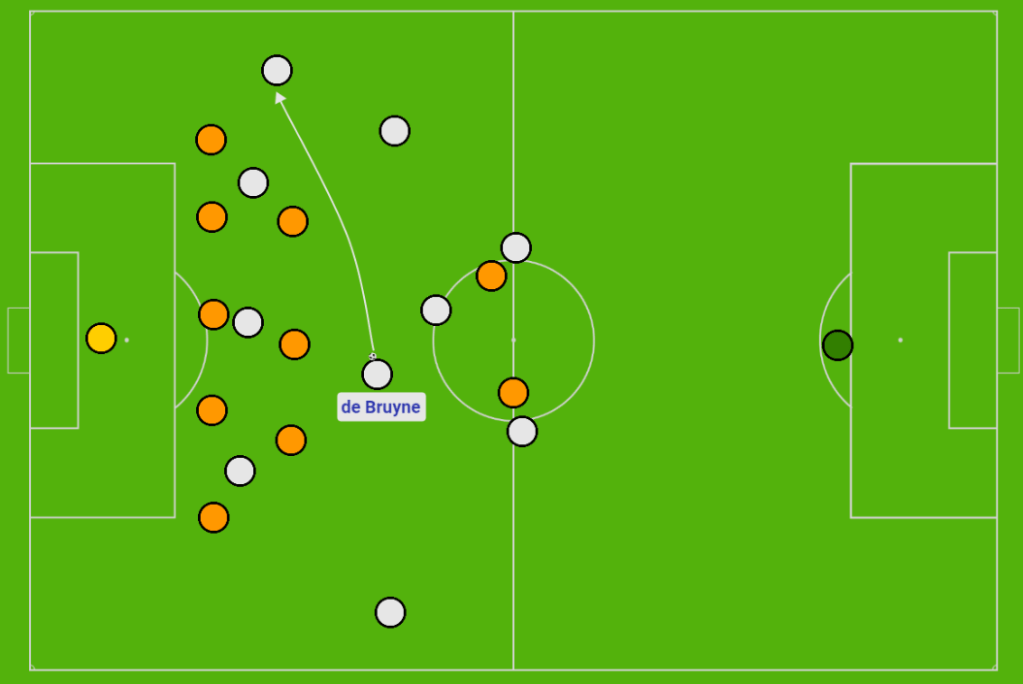
In other moments, as he recognized Sterling’s movement inside, the 30-year-old would drift wide right to receive passes, combining in one of his favourite areas of the pitch to receive the ball and drive forward. As he dropped deep to receive, de Bruyne could also use his magnificent long passing range to play passes over the top to Foden on the wide left. He completed five out of his eight long passing attempts on the day, helping his team completely break Wolves’ zonal press. Constantly scanning for where and when to adopt the exact right pocket of space to receive always allowed de Bruyne to be one step ahead of Wolves’ midfielders, as they often let him play behind their line of sight.
Often operating in these right-half-spaces, driving onto his left-foot became a prominent occurrence, and we all know the thunderbolt he possesses from range. This is how de Bruyne netted his hat-trick on the night, with a magnificent out to in run and thunderbolt strike on his left.
It is however worth noting how much De Bruyne favours his right foot in all other phases of the game, something that sometimes goes underreported in the discussions of his remarkable two-footedness. While he certainly has the quality to use both feet to equal effect, de Bruyne will often take touches across his body with his right-foot, even when receiving with an open body shape that would theoretically be best served for taking his first touch with his left. While he loves cutting onto that left-foot to let fly from range, the Belgian also loves to cut onto his right foot and deliver from wide of the eighteen yard-box, where he can whip dangerous balls into the box. His 88% right-footedness according to FBRef illustrates that effect, even despite his hat-trick of left-footed strikes in the match.
OUT OF POSSESSION
Embed from Getty ImagesOut of possession, KDB also played a crucial role in stopping passes from being played through the centre of the pitch toward game-tickers like Joao Moutinho and Ruben Neves. Wolves were often forced to play wide and down the touchline, due to City’s relentless and organized 4-2-3-1 press from the front.
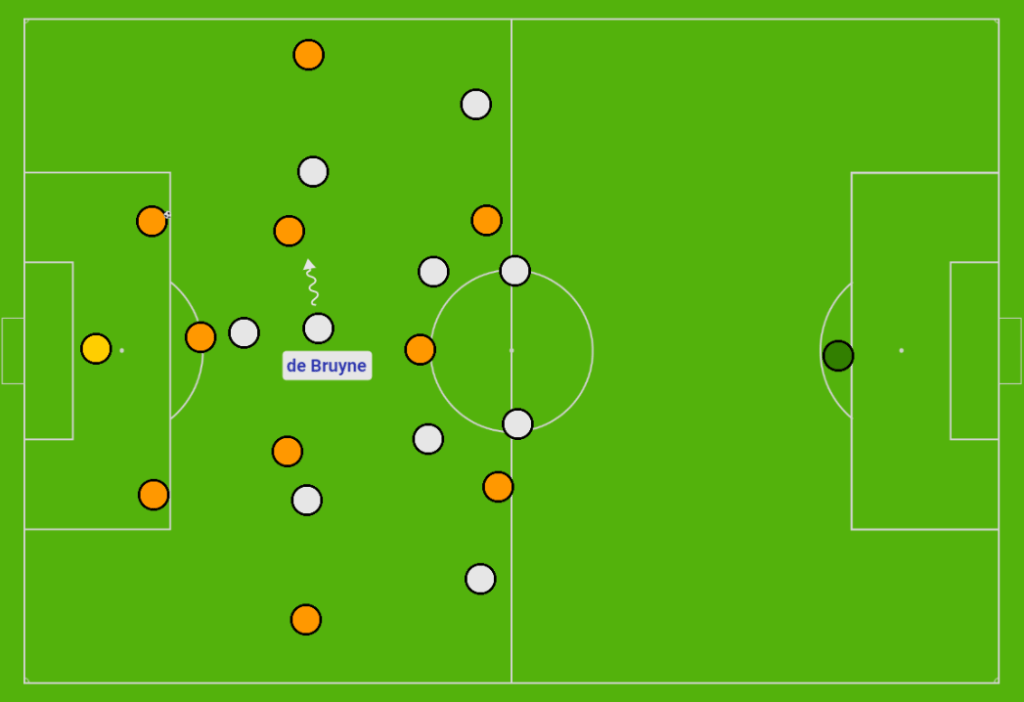
De Bruyne played the role of the ‘number 10’ in that pressing structure, with a slightly greater emphasis toward the right-half-spaces and Joao Moutinho, as Ilkay Gundogan prepared to step on Ruben Neves when necessary. While all of his brilliance in the final third will always take center-stage, we cannot forget the hard work de Bruyne put in out of possession in helping his side maintain their dominance.
Embed from Getty ImagesFinally, while Kevin de Bruyne is the star man of this Manchester City team, he understands moments where he can let others drive the bus forward. He doesn’t need to constantly be the one driving the team on, and can even pick up dangerous positions to bang in second chances as others do the hard work. But the vast majority of the time, Kevin de Bruyne is the one pulling the strings and making the magic happen. Wolves allowed the Belgian far too much space to grow into the game, and de Bruyne ended up scoring four goals as a result – one of his most formidable performances in a Manchester City shirt.
So there it is! Kevin de Bruyne’s masterclass of a performance against Wolves. Be sure to check out more Player Analyses, Tactical Analyses, and more on everything surrounding Manchester City at the moment. Also be sure to follow on social media @mastermindsite using the links below and consider becoming a subscriber. Thanks for reading and see you soon!
YOU MIGHT ALSO ENJOY…
Benjamin Šeško is United’s best striker in years
With four goals in his last five matches, Šeško earned himself the Premier League’s Player of the Month award for February. This, in just 85 minutes of making an impact off the bench. If he can continue to grow from here, the 22-year-old will almost certainly stake his claim as United’s best striker in years.


Michael Carrick has given Manchester United their joy back
At the time of Ruben Amorim’s shock sacking, Manchester United sat sixth in the table. There were signs of hope and progress, but also much in the way of disappointment and misalignment. Since Carrick entered the frame at Old Trafford, the Red Devils have won four in a row, closing the gap on City in…

Why Hugo Ekitiké has worked when so many big money signings have flopped
Every summer, Premier League clubs spend £80m–£100m chasing the next superstar forward. Every season, the league humbles them. But Hugo Ekitiké has been the exception. Ten goals, instant adaptation, and a playing style that personifies Liverpool’s identity. Here is why he’s worked when so many other big-money signings have stalled.
Casemiro is leaving, and United still can’t replace him
Casemiro’s been one of the best players in each of Carrick’s matches in charge. In fact, he’s been almost too good. Sunday’s match against Fulham exposed exactly what United will miss when he departs, and why he might be someone they simply can’t afford to lose, even if they must.
At home to Fulham, Casemiro…
Discover more from TheMastermindSite
Subscribe to get the latest posts sent to your email.
 TheMastermindSite
10 thoughts on “Kevin de Bruyne Masterclass vs. Wolves – Tactical Analysis”