

For the first time in club history, the Vancouver Whitecaps have won their first four opening matches of the MLS season. They continue be one of the standout sides in the league, playing an attractive brand of football along the way. Here is my match analysis of their win over FC Dallas, and how they dominated the Bulls from start to finish.
system of play: 4-3-3
Embed from Getty ImagesSo many teams have a distinct way of playing that they don’t ever abandon from, even if key players become injured. The common thought is to keep everything the same, but to just bring in new personnel.
To an extent, that’s what Vancouver have done since being struck by injuries to key players like Sam Adekugbe and Ryan Gauld. But what Jesper Sørensen did so brilliantly in their match against Dallas (and the mid-week fixture against Monterey) is keep the same style of play but change the side of the field in which they adopted each key approach.
They did this to match the players available for the situation and it worked so wonderfully well.
Embed from Getty ImagesThat included playing Pedro Vite as the inverted winger in the side down the right, while still getting the directness of Ali Ahmed down the other side. Mathias Laborda and Édier Ocampo also changed flanks, while the ball-carrying of J.C. Ngando dropped down to midfield to take Vite’s place.
Embed from Getty ImagesThey constructed the exact same team with the exact same style, yet switched the side of the field or role of each of these players to get the most out of their strengths. That’s a sign of a fantastic manager, I tell ya.
Within this approach, the two key connections were between Vite and Ocampo, and Laborda + Ali Ahmed.
Embed from Getty ImagesVite’s ball-carrying and supercharged mobility caused Dallas all kinds of problems, drawing five fouls. Dallas literally could not do anything else except take him down time and time again. They just couldn’t get a hold of him.
Embed from Getty ImagesAnd whenever he found space to attack or the Caps advanced the ball into the final third, that’s where Ocampo surged down the right wing to cross the ball into the box.
Unfortunately for the Caps, the Colombian couldn’t find a Whitecaps body with any of his seven crosses. But he threatened all evening long.
I’ll dissect Ocampo’s crossing choices in the next section, but first it’s important to note how that style of play again worked to bring out the best in the players down the left too.
Embed from Getty ImagesInstead of overlapping like the 21-year-old, Laborda would often make underlapping runs on Ali Ahmed’s side. Laborda’s movement forward is always meticulously planned, since he’s generally a useful part of the side’s 2+3 rest-defense – sitting in front of the centre-backs with the two more defensive central midfielders.
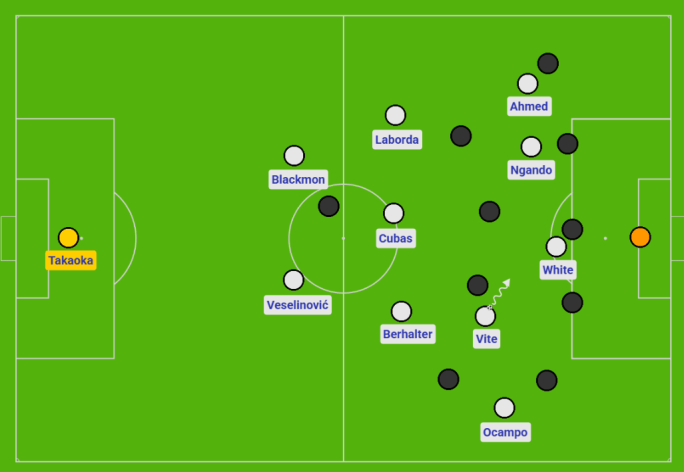
But when he gets forward, it always causes headaches. He made some fantastic underlapping runs on the day, and with more time together, that connection between himself and Ahmed will start to pay dividends.
So if the Whitecaps’ attack was so well-planned, why did they only score one goal? Ultimately it comes down to decision making in the final third, which will inevitably improve as players develop greater understanding of one another, and with greater perceptions of what I call BOTS.
DECISIONS IN THE FINAL THIRD
Embed from Getty ImagesSince so much of the Whitecaps’ attack came down the wings, this is where we inevitably have to focus the attention. & Since Vite played mostly in the half-spaces à la Ryan Gauld, the key decisions were often made by either Ali Ahmed or Édier Ocampo – responsible for playing that final pass or final decision before the potential finish.
But as mentioned, none of Ocampo’s seven crosses found a teammate.
While sometimes it looked like he was just firing the ball into the penalty area to create a dangerous situation, you can’t really fault the Colombian’s technique for this. Instead, it comes down more to tactical decision making.
Embed from Getty ImagesAs a performance analyst, I’d be working with Ocampo to break down these crossing moments and uncover ways to increase the likelihood of one of his crosses coming off in a shot or goal (raise his xG). So let’s do exactly that.
The Colombian’s first of the night was the most underwhelming. From a deep position, Ocampo made the decision to cross into the box just a few moments after receiving.
None of his teammates were in the penalty area, and they were surrounded by men in numbers (3v2). The only way an early cross works here is if it’s sent flying high and wide to Ahmed. But even then, the ball’s travel time through the air would simply be too great, allowing the Dallas defenders to react and recover position.
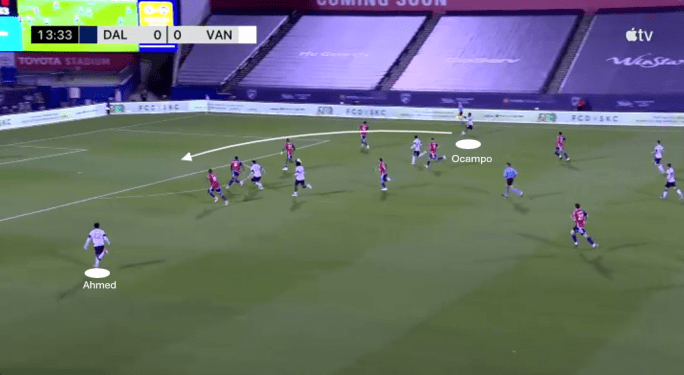
Instead, Ocampo can back his immense speed and skill, work to take that player on 1v1 and get closer to goal before delivering. Shifting the ball closer to goal would allow more time for White and Ngando to lose their markers, and for someone like Berhalter to come forward for a delivery from the half-spaces.
This isn’t to say that wide players should never cross the ball from deep positions, or shortly after receiving. There may be times where a deep and early cross (like counter attacks) works like a charm. But they are less likely to come off when the defense is well set-up to defend.
On this next occasion, Ocampo times that cross perfectly.
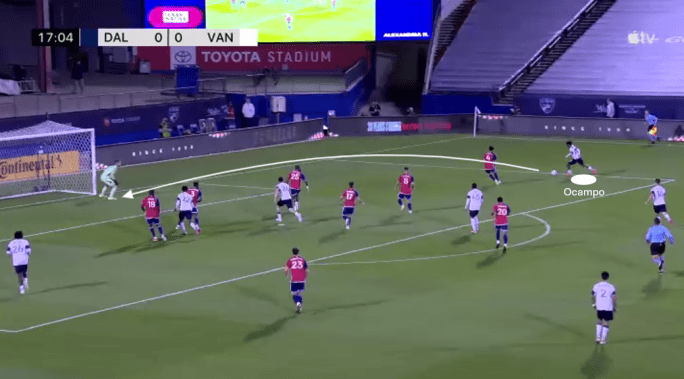
In this example, Ocampo’s first touch is great and he delivers a dangerous ball. It’s massively overhit and he should have whipped one slightly lower and slower rather than smashing it across goal. This one is more down to technique.
But in this one, he also has an equally good option the moment he receives, which is to play Berhalter in the half-spaces for a higher xA cross, where the refined midfielder can deliver a peach of a pass to Ngando at the back-post.
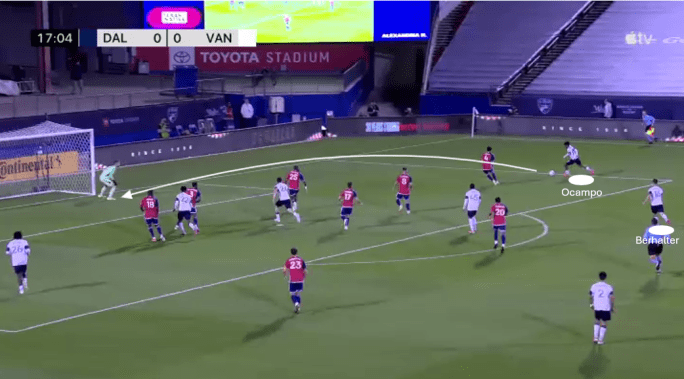
He made a great decision nonetheless and just slightly fails in execution.
On many of his other crosses across the evening, I actually wonder if he’s thinking too much of Brian White as the target he must find. He’s often crossing from unideal positions when he could still take his man on and get closer to goal, rather than delivering to White in a 3v1 situation. In these moments, he needs to scan for how his teammates are situated in relation to the opposition.

If endeavouring to play an early cross here, Ahmed again remains in the best position to receive his pass (thus automatically generating a higher likelihood that it’s a useful action).
Unfortunately, this trend continued as the night wore on. Had Ocampo fizzed this one below across goal like that stellar second cross we highlighted, this could have been the opener of the evening.
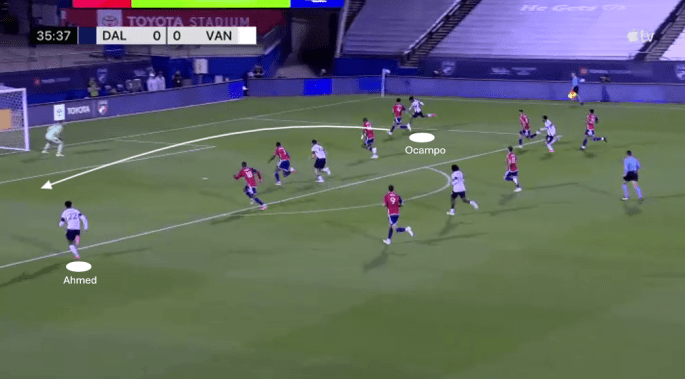
But, surrounded by opposition players, White again became the key target.
This is something Ocampo can improve as he works on his scanning – studying the opposition in relation to where his teammates are and how the space will allow for them to receive or not.
Either way, his tenacity to constantly get into the great attacking positions deserves to be commended. As he continues to develop his decision making in the final third and match that with the technique of getting exactly the right weight, the Colombian will be an incredibly dangerous player for the Whitecaps this season.
Embed from Getty ImagesThen when it comes to the movement down the other side, Laborda could only get forward in a few rare moments. But on those few occasions, it caused Dallas all sorts of problems.
Ahmed’s right-footed tendencies down the left didn’t exactly compliment Laborda’s movement forward in the half-spaces, and it also became predictable for the Dallas defenders. But the two men still had a few brilliant moments of connectivity that could have troubled the Bulls.
I love this run in particular from Laborda, where Vite plays a beautiful ball over the top and Laborda just lightly caresses the ball back across goal for a tap-in (if only someone could have tapped it in!).

Laborda’s runs all evening were supremely timed and he often just needed his teammates like Ahmed to better spot him.
You can’t see it in the frame, but here is Brian White being surrounded by four defenders (he’s not as open as he looks). It’s not the time to play the cross into him, no matter how great he is at heading the ball. Instead, check out Laborda’s positioning.
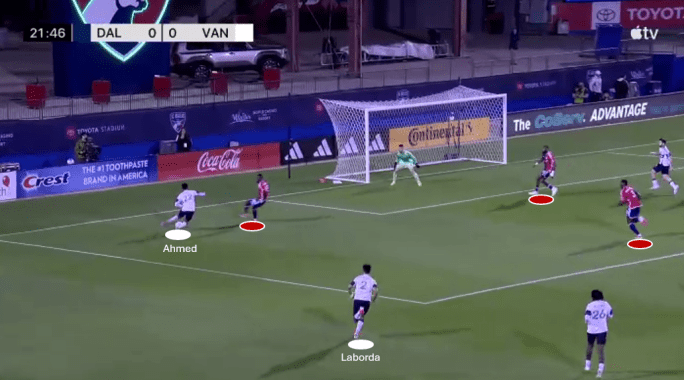
If the Uruguayan receives the ball here, he can get a shot off with a much higher likelihood of finding the back of the net (statistically – a higher xG) than the cross Ahmed produced.
When working with wide players often delivering a lot of crosses or passes into the penalty area, I help them understand better pass selection to increase their xA (expected assists – the likelihood that their decision will result in fruit for their team).
High xA crosses include cut-backs to late advancing runners, crosses closer to goal (for example if you can take on your man 1v1 before delivering an early cross), and crosses from the half-spaces.
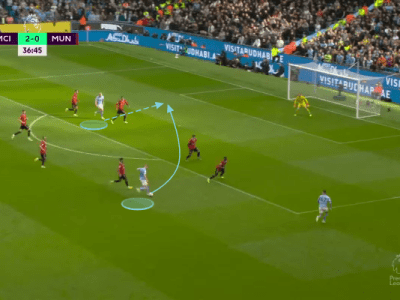
The half-spaces as a key chance creation channel
It has long been hypothesized that ‘Zone 14’ is the holy grail of chance creation. The ideas around this concept were built around a study from the late 1990s that specified that successful teams had a higher frequency of getting into this zone when compared against their peers. Since opposition clubs often compact central channels…

A perfect example of this is what we actually saw with J.C. Ngando’s brilliant cross into the penalty area for Tristan Blackmon, where the Caps defender was able to burst onto the ball and head it home. With this whipping ball coming in from the half-spaces, it’s more difficult for the keeper to catch.

Combine that with it coming from a corner kick situation (i.e. with so many bodies in the box), the keeper literally can’t come out to catch the ball. That gives someone like Blackmon all the time in the world to see the ball coming in and time his jump.
Since Ocampo is playing that overlapping role around an inverted winger, we may see less opportunities for him to cross from the half-spaces. But we may see more opportunities for him to combine with his winger (like Ahmed, Vite or Nelson) for them to deliver the whipping cross from the half-space instead.
Again, it’s so easy for any coach in the world to look at the crossing numbers of Ocampo (0/7) and go “we need to work on crossing.” But it’s not the crossing that’s the issue. Nor is it Ocampo’s technique. It’s simply about understanding when a cross is more likely to result in a goal, and how to better scan for the ball, opposition, teammates and space.
Now there’s another important consideration to this equation, which is how all of this leaves the Caps in transition, and how they can continue to mitigate the issues that arise when their full-backs get caught up the field.
DEFENSIVE TRANSITIONS
Embed from Getty ImagesFor his crossing woes, Ocampo had a brilliant match against Dallas, and much of that came from his defensive presence – particularly his speed and awareness to get back in transition.
In the build-up, the Caps create that 3+2 shape that pushes a wing-back like Ocampo higher in the attacking phase.
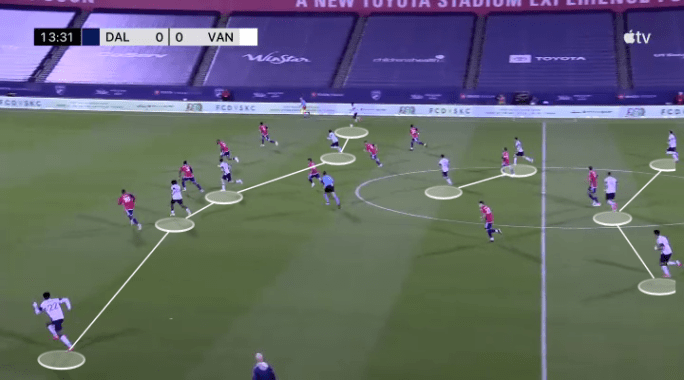
But get this wrong, and that then becomes the side that a team like Dallas can exploit in transition. The Caps almost suffered from this fate in the second-half when they lost the ball in their build-up.

Similarly, on one of the occasions that Laborda got himself high on the underlap, Dallas were able to attack the other way.
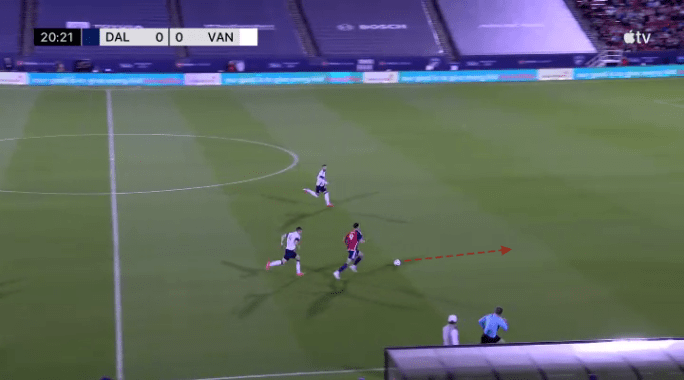
The Whitecaps have been so stellar in transition that they’ve always managed to handle the situation, and on this occasion, it was Tristan Blackmon who held off Petar Musa.
Embed from Getty ImagesEarlier this season, it was Ranko Veselinović who put together one of the best last-man tackles I’ve seen.
Embed from Getty ImagesBut it’s still something they’ll have to meticulously keep an eye on.
One crucial component to that ability in transition will be the positioning and awareness of their Paraguayan designated player – the small but mighty Andrés Cubas.
Cubas masterfully screened Musa all match, but also made his mark in transition. Fear filled my eyes when I saw the rapid pace of Bernard Kamungo on the break here.

But then the frame changed, and suddenly Cubas and Ocampo were there.
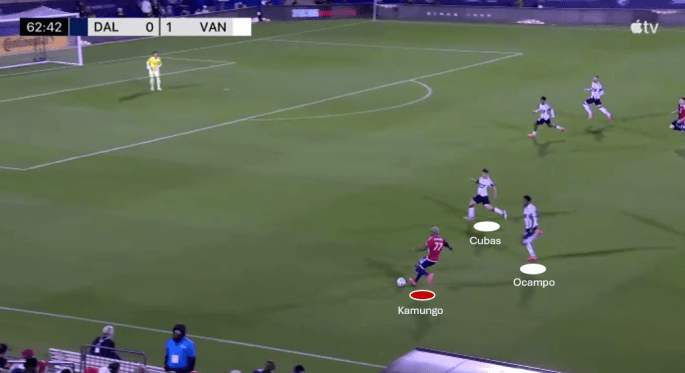
We already know Ocampo’s pace from the way he attacks with such brute force. But Cubas’ ability to get back in this moment demonstrated not only a fantastic sense of awareness, but some underlying physical attributes worth noting too.
Embed from Getty ImagesAnd this was just one example of many.
Cubas wonderfully dropped back whenever one of the centre-backs went forward (in this match Ranko Veselinović more often).
He also slowed every counter attack through his positional sense and sideways shuffling, even if he didn’t have to make that killer tackle himself. I love the example below where he positions himself in between the two centre-backs, cutting off any potential route forward, while also shepherding the striker away through his low stance body position.

It’s those simple off the ball actions that so often go unnoticed but are so critical.
Combine Cubas’ awareness with the composure of the centre-backs on every Dallas counter, and the Caps just made themselves impenetrable on this particular evening.
Embed from Getty ImagesSørensen’s side have conceded just 2 goals in their opening 4 MLS matches, a super stout record that bodes well for what’s to come. But it will be something that they need to sure up in future matches.
As far as this one goes though, they were absolutely commanding in their performance, despite the narrow scoreline. I’ve barely mentioned how stellar Sebastian Berhalter played in possession, White’s immense physical presence up top, or J.C. Ngando’s ‘X factor like’ presence in the final third where he always looks dangerous. This Whitecaps side is going to be tough to beat this season, especially if they can avoid further injuries to their list.
Embed from Getty ImagesIn the meantime, I’ll be looking forward to their next match against the solid Chicago, to see if they can continue this insane league-leading run. Thanks for reading and see you soon!
Discover more from TheMastermindSite
Subscribe to get the latest posts sent to your email.
 TheMastermindSite