

Thomas Frank’s Bees are attacking their third season in the Premier League and despite the common pre-season misperception that they would be scrambling for survival, Brentford are again defying expectations. Six points in six games doesn’t do their performances justice, having lost just twice so far. They may not be the most beautiful possession-based side in the world but the marginal gains targeted by Frank and his staff is why their overall game far exceeds the majority of English competitors. There may just be another top half finish in store for the Bees. Here is our 2023-24 analysis of Brentford under Thomas Frank, brought to you by Charlie Ellis.
System of play: 4-3-3
Embed from Getty ImagesOver the past few years, Frank has solidified his decision to play four at the back, despite the occasional diversion towards a 3-5-2. As typical of a starting formation, this change tends to be the defensive shape as they try to counteract their opposition.
Embed from Getty ImagesBut in possession, the shape is similar in either system. Maintaining the width and depth is always essential because the Bees play a direct, vertical approach to catch the Premier League’s elite defences off-guard and maximize the space in behind the final line.
Embed from Getty ImagesAs for personnel, we begin with Brentford’s new goalkeeper, Mark Flekken. Perhaps not as finely tuned as £30 million man, David Raya, but Flekken still distributes the ball nicely, with a good understanding of when to play out from the back and when to send it long. Occasionally, he gets caught on the ball and doesn’t sweep as supremely, but all in all, he’s a strong base for Brentford to build upon.
Embed from Getty ImagesImportantly, the Bees possess a vast selection of top quality centre backs, including the destructive duelling of Ethan Pinnock, Ben Mee’s invaluable leadership, Nathan Collins’ excellent ball-playing abilities and Kristoffer Ajer’s versatility to play across the back-line. In essence, all four carry a multitude of similar strengths but those listed above make each stand out amongst one another.
Embed from Getty ImagesFrank’s strong base allows the rampaging Rico Henry to advance into left winger positions, with the safety of strong defenders on the cover. Aaron Hickey plays a more balanced role from the right and has been vital in both attacking and defensive displays thus far. Mads Roerslev deputises swimmingly when either require a rest, and will now be relied upon more after Henry’s recent major injury.
The pivot allowing all other moving parts to thrive though is Christian Nørgaard. A defensive warrior, never afraid of making a tackle and fulfilling his team’s defensive needs by making the most tackles + interceptions per 90 (5.0). Additionally, his intelligent positional sense makes him a valuable pivot to build around.
Embed from Getty ImagesIn the two ‘#8’ roles either side of Nørgaard, the Bees have another Dane, Mathias Jensen. He provides a technical passing proficiency unseen elsewhere at the club, making him even more valuable for set pieces. Their German counterpart, Vitaly Janelt, is less technically dominant and thrives more with his off-the-ball movement to facilitate his teammates, dragging defenders to create space.
Embed from Getty ImagesImportantly, Thomas Frank’s midfield epitomizes the team’s collective understanding and versatility, enabling the West London side to rotate their positioning within games more often. They also have different options in Frank Onyeka, Mikkel Damsgaard and Josh Dasilva, all capable of putting in a shift where necessary. Moving into attack, Frank’s favoured trio has been Kevin Schade and Bryan Mbeumo on the left and right wing, with Yoane Wissa leading the line.
Embed from Getty ImagesNo Ivan Toney, of course, but the Bees have performed admirably in his absence, despite the loss of their talismanic centre forward. Wissa has played as a ‘Creative Link’ within his deep-lying facilitations, drifting between the lines to receive long passes and initiate neat lay-offs.
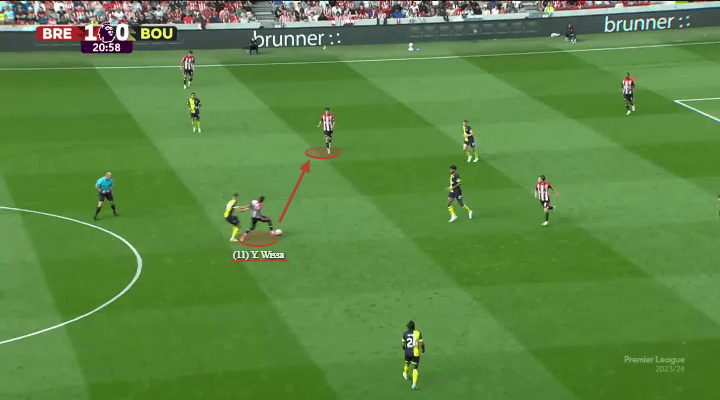
This suits the channel running of both Schade and Bryan Mbeumo. Schade might possess more technical control in tight spaces, allowing him to maneuver tougher situations brilliantly, but the speed and directness of Mbeumo, alongside his cohesion with the rest of the team and devastating end product makes him the Bees’ most valuable asset. He drives the attack forward in most transitions, and despite doing much of the same role he provided last season, he has scored 4 of Brentford’s 8 league goals so far, highlighting the extra responsibility he’s taken on.
Embed from Getty ImagesIn a system so devoted to hard-work and understanding of each other, mixed with the flexibility to adapt to the demands of their opponent, the Bees stand out for their defensive energy and compactness. With that, we start with the team’s defensive principles.
Defensive Principles
Embed from Getty ImagesThomas Frank can alter his team’s set-up depending on who they are facing and this becomes evident in his decision making between playing a 4-5-1 or 5-3-2 in the team’s own half. In turn, this changes who is responsible for keeping an eye on the opposition’s widest players, the wingers or wing-backs.

Brentford’s intensity is key in every area they defend. Beginning with the high-press, they play man-oriented from the front, aiming to scupper the opposition’s early build-up. This is fulfilled to strong success, shown by their fifth best PPDA of 9.02, signifying that when Brentford do press, they don’t allow the opposition to string together extensive passing sequences. As well, the Bees efficiently crowd the ball in their counter-press, leading to quick turnovers.
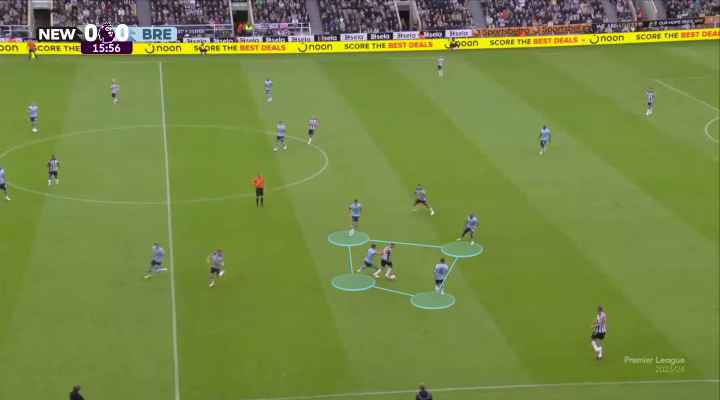
In terms of who presses where from the front, the Bees’ excellent cohesion within the squad means the nearest player can take on the pressing role closest to them. Being man-oriented across the pitch, the roles are generally similar, so long as Pinnock is in a position to attack the long balls with his head. The Jamaican leads the Premier League in aerial duels won (22), at an astonishing 84.6% success rate. Being such a smart and physical side, Brentford often get to the second balls first, as the players move into close proximity to set themselves up on the counter-attack.
When in a sustained defensive phase, the Bees move into their compact defensive structure in their own half, most commonly the 4-5-1. Despite moving into a deeper zonal block, the pressing from the midfielders remains very intense, constantly hounding the ball out of the middle of the pitch, reducing the space by crowding any ball receiver quickly.
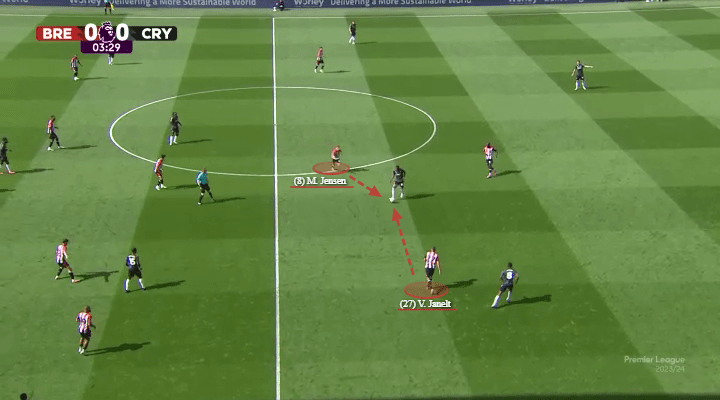
The full-backs also press aggressively in wide areas to halt forward progressions. Thanks to the excellent energy in the midfield, any gaps left in the back line by the defense squeezing wide can be filled. Nørgaard is excellent at covering spaces and adjusting his position to close the gaps.
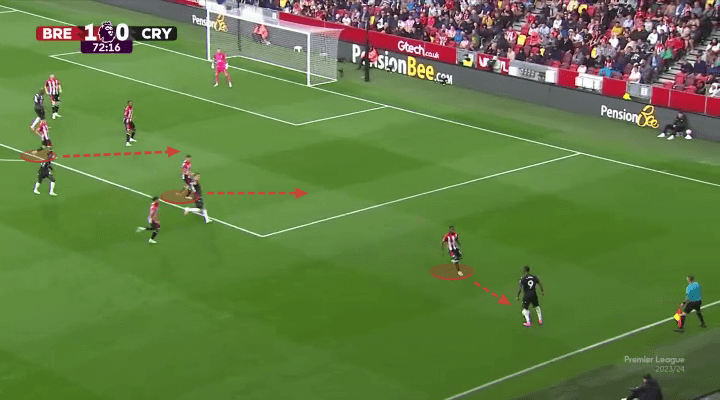
By sitting deeper and compacting the spaces so well, they force their opponents into lower quality shots. This system forces more shots from range as shown by their opposition averaging the joint-lowest xG/shot of 0.08 and the 2nd furthest distance from goal (18.6m), something that’s carried over from last season. But that’s not all, there are also unique offensive strengths that make Brentford such an effective side despite their lesser resources.
Attacking Principles
Embed from Getty ImagesBrentford are known for their grit on the break, set-piece superiority and ability to claim surprise goals against even the best in the division.
Since Brentford often prefer to attract pressure onto them and counter at speed, attacking transitions become essential to the equation. It also means that they are constantly looking for the spaces in behind the opposition’s defense. As one example, they’ve complete the fourth most long passes this season, only behind Arsenal, Brighton and Man City, who have substantially higher possession.
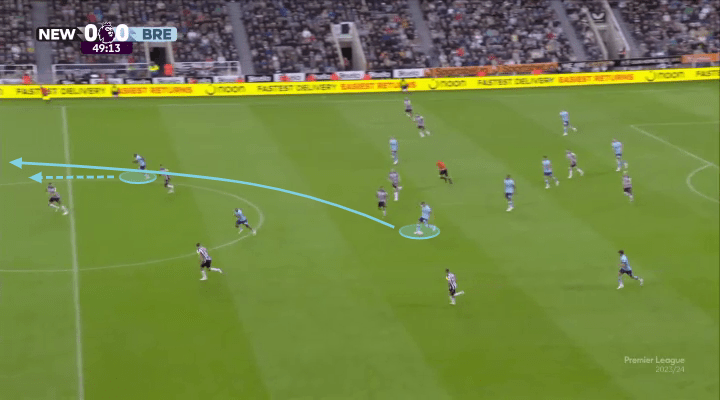
This is where not having the most technical squad in the league doesn’t matter, as they utilise their physical strengths like pace and power to attack the channels quickly. But although they mainly target transitions, it’s not unusual for the Bees to build the play with short passes from the back.
A 3+3 early buildup, utilizing Flekken as the third centre back and keeping the full-backs wide with Nørgaard as the pivot is their most common set-up. Jensen can drop in alongside Nørgaard, to create a further overload. But an important distinction for Brentord is that they are not afraid to go long if the opposition’s press is too much. It might not be option number one, but finding Wissa to hold-up the play and initiate a direct attack is not too bad an alternative.
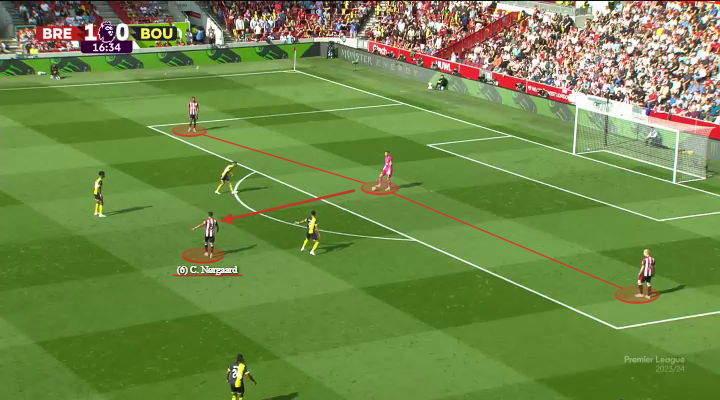
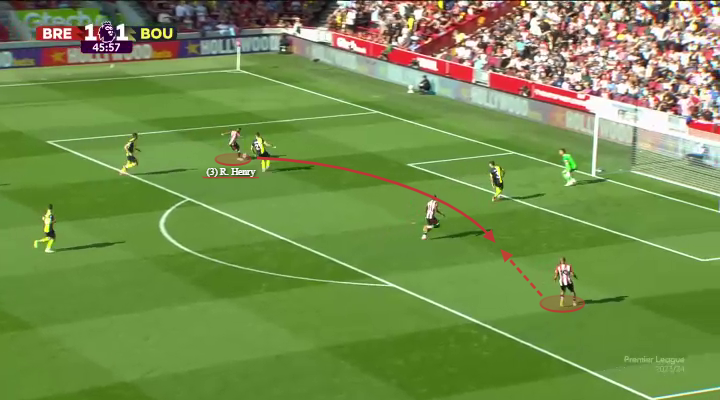
Playing a 2-3-2-3 shape as they enter the opposition’s half, the rotating side triangles are essential to maintaining unpredictability in chance creation. The fluid movement on the left side is crucial with Rico Henry such an avid voyager up the flank. These triangles also help to create wide overloads, freeing up Henry on the overlap to cross into the box.
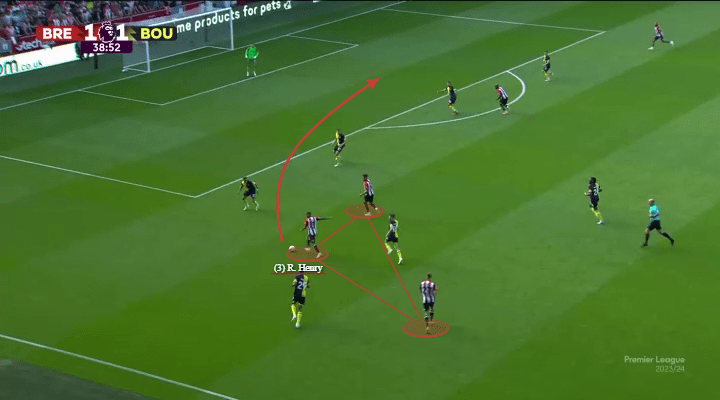
Jensen neatly takes up the left back position vacated by Henry, suiting his long passing instincts, whilst Schade’s tidy control in tight spaces makes him a worthwhile asset moving to the inside left.
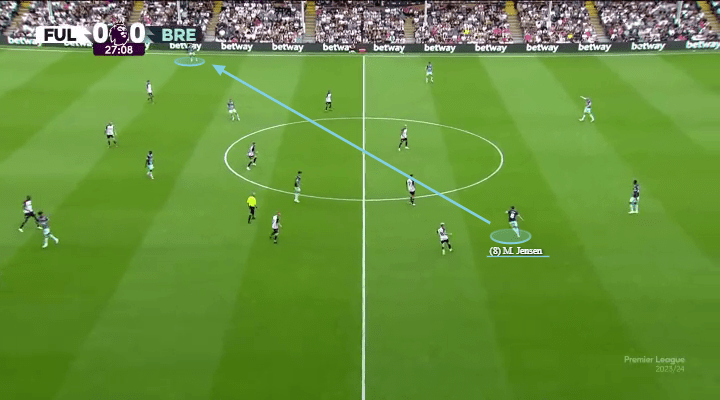
In spite of the fast transitions, clever rotations and effective overloads, Brentford can struggle to progress the ball with short passing combinations. Instead of breaking one line at a time, they often require a centre back to break all three and right now, breaking down a low-block is an area that they are not comfortable. There are glimpses of encouraging link-up in the centre of the pitch, particularly since Jensen, Nørgaard and Janelt understand one another well. However, sometimes the distances become not only too big, but too static and predictable.

Towards the end of the loss to Newcastle, they moved to a 3-2-5 to try and salvage a point, with five natural forwards on the pitch. But being 1-0 down, this was forced upon them and it would require some time to iron out the teething issues before it became a strong resolution to breaking down lower blocks.
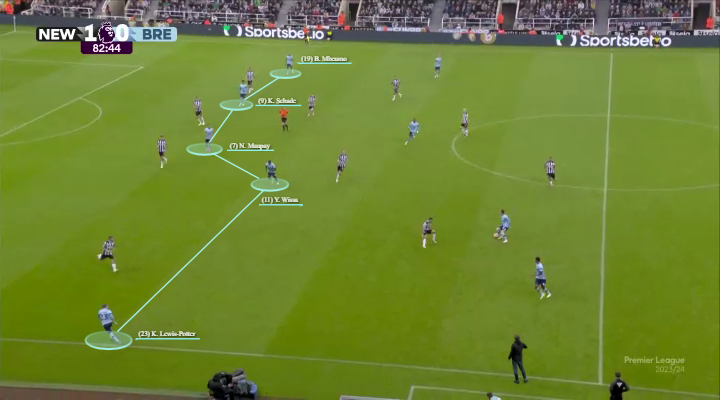
Their flexibility should still be commended, a team that is always adapting to the conditions of the game. That’s not to say Frank won’t try to suit the individual strengths within the team. For example, the more confident ball carriers like Mbeumo, Wissa, Henry and Schade have license to showcase their necessary dribbling abilities.
Embed from Getty ImagesBut it’s the ingenuity that has caused Brentford to sit fifth in xG per game so far this season. This is particularly evident during set pieces, where they have created the most shots (5.2 per 90) and xG (0.62 per 90) .
ATTACKING Set-Pieces
Embed from Getty ImagesBrentford catch the eye not only for their principles in open play, but their ability to dominate set-pieces.
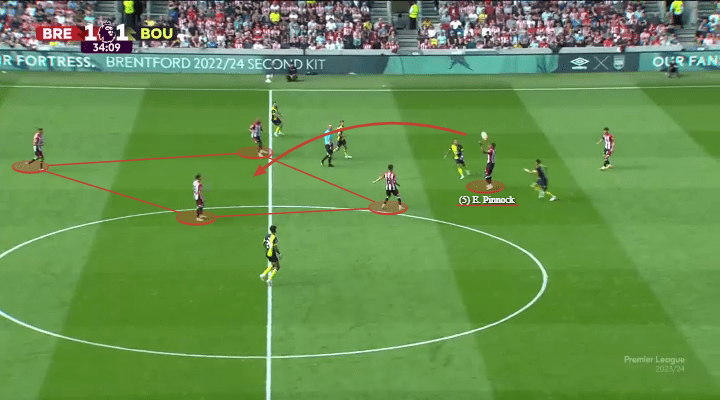
Enter Mathias Jensen, as clean and crafty as he is in open play, he brings value to the Brentford team by being excellent at whipping in corners, free-kicks, and even 20-25 yard throw-ins. His throws often get far enough to enable a flick on to the back post.
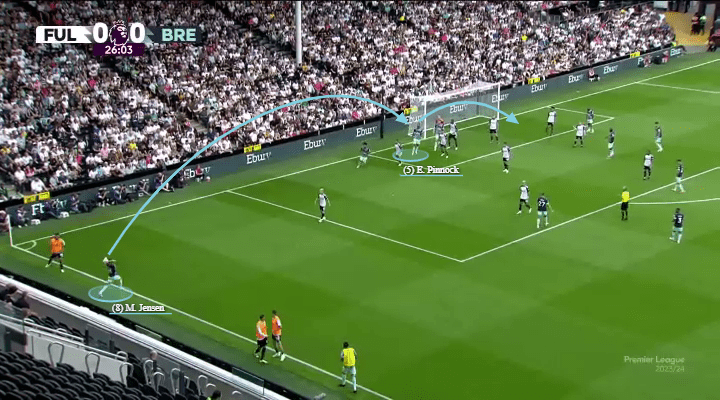
Now these are strong foundations, but Jensen is no James Ward-Prowse. Thomas Frank has built this set-play success from elaborate set-ups to attack the box and create space for his team’s ‘big hitters’ like Ethan Pinnock and Ben Mee. One of many examples of Frank’s ingenious is encouraging his players to cause confusion inside the box. They will often start hovered around one post, and immediately rush backwards to the other.
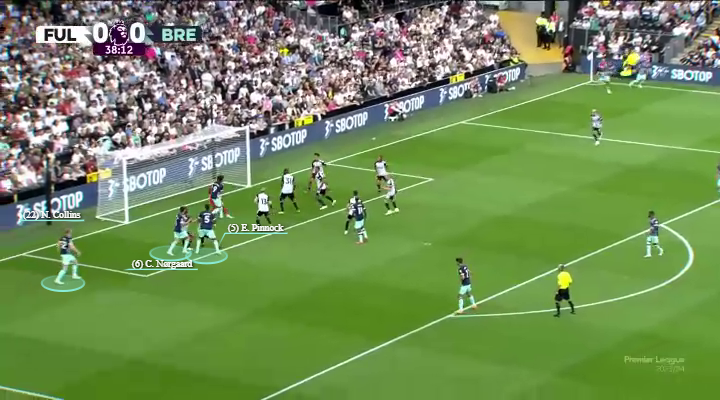
They love to clutter their players together as they prepare the set-piece, then disperse to designated positions once it’s taken. This avoids man-markers tracking them closely. Against Newcastle, they repeatedly overloaded the far-post before sending four players to attack the near post, where the defenders were caught flat-footed.
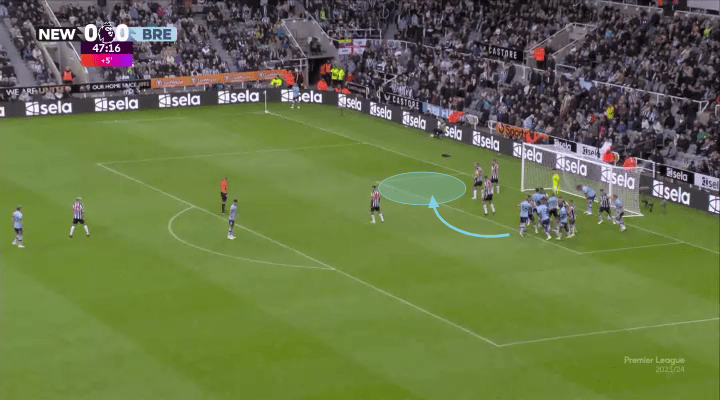
To break offside traps when attacking free kicks, the Bees position players at either end of the opposition’s zonal line, to allow for headers across the box. Those second-phase finishers don’t need to worry about offsides on the first kick so they can gain a few yards on the defense before the vital moment.
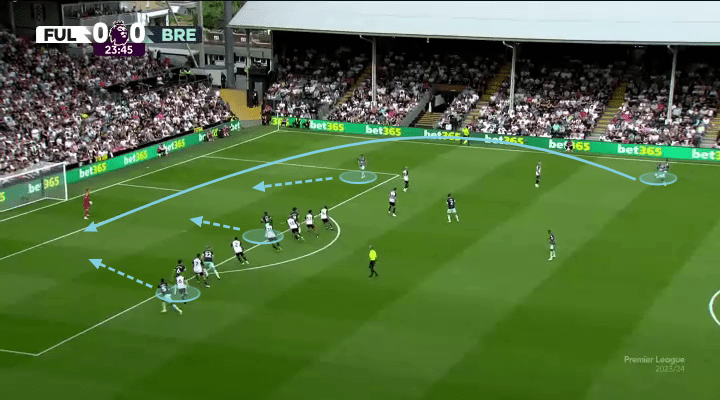
These are all resourceful ways that Brentford look to score and helpfully encapsulate Thomas Frank’s attention to detail, a key facet of his side forging results in the Premier League.
Conclusion
Embed from Getty ImagesAlthough there hasn’t been too much change to Thomas Frank’s tactical structure this season, losing his star striker and failing to make a marquee signing towards the end of the transfer window has required some improvisation. He and the squad have done this magnificently with some of the most hard-working characters in the Premier League that will help them grind out results when they need it most. Their quest for European football leads on and having only missed out by 2 points last season, who knows what magic Brentford can drum up this year!
YOU MIGHT ALSO ENJOY…

Picking the 2025-26 Premier League Team of the Season
Every time you open social media and listen to the noise of the 2025-26 Premier League season, you will often hear cries of “worst season ever.” Even Arne Slot called the league “boring”. I beg to differ. This feels like a season that will come down to the final day, and still have plenty to…


Tottenham win the award: Most disastrous season in Premier League history
With one of the highest wage bills in the league, if Tottenham succumb to relegation, this will be one of the most disastrous seasons of any top-flight side.

Picking England’s 2026 World Cup Squad
The World Cup is just a few months away, and Thomas Tuchel already seems to have a clear idea of both his squad and how he wants England to play. His teams are built on energy, physicality, and discipline — players who stick to their roles and execute a system, rather than drift and freelance.
…
Discover more from TheMastermindSite
Subscribe to get the latest posts sent to your email.
 TheMastermindSite
3 thoughts on “Thomas Frank – Brentford – Tactical Analysis (2023-24)”