

Much has been made this summer about Real Madrid’s lack of a natural Karim Benzema replacement up front, and the downgrade of Joselu entering that position for Los Blancos instead. But sometimes, you don’t need to replace a player in the transfer market with a like-for-like switch. Sometimes, all you need to do is tweak the shape of the team. This is what Real Madrid have done in finding a solution for their Benzema dilemma. In the process, they’ve also presented a solution to the conundrum regarding how to fit all their fantastic pieces in midfield together.
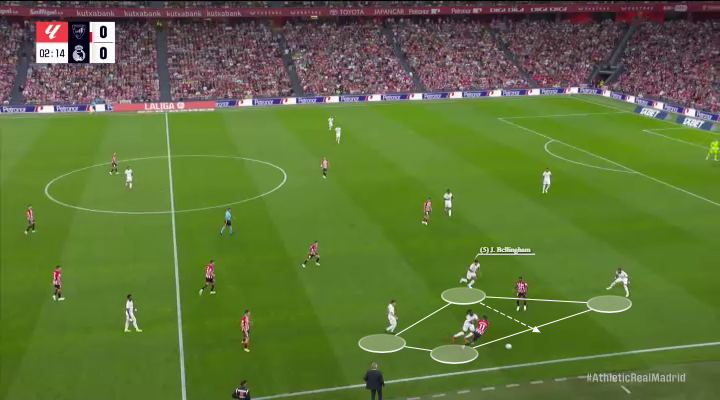
Ancelotti’s team were far and away the better side in their opener against Athletic Bilbao, playing a 4-4-2 diamond with Jude Bellingham at the tip of the shape. Here is what the Englishman offers in the role, and why it could be a great position for him this season.
JUDE BELLINGHAM AS THE ’10’
Embed from Getty ImagesBellingham primarily played as an ‘8’ for Borussia Dortmund on the right-side of either a 4-2-3-1 or 4-1-4-1. He played as a ’10’ on occasion for the Black & Yellows, but managers typically preferred to have his powerful ball carrying as an asset deeper on the field.
However, there are many advantages to playing the 20-year-old as an attacking midfielder, especially for a club like Real Madrid that already have so many capable #8’s. First and foremost, it harnesses his fantastic ability to press from the front. Bellingham’s energy can be quite intimidating, and as the name suggests, a 4-4-2 diamond already supports optimal creation of diamonds in pressing phases.
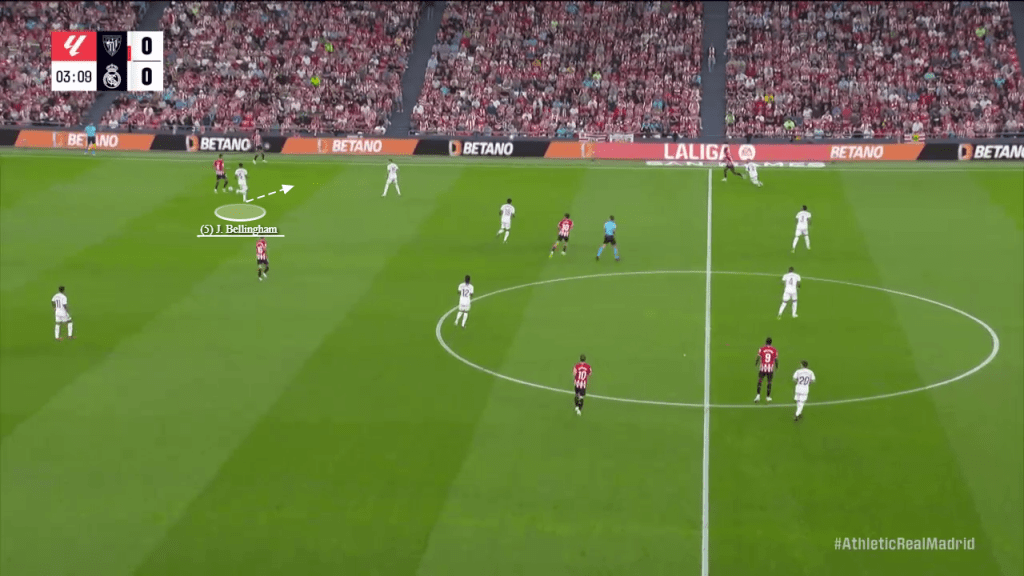
This naturally puts less emphasis on players like Vinicius or Rodrygo to have much in the way of defending to do. If they then want to go toe-to-toe in 1v1 situations, they know that they’ll be backed up every step of the way by the former Dortmund vice-captain if they lose the ball.
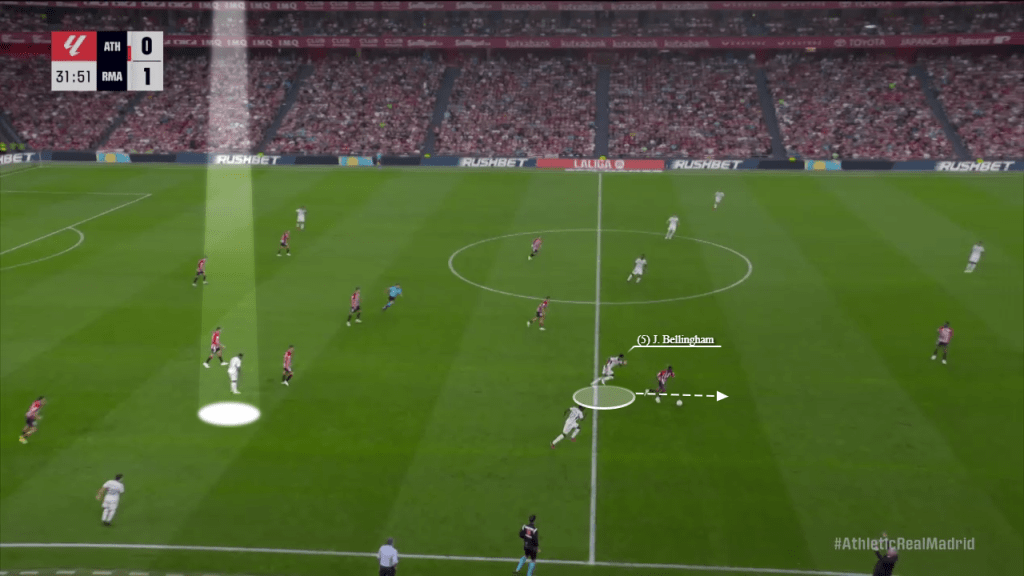
Check out this moment in the match, where Vinicius immediately becomes dejected after losing the ball. Don’t worry Vinicius! Bellingham’s on the case! Those long legs tend to come in handy, and allow the Brit to time his tackles to perfection.
Embed from Getty ImagesThen going the other way, the midfield maestro is not necessarily one for picking out a perfect through-pass into space. That’s not what he’ll provide as a ’10’. Instead, he’s excellent at driving at the opposition, pushing defenses back, and most importantly, running into space off-the-ball.
Embed from Getty ImagesThis will be a massive benefit to Vinicius and Rodrygo, neither of whom want to play through the middle. They’ll want to work the half-spaces to wide channels, taking players on in 1v1’s as someone else bursts through the centre. This is where Bellingham will come up clutch this season, with these types of lung-bursting runs into open spaces to create chances.
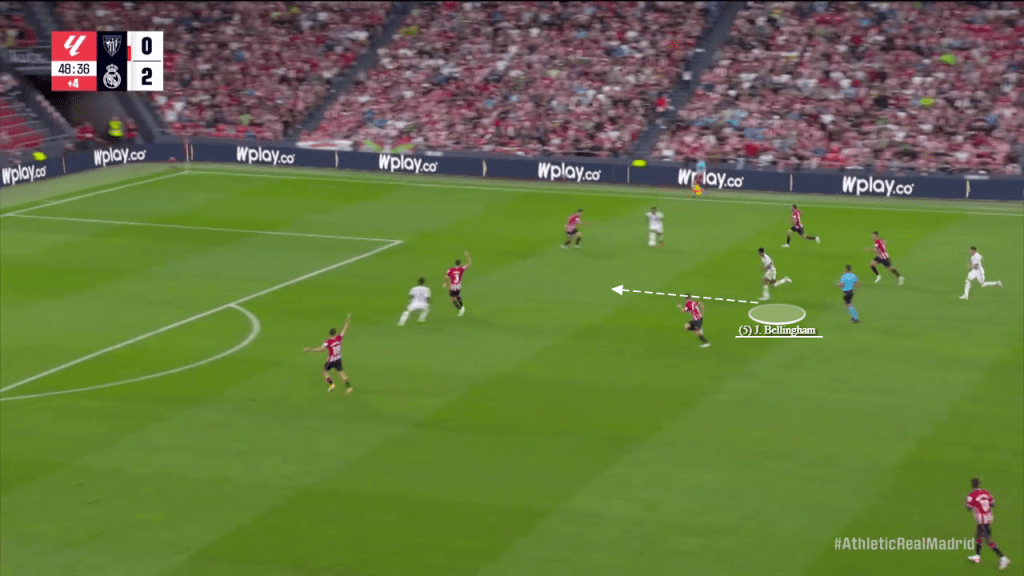
Capable of breaking lines all on his own, we can expect that at some point in his Real Madrid career, Bellingham will return back to an ‘8’ position. He’s simply too good with the ball at his feet, and his box-to-box mobility makes him an ideal candidate to have all the way back in defensive phases in the team’s own half. But for now, the ’10’ role serves as a great fit for his talents, allowing his dynamic dribbling, powerful pressing, and magical movement to come to life.
Embed from Getty ImagesReal Madrid’s opening match against Athletic Bilbao was a great sign of what’s to come from Bellingham this season, and we can’t wait to see how his career at the club continues to unfold.
MANCHESTER CITY’S BUILD-UP VS. BURNLEY
Embed from Getty ImagesMuch of the discussion surrounding Manchester City this off-season centered around a similar premise – how will they replace the brilliance of İlkay Gündoğan? Mateo Kovačić may lack Gündoğan’s quality in front of goal, but we argued that the Croatian simply provides Guardiola more options in how he wants to build out from the back.
SEE: Why Mateo Kovačić is perfect for Manchester City
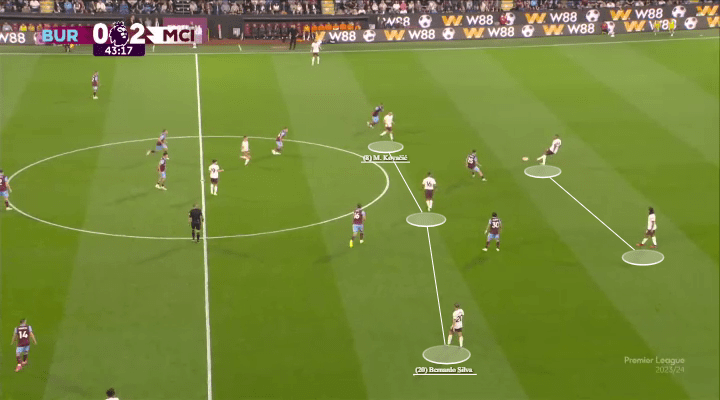
However, Kovačić had to bide his time from the bench at the start of their opening fixture against Burnley, with Kevin de Bruyne favoured instead. Julián Álvarez fulfilled the Gündoğan role instead, as City started the match in a similar vein to what we witnessed last season.
Embed from Getty ImagesRico Lewis inverted into the centre of the pitch from left-back, forming a familiar 3+2. But being a well-studied team under Vincent Kompany, Burnley reacted with their own 5-2-3, matching City man-for-man.

If you can now imagine Pep Guardiola having a lightbulb over his head, it will help your understanding of what happened next. First, Ederson started to come out of his goal, ensuring City would always have an extra number in possession. Now the 3+2 had a different look, with Kyle Walker able to push wider and higher.
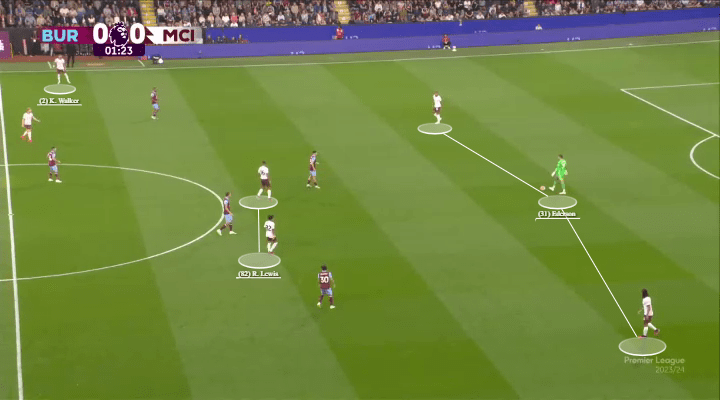
Even then, the Clarets were relatively patient as Ederson paused on the ball and waited for them to react. In fact, they didn’t press him at all. Ederson reacted by pumping high balls over the heads of Burnley’s first pressing line. Sometimes these passes worked well, and other times Burnley’s physicality allowed them to win the headers over smaller players.
Then Kevin de Bruyne’s unfortunate injury served as the catalyst for City chaos, better known as positional rotation. Kovačić entered the frame, but it was Bernardo Silva who returned to the ‘Bernardo Silva role’, dropping all the way back to facilitate deeper builds and showcase his silky smooth control.
Embed from Getty ImagesKovačić could then drop in different moments, and so too could Foden, working that same kind of close control magic to unlock the Burnley marking system. We most recently discussed the necessity of positional rotation in unlocking a tight marking scheme with USA’s commanding victory against Vietnam.
SEE: Game of Numbers #23 – Women’s World Cup – How USA unravelled Vietnam’s marking
Constant movement simply pulls defenders way out of their normal positions, and causes uncertainty in their marking responsibilities.
Simultaneously, now the shape wasn’t a 3+2, but a 3+3.
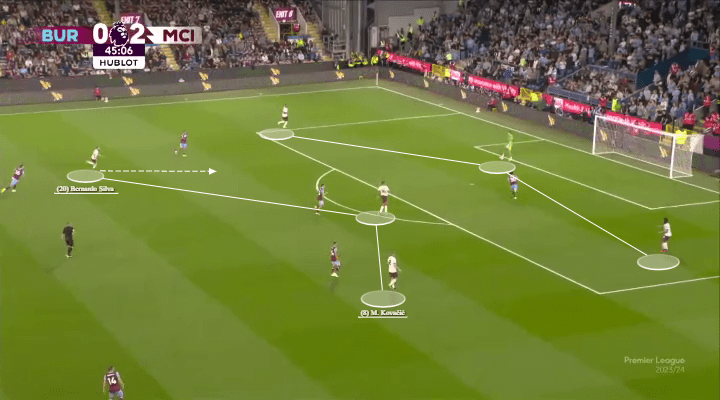
And now, it didn’t involve an ‘Inverted Fullback’. Rico Lewis showed his versatility by galloping up the left wing instead, allowing Julián Álvarez to continue playing more through the middle. Walker tended to do the same down the right, allowing Foden more of a free role coming inside from the right. Kovačić meanwhile hung out closer to Rodri and Bernardo Silva, as Ederson formed the base of the back-three in possession. If you’re Burnley now, who do you mark?
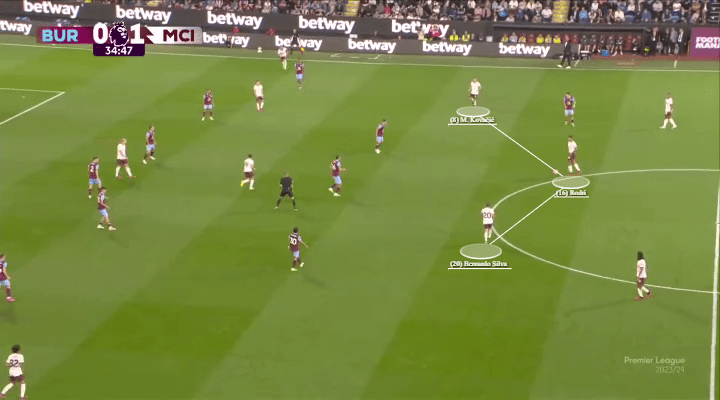
They have an extra man in possession because you can’t fully account for Ederson, and now you have three ball-savvy controllers in midfield that rarely give away the ball. No wonder Man City only took off from there!
In the context of what this means for the entire season, it once again demonstrates Pep Guardiola’s tactical flexibility and tremendous problem solving. He doesn’t have to be rigid in playing with an ‘Inverted Fullback’ as an essential component to his build-up. Instead, he can inject chaos, variety, and positional rotation at any moment to completely unbalance a defense. This will be interesting to keep an eye on throughout the season, especially as Pep Guardiola rotates his eleven and finds new solutions based on the personnel.
Embed from Getty ImagesWe can’t all be geniuses like Pep Guardiola, but we can certainly take lessons from his ability to identify a problem, and work to find solutions that work against the opposition’s plans. Thanks for reading this edition of Game of Numbers and be sure to be back next time for more weekend analysis!
Thanks for reading and see you soon!
YOU MIGHT ALSO ENJOY…

Benjamin Šeško is United’s best striker in years
With four goals in his last five matches, Šeško earned himself the Premier League’s Player of the Month award for February. This, in just 85 minutes of making an impact off the bench. If he can continue to grow from here, the 22-year-old will almost certainly stake his claim as United’s best striker in years.


Why Hugo Ekitiké has worked when so many big money signings have flopped
Every summer, Premier League clubs spend £80m–£100m chasing the next superstar forward. Every season, the league humbles them. But Hugo Ekitiké has been the exception. Ten goals, instant adaptation, and a playing style that personifies Liverpool’s identity. Here is why he’s worked when so many other big-money signings have stalled.

Casemiro is leaving, and United still can’t replace him
Casemiro’s been one of the best players in each of Carrick’s matches in charge. In fact, he’s been almost too good. Sunday’s match against Fulham exposed exactly what United will miss when he departs, and why he might be someone they simply can’t afford to lose, even if they must.
At home to Fulham, Casemiro…
Discover more from TheMastermindSite
Subscribe to get the latest posts sent to your email.
 TheMastermindSite
5 thoughts on “Game of Numbers #24 – Bellingham at the top of the diamond”