

After a 0-0 draw against Nigeria where they showed some promise but ultimately failed to get the job done, Canada came out of the gates shell-shocked against Ireland.
Leading into the match, I broke down three key areas where Ireland would hurt Canada:
- In transitional moments using their pace and power down the right and left wings.
- From set-pieces, where they crowd numbers on the six-yard box and use their physicality to cause havoc.
- The lack of space through the centre of the pitch when they defend, backed up by their physical approach in throwing themselves into challenges.
Unfortunately for Canada, all three of these items came to life against Ireland, and they looked a team lacking identity. But then everything changed in the second half, and finally they got going, with the help of some experienced heads. Here is our analysis of the match between Canada and Ireland, and how the Canadians turned things around.
PRIORITIZATION OF LEFT-SIDED ATTACKS
Embed from Getty ImagesIn the pre-match analysis, I spoke about the possibility of using Ashley Lawrence on the right side to combat the physicality of Katie McCabe. It turned out to be perfect in keeping Lawrence on the left, allowing the new Chelsea signing to be as far away from the physicality of McCabe as possible.
Embed from Getty ImagesIn the first half, Canada lacked any sense of connectivity between their lines. They continuously played hopeful passes over Ireland’s defense, overhitting these attempts time and time again and playing them at inopportune moments. Ireland meanwhile would counter-punch Canada on any counter-attack they could conjure up, utilizing those same passes over the top – just with a much better weight and accuracy.
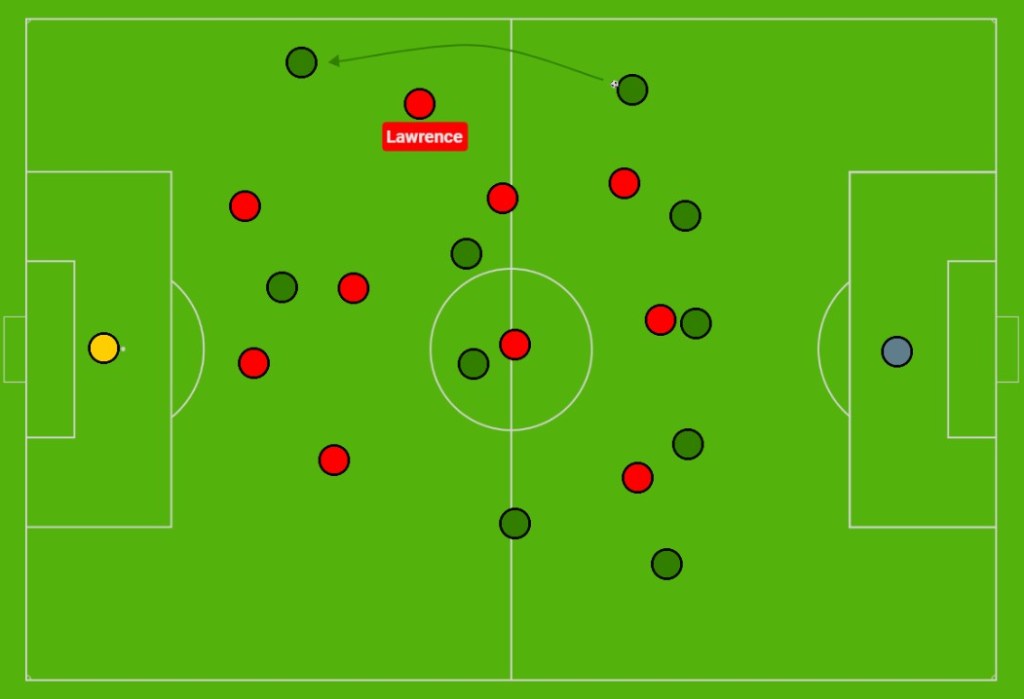
Kyra Carusa and Lucy Quinn made their presence felt in running the channels and creating chances, especially in seeking space in behind Canada’s full-backs as they made their way forward in possession. This is exactly how they won the corner kick leading up to Ireland’s goal, with a slick pass played into the vacated space behind Ashley Lawrence, where Lucy Quinn ran the channel and delivered a nice ball into the penalty area.
Lawrence’s side continued to be a frequent target of Ireland’s counter attacks, and Buchanan could not cope whatsoever with the running power of Kyra Carusa through the middle.
Embed from Getty ImagesIn possession, Canada lacked connectivity without someone to link the play with their back to goal, pulling Ireland’s centre-backs out of position. Sound like anyone you know? The second round fixture seemed like a match made in heaven for Christine Sinclair, given her quality in linking play and using her imposing frame to bounce passes back as she drops in deep. This isn’t something that you lose at age 40.
Embed from Getty ImagesAgainst any 5-4-1, spaces through the centre are limited. You need to get into the half-spaces in front of the line of four, and then look to break in behind further gaps created within the five. Going through the centre is simply too congested. But the one way that you can combat that is through positional rotation.
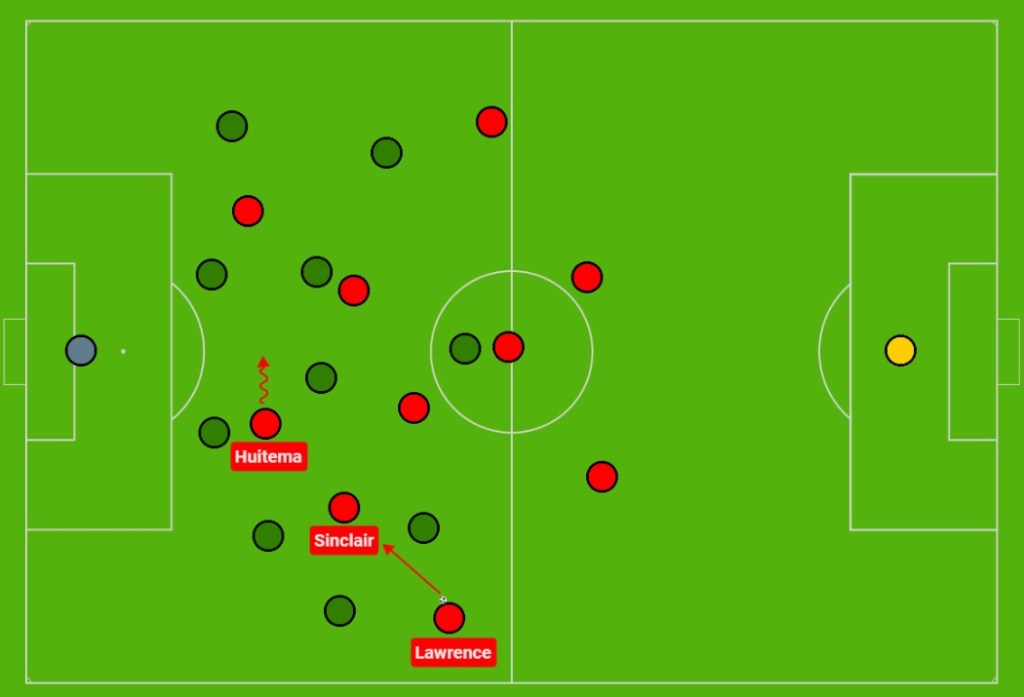
For example, Sinclair drops deep into the left-half-space to pick up possession from Ashley Lawrence, pulling a centre-back with her. Jordyn Huitema can then react by picking up space in what is now a less congested central channel. This kind of rotation is exactly what Canada missed in the first half, and it’s exactly why they looked so much better in all phases of the game upon the arrivals of their experienced heads into the match.
It’s even how Canada created that first warning sign in the second half, with Huitema nearly finding the back of the net. On that note, Canada utilized their only moment of genuine connectivity in the first half to create their only chance of the first half, via the use of the left-half-spaces. This seems to be the area of the pitch where Ireland struggle to defend the most, again, as far away from Katie McCabe as possible.
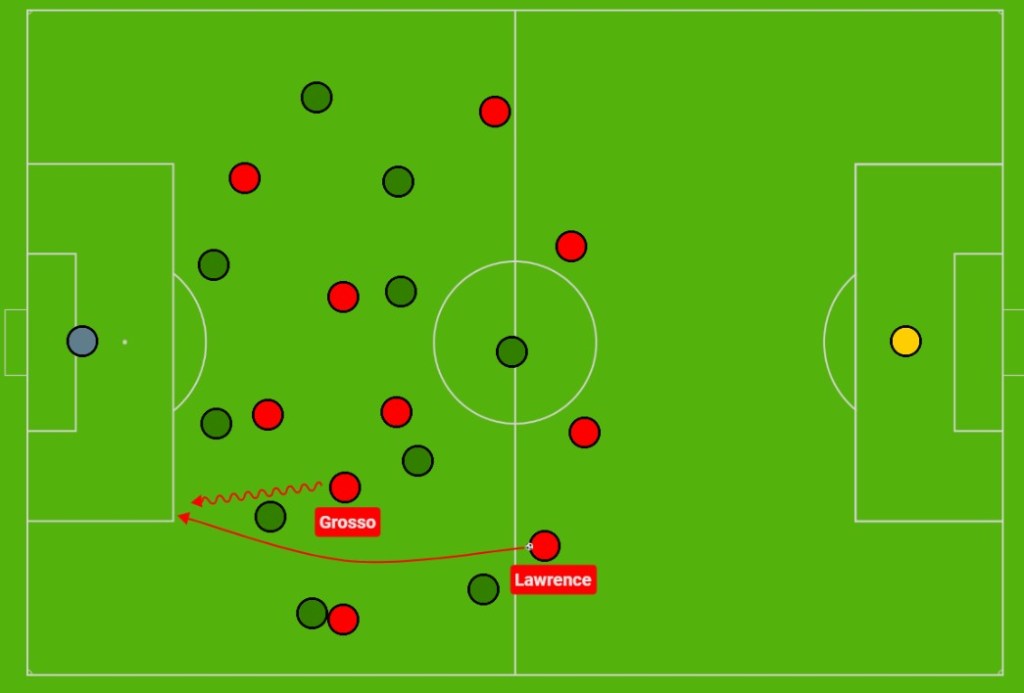
Embed from Getty ImagesLawrence played a nice pass over the top to match the movement of Julia Grosso, and the cross into the penalty area naturally created danger for Ireland to contend. This is what they needed more of in the second half, and it’s exactly what they got.
Sophie Schmidt’s introduction calmed the match down, and it was even her that found the killer pass from an almost identical area of the pitch to when Australia won their penalty in the previous fixture. Adriana Leon timed her movement to match the brilliant pass into the penalty area, perfectly positioning herself in between the centre-backs to receive in front of goal.
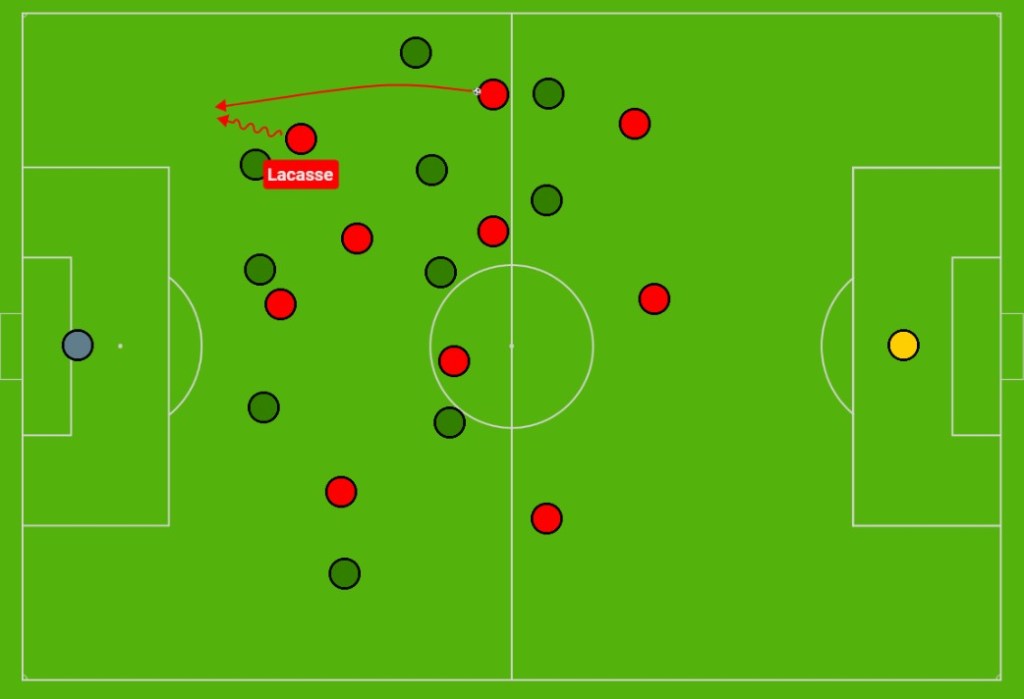
But it was Cloé Lacasse who again looked the most impressive substitute (perhaps other than Sinclair). With her explosive speed and brilliant timing of runs, Lacasse continues to be the ideal candidate to start from the right wing in support of Sinclair. She’s the most Nichelle Prince adjacent player Canada have other than Prince herself. And let’s be honest, Nichelle Prince would be starting every game if fully fit.
Embed from Getty ImagesLacasse used those two qualities we named above to continuously get in behind the left-wing-back’s advanced position, where she could pull other players out of position. Finally those overhit passes into those exact same areas from the first half were becoming perfectly placed.
Ahead of Canada’s next match against Australia, they will need to take note of all the tactics Australia used in their opening two matches to ensure they start this match with more composure and connectivity. But the starting births of players like Sinclair and Lacasse will be musts. I’d even love to see the experience of Shelina Zadorsky and Sophie Schmidt added into the mix, knowing the quality they bring to the table and Kadeisha Buchanan’s struggles to start the tournament.
Embed from Getty ImagesThe win puts Canada in a great position to now go on and top Group B, but there’s still much to sort out ahead of their next match.
Pre-match analysis:
-> How Canada can beat Ireland – Women’s World Cup 2023 – Tactical Analysis
-> Patreon: Tactical implications of the opening round of Women’s World Cup action

Chloe Kelly has the strongest mental frame in Women’s Football
One of my biggest disappointments of not having a functioning laptop the past few weeks has been my inability to watch the Women’s Euros. But I’ve seen all the highlights, and just about every single time a highlight comes on of the Women’s Euros lately, England’s Chloe Kelly remains a prime fixture. Chloe Kelly, for…


Women’s World Cup 2023 – Team of the Tournament
This summer’s Women’s World Cup has been full of drama and entertainment, with several big hitters going out early, and under-established sides making deep runs into the competition. Tournament hosts Australia have certainly made their mark, and the competition on the other side of the bracket with the likes of Sweden, Netherlands and Spain has…

Spain – Women’s World Cup 2023 – Tactical Analysis
With the likes of Aitana Bonmatí, Mariona Caldentey, and Ona Batlle back in the fold following the dispute, Spain have been firmly on fire at the World Cup. They’ve lost just one game in their possession-heavy flamboyance, a 4-0 loss to the counter-attacking genius of Japan in the group stage. Since then, Vilda’s team have been…
Discover more from TheMastermindSite
Subscribe to get the latest posts sent to your email.
 TheMastermindSite