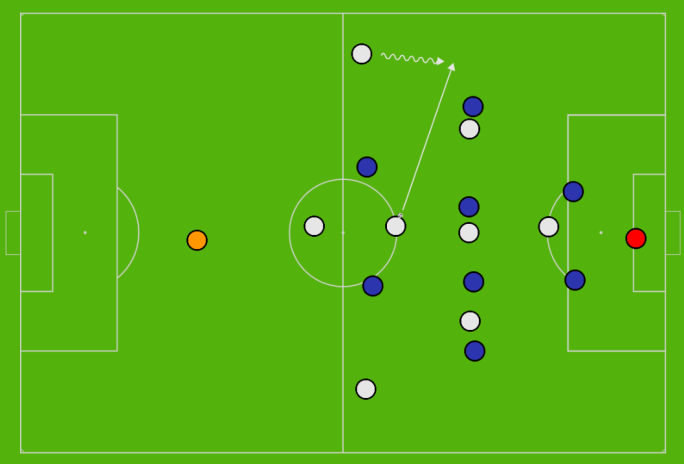
The 'Tempo Setter' is a unique player type to our system, taking into account the possession-based players that operate in a 'number 8' position, and thrive when given the ball in the half-spaces. Youri Tielemans, Christian Eriksen and Jordan Henderson feature as some of the best within the role from an emblematic perspective, perfectly exuding the cucumber coolness required. But the likes of Thiago and Tchouaméni also stake a claim despite their extreme exceptionalities on the ball, due to the high influence they present in keeping the game moving along from a withdrawn position. Beyond the streamlined skill of Thiago, they tend not to be the flashiest of players in their teams. But 'Tempo Setters' are key to setting the tone of a football match, and conducting the orchestra from start to finish. Quite simply, without their class and composure in possession, the whole entire musical production could crumble.

Tag: Playing out from the Back
Explaining the Deep-Lying Playmaker – Player Role Analysis
The 'Deep-Lying Playmaker' is one of the already attributed player types that we have adopted within our system. Also known by its Italian name 'Regista', the 'DLP' is tasked with setting the tempo of the match from build up to progression, all the way to creation. They sit in front of the defensive line as an 'Anchor', but hold a more offensive, progressive and possession-oriented role than the other two 'number 6' types within our 'Anchor' persona. Their role is in both helping create space between the lines, and then breaking lines, recycling play, or even changing the point of attack upon receiving the ball, so that their team can advance up the pitch, beat an opposition's press and seek spaces closer to goal.
Coaching the 3-1-3-1 (9v9)
When deployed correctly, the 3-1-3-1 can be one of the most fluid, flexible and fantastic 9v9 formations. Like anything in the beautiful game, team tactics, style of play and intricacies can only evolve within the realms of a team's own unique characteristics (including players involved, level of opposition, coaching preferences, and more). But if I had my pick of the litter within my squad, this is how I would deploy the 3-1-3-1 formation at the 9v9 level.
Explaining the Ball-Playing-Centre-Half – Player Role Analysis
As the name suggests, a 'Ball-Playing-Centre-Half' is a centre-back that excels in possession of the ball, from passing to long passing to carrying to dribbling. They can simultaneously exist as 'Sweepers' or 'Stoppers', providing another interesting asterisk to the role not found in many other positions. Unlike say a fullback or goalkeeper where we have created clearly defined separations and almost polarizations on a style scale, 'Ball-Playing-Centre-Halves' can also be 'Stoppers' or 'Sweepers'.
Washington Spirit 1-1 Chicago Red Stars – Match Analysis
As often happens in a tightly contested affair, Washington Spirit's encounter with the Chicago Red Stars saw one team outperform the other in the attacking third, and the other come out in wonderfully matching that intensity in the defensive third. Washington should have claimed victory, having hit the bar twice and dominating much of the play, but Chicago held their own, accumulating chances to put the game to bed themselves.
Why there’s an abnormal amount of centre-backs taking set-pieces in the NWSL
In quite fantastic fashion, there is an abnormal representation of centre-halves on set-piece duties. Normally associated with banging in the goals from free kicks and corners, several NWSL teams instead have one of their centre-backs as a key taker of set-pieces. This begs the question we should always be asking in analysis - and that is...why?
How Cavalry’s staggered shape stunned Edmonton – Match Analysis
The Cavs started the season in a 3-4-2-1 formation, suffering two embarrassing losses to York and Atletico, and a stagnant draw against Forge. After realizing the slow-moving car wasn't quite motoring the way he wanted it to, even despite the gas pedal being pressed, Wheeldon Jr. was right to identify a new vehicle. Now in a flexible 4-4-2 shape, Cavalry have been utterly dominant in both of their matches since, both in and out of possession. On this particular occasion, they completely stunted Edmonton's progress going forward, and massively exploited space in exactly the right areas through staggering their personnel across the pitch. Here is a quick tactical analysis of Cavalry's commanding 3-0 win over FC Edmonton.
The simple task anyone can do to improve their tactical knowledge
As coaches, analysts, players, fans, and football obsessed individuals, we all want to grow our tactical understanding of the game. In fact, it's one of the top five questions I get thrown my way on social media or email (links at the end of the article), where people either want to know how I developed my degree of tactical knowledge, or want to know how they too can take their tactical and analytical understanding to the next level. Here is a structured process that you can follow to develop your own tactical knowledge, and continuously learn about the game on repeat.