

Vancouver were far and away the best Canadian side inside Major League soccer last season. Showing much in the way of promise and potential, the Caps still made the decision to change coaches and bring Jesper Sørensen into the equation in place of Vanni Sartini, hoping for better fulfilment behind all that promise this season. Since the opening day of the season, the Whitecaps haven’t looked back.
Embed from Getty ImagesSørensen’s side have arguably been the best team in the MLS so far this campaign, winning all three of their matches in confident fashion, backed by an attractive brand of football. Here is my tactical analysis of Sørensen’s team inside the first three matches, and what they can look forward to this season.
SYSTEM OF PLAY: 4-3-3
Embed from Getty ImagesThe Whitecaps have been consistent in each of their matches so far, operating in the same 4-3-3 formation.
But while the 4-3-3 is their true shape out of possession, you can expect to see the Whitecaps evolve into several different shapes in attack, most notably a 3-2-5 to 3-4-3.
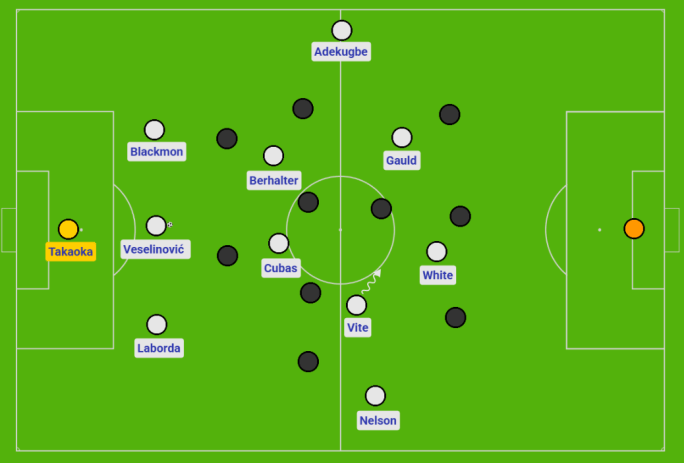
In goal, Japanese keeper Yohei Takaoka has enjoyed a fantastic start to the season, conceding less than a goal per game (0.7). He’s backed up by a formidable defensive partnership between Tristan Blackmon and the man I call “Vessel” in my notes even though his name isn’t that complicated – Ranko Veselinović – the team’s vice-captain.
Embed from Getty ImagesVeselinovic plays more of the sweeping, defensive role, as Blackmon struts his stuff and shows more attacking promise.
Next to the two centre-backs to make up that back-three in possession is the Uruguayan Mathías Laborda, who also has license to push up into the attack when the time is right. But Laborda will stay within the back-three scheme wide on the right-hand-side, giving more freedom for the forward movement of whomever plays at left-back.
Embed from Getty ImagesThat would be Canadian international Sam Adekugbe without question, who’s already started the season with two goals. But the Whitecaps have suffered through injuries to start this campaign, giving opportunities to 19-year-old Tate Johnson (wow, what a debut), and the energetic Édier Ocampo, only two years older.
Embed from Getty ImagesIt will be interesting to see if Ali Ahmed stakes his claim from this position again in the future, but for now, he’s been more straightforward in taking players on down the right wing.
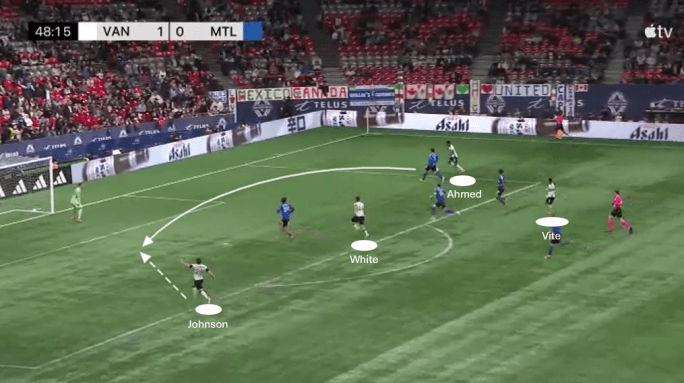
Vancouver have seen the most consistency in midfield areas, starting the trio of Sebastian Berhalter, Pedro Vite and Andrés Cubas in each MLS match so far. Within this wonderfully constructed midfield you have the metronome of Cubas keeping the game ticking along and breaking up play in between; the box-to-box energy and mobility of Pedro Vite; and the poise in possession of Sebastian Berhalter. It’s the kind of combination that most look to strike when constructing midfield threes, but a masterful example of harmony nevertheless.
Embed from Getty ImagesIn attack, Sørensen’s added reinforcements in the form of Jayden Nelson, who had a stunning debut against Portland – scoring one and assisting three in a 4-1 win.
Add Ryan Gauld and Brian White to the equation and you again get one of the most masterfully constructed attacking units in the league. Gauld plays the inverted winger role – acting as both a creative outlet and a space invader to allow for the left-wing-back to bomb forward. White meanwhile links up, holds up and presses relentlessly from the front – everything you could want from a ‘Target’ up top.
Embed from Getty ImagesEvidently, it’s one of the best sides in the league at every turn. But what’s been equally impressive is that they haven’t faltered even despite losing key players. They always have someone to come into the fold, ready to go and play their part in keeping the team ticking along. This has been part of the magic of the Whitecaps formula thus far, and a key part to their opening success.
ATTACKING PRINCIPLES
Embed from Getty ImagesIn possession, the Whitecaps start with a 3+2 build. The left-back can start low on goal kicks, but will rarely engage in build-up phases as the ball moves up the pitch. Takaoka will even be more likely to get involved as he pushes up from goal, with Laborda typically wide right to receive and help play progress.
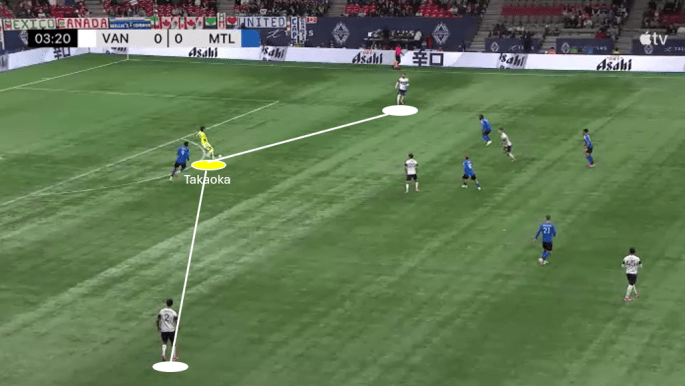
In cases where Takoka steps up, you might even see Blackmon advancing into midfield areas before dropping back toward possession, as Berhalter pushes higher.
More commonly though, Berhalter and Cubas will sit in front of the defense to help progress the play and provide dynamic forward passes, with Pedro Vite either shifting wider or higher. As play progresses into the attacking half, a 3-2-5 is the more common attacking shape, with the left-wing-back and right-wing holding the width of the field. This allows the creativity of Gauld to drift inside, and Pedro Vite to soar forward and hammer some shots at goal.
Embed from Getty ImagesVite’s movement off the ball is phenomenal, but he’s also an equally capable carrier. His powerful stride on the ball can often completely unlock defenses, before he plays the pass wide to that right winger holding the width.
Embed from Getty ImagesIt’s no surprise then that 42% of the Whitecaps’ attacks have come down the right (31% left and 25% middle), and that their left-back has been the man to finish off the final piece to the move on three occasions this season, as they switch play to the other side for that finishing touch.
Within this shape and right-sided dominance, Laborda may also gallop forward to contribute, leaving the Caps with no more than a 2+1 rest-defense at times.
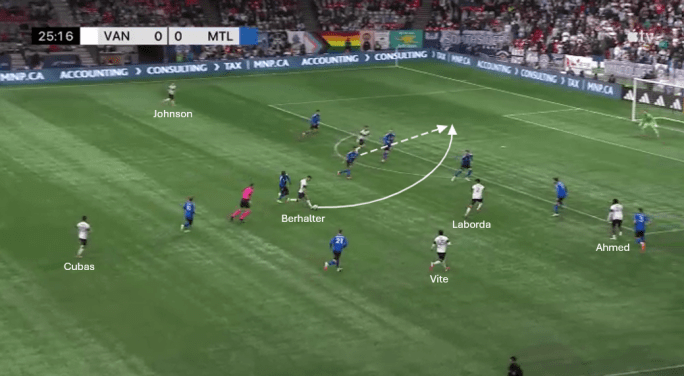
Theoretically, this could leave them exposed with minimal support in the wide areas. But the Caps have been quick to recycle play to Takaoka whenever winning possession, and Veselinović has been fantastic at sweeping up those balls over the top. Combine the Serb’s positional sense with Blackmon’s physicality and aerial dominance, and you get a stern defensive unit to break down.
Since they try to attack quickly and dynamically, the Whitecaps play some risky forward-thinking passes that aren’t always going to come off. They even sometimes play too quickly in trying to play the forward option and counter. But even at that, they still vastly outweigh their opponents on most possession and passing metrics, and consistently get the ball closer to goal before striking.
While Berhalter is the classiest, most dynamic passer in the side, Vite and Cubas are also neat and tidy possession players that also play their part in keeping the Caps in control. In fact it’s Vite that’s producing the most forward and progressive passes in the side, often from more dangerous positions higher up the pitch. His link-up play with the front-three has been superb, always in lockstep with his forwards.

Blackmon’s the other standout progressor, with 30 forward passes per 90 (Laborda next with 21). He’s fantastic at breaking lines and allowing the men further ahead to do their magic, whilst never shying away from a forward carry or even a chance to have a crack at goal.
Embed from Getty ImagesSince Gauld, Vite and White are always in close proximity and able to combine in nice triangulations through the half-spaces and central channels, the dynamism can then come directly down the wing from players like Ali Ahmed, Jayden Nelson and Sam Adekugbe. Nelson had a particularly impressive MLS debut in his Whitecaps shirt, causing all sorts of problems through his unmatched speed and silky smooth moves down the right.
Embed from Getty ImagesHe’s often been used as an inverted winger down the left for other teams, and Sørensen’s simplified his game by simply making him the star of the show down the right, allowing him to go 1v1 and work his magic. But much of the magic to this Whitecaps team so far hasn’t even been what they’ve accomplished in attack, but all they’ve done right in defense.
DEFENSIVE PRINCIPLES
Embed from Getty ImagesIf you think all of that sounds impressive so far, wait till you hear this.
Vancouver press in a way that resembles the principles of an early Jurgen Klopp Liverpool. It’s fast-paced, completely collective, synchronized, and so very heavy metal.
Embed from Getty ImagesLeading that process from the front are speed demons like Nelson and Vite, nasty bulldogs like White and Cubas, and intelligent operators like Gauld and Berhalter.
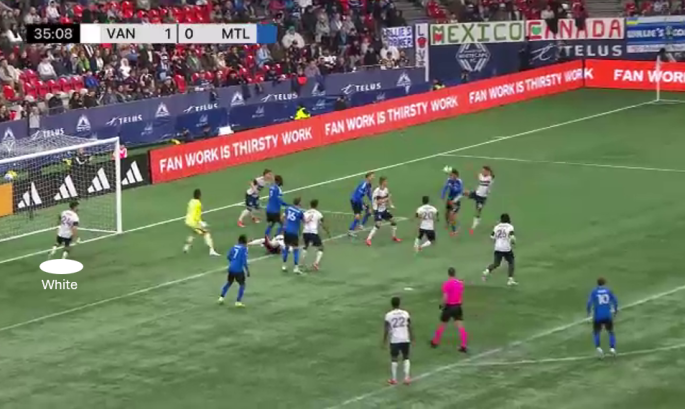
That 4-3-3 stands so solid that they become incredibly difficult to break down. Montreal actually had the best luck against them from set-pieces, where the likes of White held their own in defending the penalty area and clearing the ball away.
Their PPDA (passes per defensive action) sits at just 8.7(!), compared to the league average of 12.7. In other words, Vancouver’s opposition can hardly construct their attacking moves let alone their basic build-up, before the likes of Nelson and White are hunting them down.
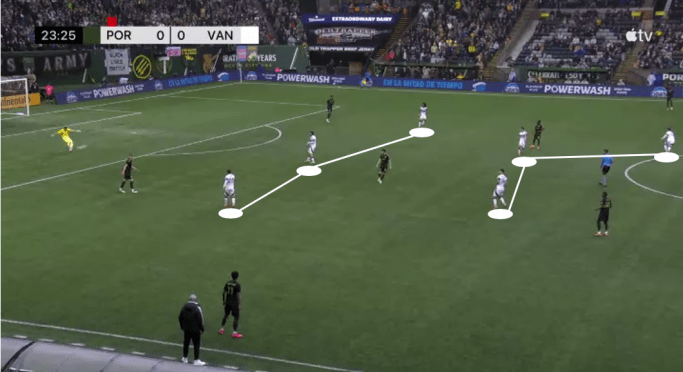
Even if not always winning the ball in the final third, they’re fantastic at forcing errors such as sloppy giveaways or long-balls that allow the Caps to regain control. That’s partially down to the ferocity of their defensive intent, but also down to shape and principles. One player (closest to the ball) will begin pressure as the opposition player is about to receive, collectively and intensely until the ball has been won or an error is forced.
They’re great at cover-shadowing what’s behind, angling their approach to both put pressure on the ball carrier, whilst covering potential passing angles behind.
Get this wrong and the distance between the defensive four and front three can be exposed.

But it’s rare that they get their angles wrong, especially on a collective level, limiting the opposition to sideways and inconsequential passes until they give the ball away.
Within that 4-3-3 press, Berhalter and Vite will often have the half-spaces covered, with the vertical compactness between lines always remaining low. This invites the opposition to play passes over the top, where again, the two centre-backs have rarely looked out of sorts.
And while the Whitecaps have struggled in some 1v1 moments, they rarely mess up when the ball gets closer to goal.
Embed from Getty ImagesThey’ll hold to a 4-5-1 low-block in their own third, holding shape rather than stepping out of position to relentlessly pressure the ball carrier. That relentlessness is reserved for closer to goal, or when they look to counter the other way.
Or perhaps most prominently, when counter-pressing. Immediately after losing possession, the Whitecaps are quick to form diamonds around the ball.
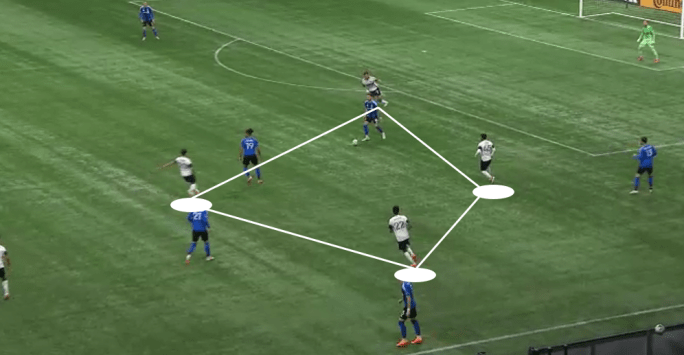
They’re quick to communicate about the needs in behind in these moments, whilst swarming the ball carrier with the most logical set of four players available.
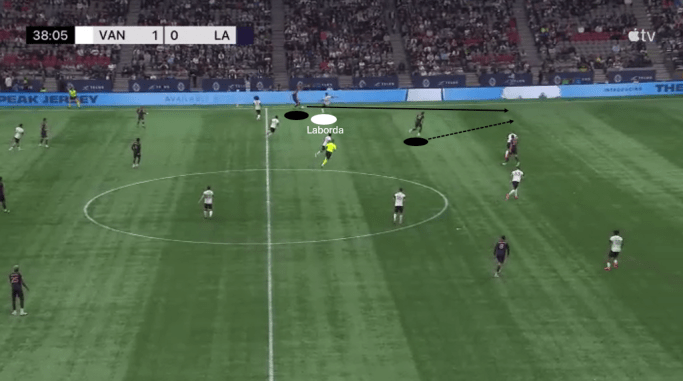
On the few occasions that the Whitecaps have been beaten, it’s sometimes been from one of the full-backs abandoning that approach to hold position and pressing up instead. An example of this can be seen in the match against L.A. Galaxy, where Laborda stepped to press and thus allowed for space to be found in behind his position.
But again, their defensive resilience goes all the way to set-pieces, where they look to battle their way out of any situation.
Sørensen’s team had several close calls against Montreal from set-pieces, but always managed to clear their lines. It didn’t matter if it was 19-year-old Tate Johnson or the big man up top in Brian White all the way at the back, they always cleared the ball away. It’s that kind of team camaraderie and togetherness that will continue to suit them incredibly well as the season unfolds.
The only thing that could be a catastrophe is if they continue to lose so many numbers, particularly to their core. It’s been okay to lose a few wide players here and there, but it could be a different story to lose someone as solid as Blackmon, Veselinović or Cubas.
Embed from Getty ImagesBut for now, the Whitecaps sit in first place across the Western Conference, bested only by the goals of Philadelphia in the East. They’ve won each of their first three matches to start the MLS season, showing no signs of slowing down so far. I’ll be covering the Whitecaps all season long, including opposition analysis prior to big fixtures, team and player analysis as the season unfolds, and even some scouting and recruitment. Be sure to be back soon for more, and thanks for reading!
YOU MIGHT ALSO ENJOY…

Ali Ahmed: The £1.4 million steal powering Norwich’s revival
Norwich might not be in the hunt for Premier League football next season, but they are slowly rebuilding their squad back to one that can challenge toward the top of the Championship. And in Ali Ahmed, they didn’t just sign a useful squad player. They may have found their next star.


Sebastian Berhalter has become the Whitecaps’ most important player
With his all-around quality, it’s abundantly clear. Sebastian Berhalter is the Whitecaps’ most important player right now. His performance against Portland was one of the finest individual performances of any player so far this season, and continues to help cement the ‘Caps as one of the most cutthroat teams in the league.

Why Brian White scores so many goals
The Vancouver Whitecaps have been flying high this year, and the man at the centre of it all has been their leading scorer – Brian White. I break down exactly why Brian White scores so many goals, and what other forwards learning their trade can take away from White’s scoring record so far in 2025.…
Discover more from TheMastermindSite
Subscribe to get the latest posts sent to your email.
 TheMastermindSite
3 thoughts on “Jesper Sørensen – Vancouver Whitecaps – Tactical Analysis – 2025”